

I wrote this project in 2020, during the pandemic, a period when I was examining my ethical positions. At the beginning of that year I posted a video about plant-based diets and someone commented: “Reducing meat consumption is pointless because plants feel pain too.”
My instinct was to dismiss it as a bad-faith attempt to muddy the waters. But then I caught myself. Wait a minute. Do we actually know for sure that plants don’t feel pain? What if, against all my assumptions, plant can in fact suffer? That possibility would completely undermine the logic of replacing animal protein with plant alternatives and, more broadly, the way we think about morality toward living things. So for me, this question wasn’t just trivia. It could shatter one of my strongest beliefs. And I would welcome the truth either way. As the saying goes: if it can be destroyed by the truth, it should be destroyed by the truth.
So I began reading about consciousness, determined to find out which creatures are capable of subjective experience and which are not. I thought it would take maybe two weeks. I couldn’t have been more wrong. Consciousness is one of the murkiest, most counterintuitive subjects you can study: full of speculation, flawed reasoning, and a striking lack of experimental tools.
What began as a quick fact-check turned into a year-long rabbit hole: poring over obscure philosophical papers, examining studies on nervous systems from C. elegans to box jellyfish, and wrestling with questions most people never think to ask.
Eventually, I emerged with some degree of clarity on what is necessary for subjective experience and what that means for how we treat other beings. This article (which is almost book-length) is the result. It’s packed with insights, and I believe that if you read it carefully, you won’t see morality and the living world the same way again. It will dissolve many of your intuitions and traditional concepts and leave in its wake a revolutionized worldview (for the better).
Consciousness as the basis of morality
Morality and values depend upon the existence of conscious beings.
The concepts of ‘good’ and ‘bad’ only make sense when considered in relation to the feelings of conscious beings. Indeed, the very notion of preferences is based on the existence of positive and negative feelings, and the concept of values requires conscious creatures able to assign worth to things based on their preferences.
Think about it. In a universe devoid of subjective experience, nothing could matter. In order to care about anything, you first need to be conscious and to have positive or negative feelings towards events and actions.
In other words, subjective experience defines the essence of the word ‘important’. Feelings are what it means for something to be important or to have value.
For most of history, human morality was only concerned with the feelings of humans. But now that most people living in developed countries are doing reasonably well, for the first time in history we afford to ask ourselves: what about other life forms? Should we give them moral consideration as well? And if so, which ones?
It seems that moral status is something that applies only to sentient creatures. If an organism doesn’t have a sense of self and doesn’t subjectively perceive sensations in its body, it cannot care what happens to it. It can still be considered bad for that organism to be hurt or die because it obviously has the goal to keep living, but a non-subjectively experiencing organism doesn’t suffer when it is hurt or dies and doesn’t desire to keep on living. The ability to suffer seems to confer an organism a higher moral status compared to one that cannot. Or at least this is the moral intuition of most people.
So which lifeforms are sentient? All of them? Only vertebrates? Insects? Plants? Bacteria?! Can these creatures feel themselves being alive or are they just sophisticated biological action programs with no subjective experience? And if they are subjectively experiencing their existence, are the sensations felt the same way they are felt in humans?
We cannot answer these questions right now because consciousness research is still in its prescience days. By prescience I mean researchers don’t yet agree even on the definition of that which they are studying. What is subjective experience? How can atoms and molecules arranged in the form of an animal feel sensations? How come a cut on my finger feels like the sensation of pain? What accounts for the painfulness of pain? How are all our senses integrated into a single experience?
These sorts of questions don’t have clear answers yet. I’ve heard people refer to neuroscience as a science in its infancy. They say we’ve only barely begun to understand how the brain works. Many theories have been proposed to explain subjective experience but so far none has stood up to all criticism and none has been elevated to the level of scientific paradigm onto which further research should be based. So, unfortunately, because we don’t even understand subjective experience in humans it’s not clear what creatures are sentient either, especially those very different from us.
But that doesn’t mean we don’t know anything.
To help answer these questions, scientists are currently studying the evolutionary origins of minimal consciousness. The thinking goes, human sentience is the way it is because it got this way. It’s a product of evolution by natural selection, just like any other biological feature. If we accept this starting position, then it seems one way to solve the puzzle is to make a list of all the things a creature has to be able to do to qualify as minimally sentient and then ask what sequence of possible events could gradually bring together, non-miraculously, all the necessary parts in the right positions to accomplish the job.
I’ve read five recent books to help me navigate this topic: Other Minds: the Octopus, the Sea, and the Deep Origins of Consciousness along with its sequel Metazoa: animal life and the birth of the mind by Peter Godfrey-Smith, The Ancient Origins of Consciousness along with its sequel Consciousness Demystified by Todd Feinberg and Jon Mallatt, and The Evolution of the Sensitive Soul: Learning and the Origins of Consciousness by Simona Ginsburg and Eva Jablonka. They all propose similar theories for when the first lifeforms started subjectively experiencing their existence and which are likely sentient and non-sentient today. I’ve also sharpened my way of thinking about the evolution of subjective experience by reading Daniel Dennett’s book From Bacteria to Bach and Back. Based on these books and more than a hundred studies and philosophy papers I’ve read, I now think the distribution of subjective experience looks something like this:
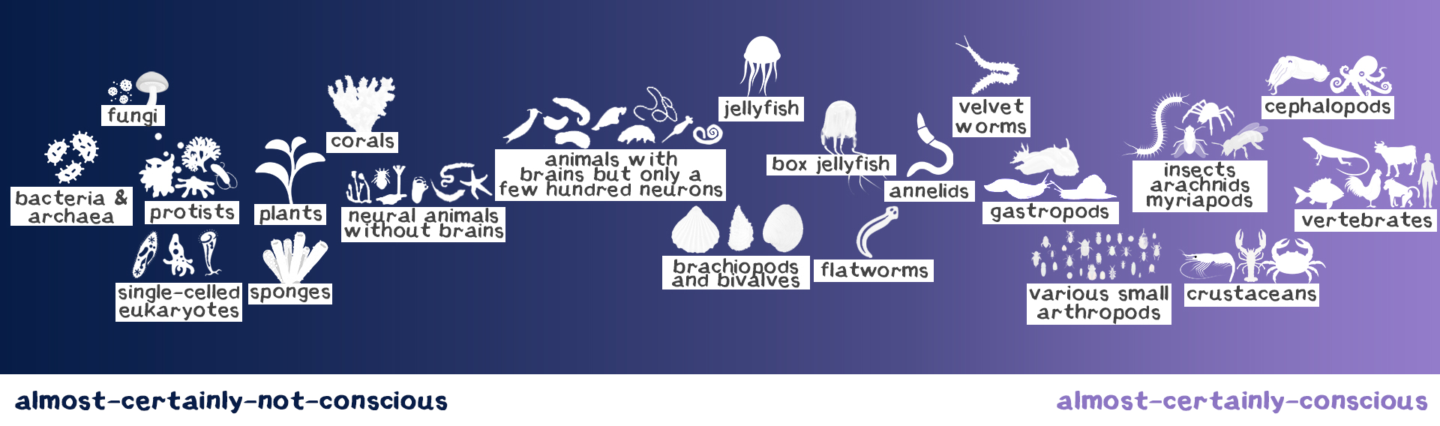
The organisms on the purple side of the spectrum are almost certainly conscious. The life forms on the dark blue side of the spectrum are almost certainly not conscious – at least in the way that we understand consciousness.
The most important thing I want to point out is that it’s probably best to think of organisms as existing on a spectrum of subjective experience, rather than in strict yes and no categories. Our intuition is that an animal is either subjectively-experiencing or it is not, just as an animal is either alive or not alive. It seems that there is a sharp threshold between the two categories. The lights are either on or off. But this intuition is misleading. Categories with strict borders don’t exist in evolution; we make them up based on what we agree are appropriate criteria. In evolution it’s possible for things to be halfway to life and for animals to be halfway to subjective experience!
On the almost-certainly-experiencing end of the spectrum we have all vertebrates (mammals, birds, reptiles, fish, amphibians), most arthropods (insects, arachnids, myriapods, crustaceans) and the cephalopod mollusks (octopuses, squid, cuttlefish, nautilus). On the almost-certainly-not-experiencing end we have all prokaryotes (archaea, bacteria), all fungi, all protists, all plants, animals without nervous systems, and neural animals without brains. And in the gray zone, animals with brains but only a few hundred neurons, jellyfish, brachiopods and bivalves, flatworms, annelids (which include earthworms and leeches for example), velvet worms, gastropods, and various small marine and terrestrial arthropods.
I don’t know what your reaction to this spectrum is. Perhaps you cannot understand how it can possibly be a spectrum. How could an animal be halfway to subjective experience? And how can you have degrees of sentience?
But even if you accept this gradual distribution of subjective experience, maybe you think the subjectively experiencing end is too ambitious. You might be willing to accept that mammals and birds feel themselves being alive but fruit flies and slugs? Come on. What does that mean, you can’t swat flies anymore? Or you might be on the other extreme. You might think that the subjectively experiencing end is way too conservative. Maybe you believe all life is conscious, from bacteria, to fungi, to plants, to humans. You might be appalled by how scientists can be so arrogant as to say that only the creatures which are reasonably similar to us are subjectively experiencing. Who are we to decide which creatures are worth moral consideration and which aren’t? On what grounds do we deny subjective experience to corals and tomato plants?
Well, sit back and grab a cup of coffee because in the rest of this post I’ll explain in depth how I arrived at these conclusions. I’ll leave it up to you to decide if the evidence is convincing or not.
How can sensations exist?
Subjective experience is difficult to understand because it doesn’t seem to fit into the physical world. How can we make sense of sensations and feelings in a physical world of fields and particles obeying the laws of physics?
To appreciate what I mean by that, I’ll explain what happens in your body and brain when you experience two very different sensations: pain and colors.
Let’s start with pain. Give a light hit to one of the bones in a finger. You felt a bit of pain there. How does that happen? I’ll give you the detailed explanation now. But before I begin, I want to tell you that it doesn’t matter if you don’t understand everything because the point I’m making will be obvious anyway. So during the explanation don’t click away thinking you’re not interested in this stuff or it’s boring. Just wait.
It all starts with sensory neurons. Somewhere near your spinal cord, around the level of your shoulder, you’ve got a bunch of neuron cell bodies. The axon and dendrites of those neurons (what people usually call nerves) stretch all the way down your arm and into your finger. Some of those neurons have free nerve endings. These are the types of nerve endings that respond to tissue damage. Here’s how that works. When you hit your finger, the energy of the impact deforms the free nerve endings of several sensory neurons. That deformation opens small channels in their membrane which allow positively charged sodium atoms (called ions) to flow from the liquid surrounding the free nerve endings inside them. That happens because a molecular mechanism keeps the inside of neurons less positively charged than the surrounding liquid by using energy from the food you eat to dumb sodium out and by constantly leaking potassium atoms. Because of the charge difference between the inside and outside, when channels in the membrane open, positively charged atoms from the outside naturally flow towards the more negative environment inside the neuron. Watch this video to see how that works:
Also, play with this simulation a bit to get an understanding of how ions flow in and out of the neuron:
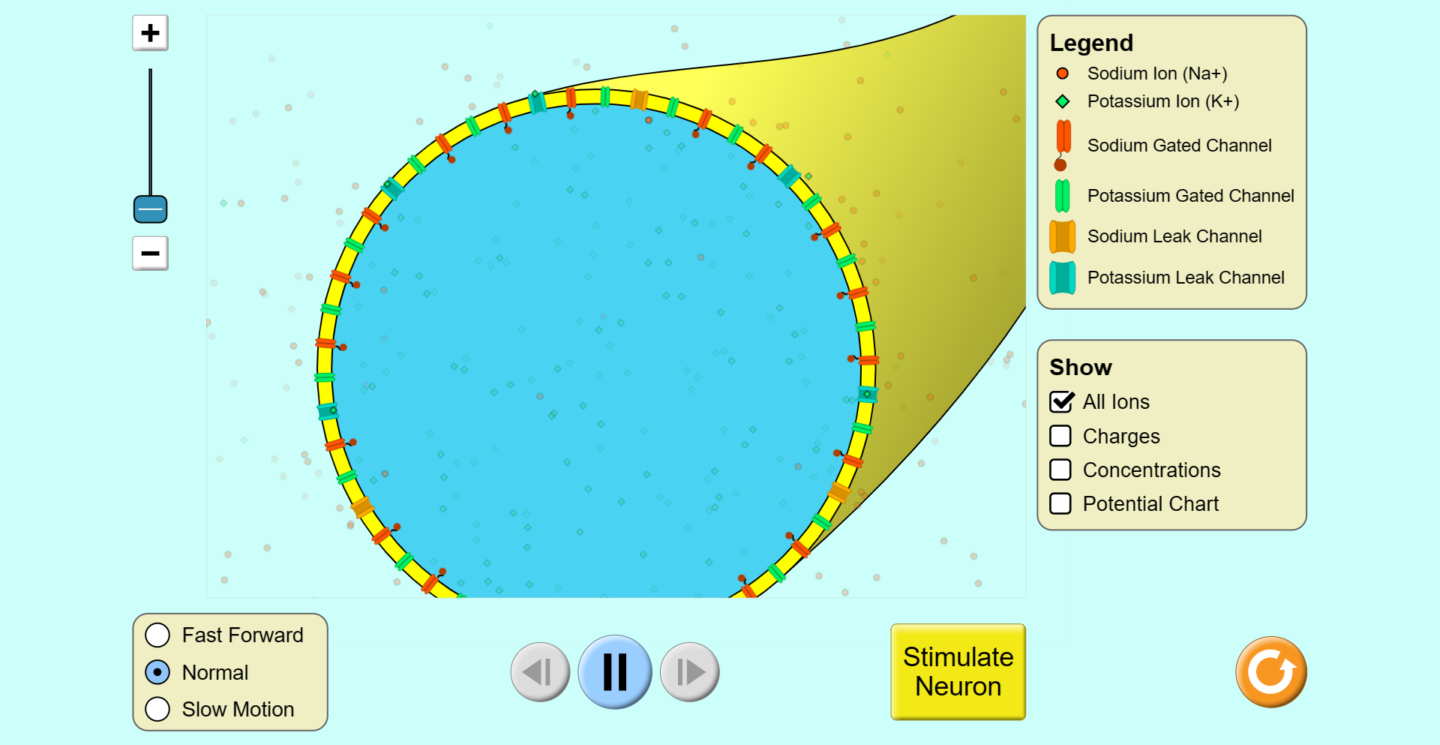
Now, because the atoms flowing in are positively charged, the voltage suddenly spikes around that location of the nerve ending. The increased voltage opens voltage-gated potassium and sodium channels nearby. The potassium channels allow positively charged potassium atoms to escape outside and thus reduce the voltage in that area. But just a bit further ahead, the sodium channels do the opposite. They allow sodium in and spike the voltage. This feedback loop creates a wave-like pattern of atoms moving in and out of the neuron that travels the entire length of your arm until it reaches the end of the sensory neuron.
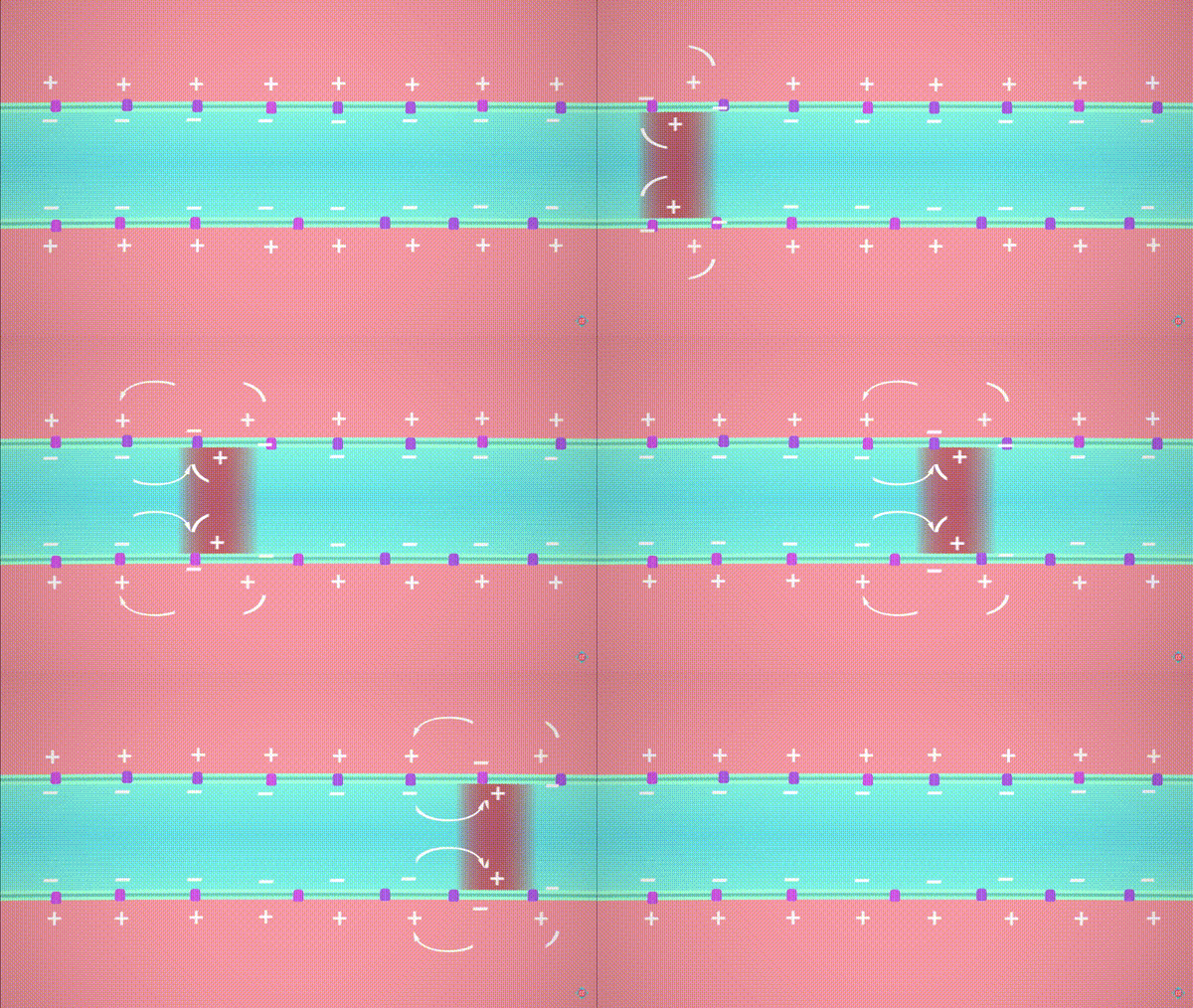
That’s essentially what happens when we say a neuron is firing. It’s not electricity. Electricity is electrons moving from one atom to another, for example inside a wire. This is a wave-like movement of atoms in and out across the length of a neuron. It’s still an electrical current, but it’s not electricity.
Sensory neurons end right next to the beginning of another set of neurons in the spinal cord. The job of these spinal neurons is to carry the nerve impulse to the brain. Here’s how that happens. When the waves of particles reach the end of the sensory neuron, the voltage causes some molecules we call neurotransmitters to move out of the sensory neurons and attach to receptors on the spinal neurons which are located just a few nanometers away. The attachment of neurotransmitters opens channels in the membrane that allow positively charged atoms to rush into the spinal neurons and kickstart new wave-like movements of atoms. This is how the impulse is passed on from one neuron to another. The new wave-like pattern of atoms moving in and out of the neuron travels up your spinal cord until it reaches the thalamus in your brain. The same thing happens there. The ends of the spinal neurons release molecules that attach to the neurons in the brain, open channels, allow positively charged atoms to rush in and kickstart a wave-like movement of atoms across the length of these neurons. The big difference however is that in the brain, a single neuron can exchange neurotransmitters with hundreds or even thousands of other neurons. So once the impulse has reached the brain, it essentially causes a chain reaction and this type of wave-like movement of atoms happens in millions of neurons at the same time. Touching or hitting a finger correlates with significant activity in a particular area of the cortex that maps your finger; while the feeling of pain doesn’t correlate as clearly with a single area but with activity in multiple regions throughout the brain, especially the posterior region of the insula. But nothing different happens in the neurons that make up those areas of the brain. They work the same way. Trillions of atoms move in and out of them in a wave-like pattern. And this is as far as the story goes: trillions of atoms move in and out of hundreds of millions of neurons in your brain and…you feel pain. How? How come that is felt as pain? The pain itself is nowhere to be found. How do you get pain from the movement of atoms and their interactions?
We can ask the same questions in the case of seeing colors.
Let’s say you turn on a light in your room. Photons come out of the lightbulb at different frequencies. When they hit objects in the environment, they are either absorbed or reflected. That depends on the substance the objects are made of or covered with. For example bananas reflect photons with wavelengths around 580 nm but absorb those with wavelengths below let’s say 570 nm and higher than 590 nm. Avocados on the other hand reflect photons with wavelengths around 530 nm but absorb those below let’s say 500 nm and higher than 570 nm. All of the objects in your room reflect photons with certain wavelengths and absorb others.
Now, some of those reflected photons enter your eyes and are absorbed by molecules inside the photoreceptors of your retina. The molecules inside one type of photoreceptors called rods absorb photons of various wavelengths. But the molecules inside the other type of photoreceptors called cones absorb only photons within certain wavelengths. The reason for that is because the shapes of the photosensitive molecules are slightly different. We humans have three types of cone photoreceptors: one type contains molecules which absorb photons at wavelengths between around 400 and 500 nm, another type at wavelengths between 450 and 630 nm, and the other around 500 and 700 nm. So photons reflected by a banana will be absorbed most efficiently by the third type of cones, less efficiently by the second, and not at all by the first. On the other hand, photons reflected by an avocado will be absorbed most efficiently by the second type, less efficiently by the third, and not at all by the first.
Let’s see what happens afterwards.
Whenever a photosensitive molecule inside photoreceptors absorbs a photon, the energy of the photon changes its shape. If a high enough number of them do so, the new shape of the molecules kickstarts a very complex molecular cascade that opens and closes channels in the membrane of several cells that make up the retina, positively charged atoms flow in and out of cells, until eventually some neurotransmitters are released and bind onto sensory neurons. Then just like in the case of pain, those neurotransmitters open channels in the membrane of the neurons in your eyes which trigger a wave-like movements of atoms that travels up into your head, it is passed onto other neurons in the thalamus, then to other neurons in your primary visual cortex, and then onto some areas that make up the color center in your brain. Billions of atoms move in and out of millions of neurons in those areas of the brain and you see colors. If the waves originate from a part of your retina where the most active photoreceptors were those which contain molecules that change shape when they absorb photons at shorter wavelengths, you see blue colors there. The shade of blue depends on how active the other types of photoreceptors are as well. If a lot of long wavelength photoreceptors were also active in that area, you see violet. On the other hand, if a lot of medium wavelength photoreceptors were active as well you see shades of cyan. If all of them are active you see white. The average activation of the three types of photoreceptors determines the shade of colors you see. But how? There’s nothing colorful about photons. There’s nothing colorful about their wavelengths. There’s nothing colorful about molecular cascades. There’s nothing colorful about action potentials. How do you get colors from atoms moving in and out of neurons? And how come you feel colors only if neurons are firing in the color center of the brain and not anywhere else? How come if they are firing over here you feel sounds? And if they are firing over here you feel pain? And if they are firing over here if you feel heat?
Do you understand the problem? All our sensations, when analyzed at the mechanistic level, are nowhere to be found. All our sensations are explained by the fact that something opens channels in the membrane of sensory neurons which eventually trigger wave-like movements of atoms in and out of neurons in our brains. That “something” is kinetic energy in the case of touch, photons in the case of sight, different molecules in the case of tastes and smells, molecular vibration in the case of heat, kinetic energy or different molecules in the case of pain and so on. All these things in one way or another trigger wave-like movements of atoms in and out of the neurons in our brains and we experience sensations. How? How do you get sensations from the movement of atoms and their interactions?
For the people that want to understand subjective experience in a physical world, this puzzle is baffling. It appears as if neurons firing in the brain create a subjective experience or are accompanied by a subjective experience – which is something that exists – but it is not the same thing as the firing of the neurons. So no matter how well neuroscientists explain the physical workings of the body and brain, the experience itself is always unaccounted for. For example, you can explain the entire molecular pathway that enables a person to see – from the photon entering the eye, to every molecular vibration and atom movement, and to every neuron firing in the brain. But after all that we can still ask: great, and why is that accompanied by the subjective experience of sight? There seems to be no way to squeeze subjective experience out of the brain.
The philosopher David Chalmers has famously called this “the hard problem of consciousness”. Here’s how he explains it on Sean Carroll’s Mindscape podcast.
My background is very much in mathematics and computer science and physics, and all of my instincts, my first instincts are materialist, to try to explain everything in terms of… Ultimately, in terms of the processes of physics. I mean, explain biology in terms of chemistry, and chemistry in terms of physics. And this is a wonderful, great chain of explanation. But I do think when it comes to consciousness, this is the one place where that great chain of explanation seems to break down. Roughly because, when it comes to biology and chemistry and all these other fields, the things that need explaining are all basically these easy problems of structure and dynamics and ultimately the behaviors of these systems. When it comes to consciousness, we seem to have something different that needs explaining. And I think that the standard kinds of explanation, say, that you get out of physics derived sciences, physics, chemistry, biology, and neuroscience and so on, just ultimately won’t add up to an explanation of subjective experience. Because it always leaves open this further question, “Why is all that sophisticated processing accompanied by consciousness, by a subjective experience?” And as it stands, nothing that we get out of the Neural Correlates of Consciousness program in neuroscience comes close to explaining that matter.
Ok, so if subjective experience doesn’t seem to fit into the physical world, what are some possible ways to explain it? Let’s look at some of the major theories currently on the table.
Possible ways to explain subjective experience
Because consciousness research is in its prescience days, a huge number of theories have been proposed to explain it. The spectrum is so vast it doesn’t even fit in the same reality.
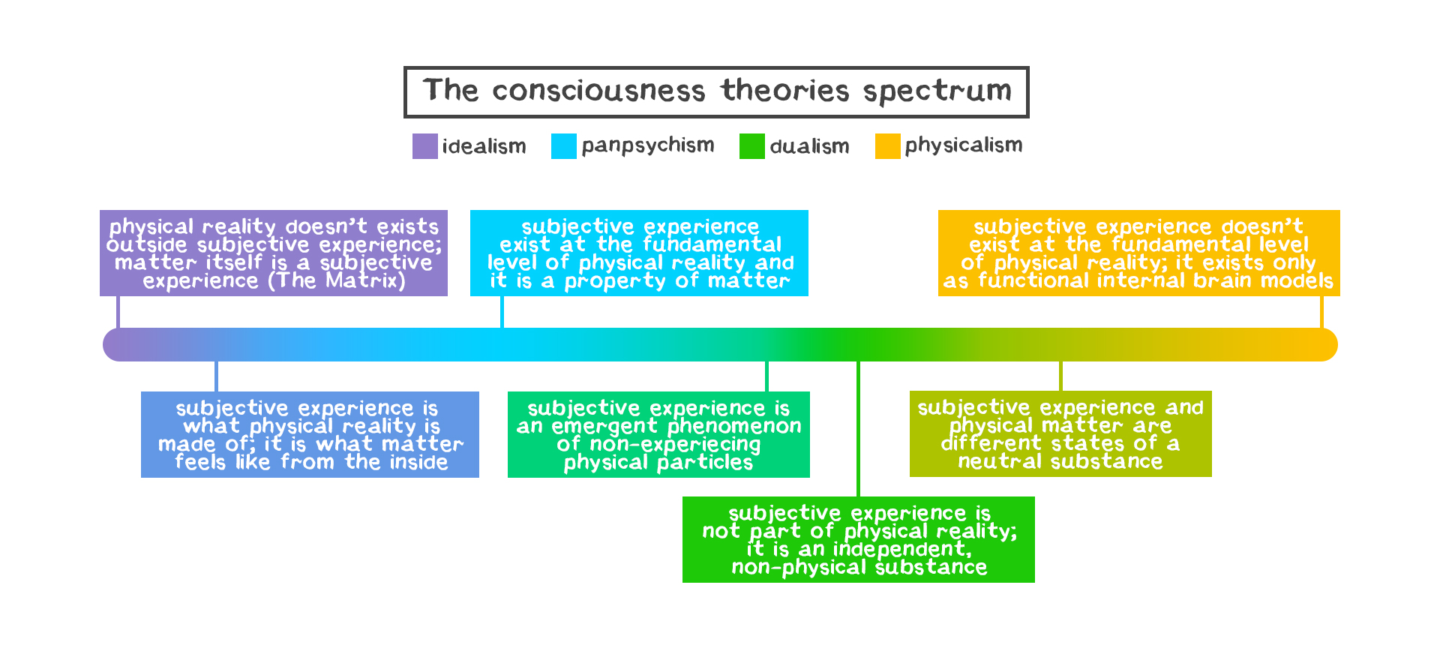
On one side of the spectrum you’ve got physicalist theories that in one way or another say subjective experience fits in the physical world as we understand it today because consciousness doesn’t exist. More on that later. Towards the middle of the spectrum there are theories that accept the physical layout of the world as it appears but say new fundamental principles and laws of physics are needed to explain consciousness. And on the other end of the spectrum you’ve got theories that flip the problem around and say the physical world exists only in our minds, something like the plot of the movie The Matrix.
Here I’ve clustered theories based on their main idea but in reality there are theories that fit the gradient areas of the spectrum as well. For example there are physicalist theories that lean towards dualism to different degrees or dualistic theories that lean towards panpsychism. They are too many to cover individually and as one researcher put it, most consciousness theories are believed only by the students of the professors who propose them anyway. So here I’ll be looking only at the leading version of each cluster.
Substance Dualism
The default way people around the world make sense of subjective experience is by believing in souls. So I’ll begin here. Based on this view of the world, the physical body has some sort of essence in it and that’s where the subjective experience exists.
In philosophy, this is called substance dualism or Cartesian dualism, after the 17th century philosopher Rene Decartes.
Substance dualism is the theory that the mental and physical – or mind and body – are, in some sense, two radically different kinds of things. The body is made out of the physical substance we call matter and the experience is made out of some other type of substance that is non-physical. In the modern age, people might call this type of substance mind, energy, aura, vibration, universe, infinite intelligence, primordial substance, subconscious mind, chakra, and other terms like that. But the basic line of thinking is the same. All these terms refer to some type of thing that isn’t made of physical matter.
These two types of substances exist in the same space at the same time but the mental substance does not interact with physical matter in any way that could be detected by scientific instruments. I see it as a formless stuff that freely permeates and penetrates matter. Imagine putting on some special goggles and suddenly being able to see a fluid-like substance flowing through your head. That would be the substance from which your subjective experience is made. Importantly, this mental substance can’t be detected in any way from the physical world. Only the mental substance can observe the physical substance and never the other way around.
Here’s a famous drawing by Rene Decartes showing how a person can point at an object he sees.
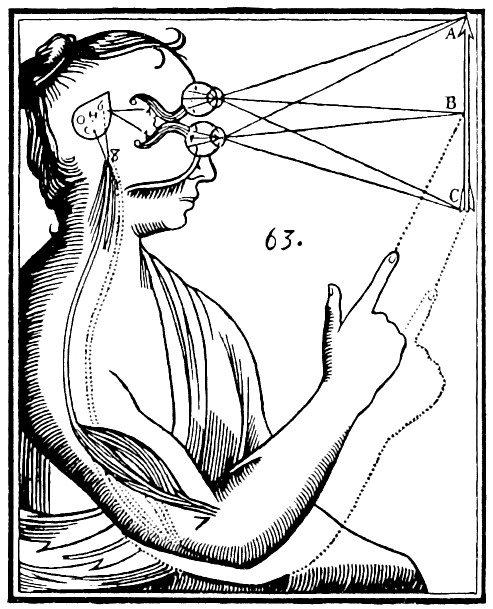
The photons enter the eyes, trigger a physical process in the brain and this makes the pineal gland send some sort of message to the soul. The soul interprets the message and decides to point at the object. So it sends some sort of message back to the pineal gland, which triggers another material process in the brain and body, and the person points at the object. As Daniel Dennett put it, “the pineal gland was Descartes’ bluetooth to the soul”. 😅
Substance dualism is extremely attractive because it’s our default way of thinking. Humans are natural substance dualists. But the majority of the world’s neuroscientists and professional philosophers don’t take this view seriously anymore. That’s because if the two different substances were to exist, their interaction should be detectable from the physical side as well. We should be able to detect mental causation and energy appearing and disappearing spontaneously.
As far as we can tell, our world is causally closed under physics. What that means is that every physical effect that we observe has an entirely physical cause.
Presumably, every substance dualist believes that what happens in consciousness can causally affect the physical body. For example, I can think about a shape and I can command my hand to draw it in the physical world. But if my mental image was what caused neurons in my brain to fire, it must mean that mental substance exerted some sort of physical force onto the physical matter that makes up my brain. How else would that work? To move something physical you need a physical force. And if this happened then we should be able to detect some physical force in my brain for which we have no physical explanation. It would have to appear as if out of thin air. But we don’t find such a force. It seems impossible for something to be able to act onto matter without us detecting it somehow.
The second problem has to do with the physical law of energy conservation. All our sensory sensations happen because of physical stimuli. I think all substance dualists would agree that physical sensory organs are essential for sensations. If you pluck out my eyes, I can no longer see. If you cut my spinal cord, I no longer experience sensations below the point of incision.
That means the physical body and brain has to relay sensory information to the non-physical mind somehow. But if this happens, it must mean that some sort of energy is constantly disappearing from our physical reality and passes into the non-physical realm. We should be able to detect that. Your wireless internet, phone signal, and bluetooth are invisible but those signals are still carried by waves in physical fields. Those signals are still part of our physical world. If my brain was emitting such signals and they disappeared into thin air somewhere above my head, we should be able to detect that somehow. Mass would be disappearing from our universe.
There are other problems with substance dualism but these two examples are usually considered enough to prove that mental states are part of the same reality as our physical bodies. They’re not made of some separate substance.
Reading this section you might have laughed at the idea of explaining subjective experience through souls. You might have thought: “ugh I can’t believe in the 21st century people still believe there’s some sort of essence in us that survives after death”. But actually, most atheists still think about consciousness in dualistic ways! Probably even you. The philosopher Daniel Dennett calls it “cartesian gravity”. Dualism is a way of thinking that pulls you in whenever you’re not paying attention. It’s something that you constantly have to fight against, like the pull of gravity. That’s because the belief in non-physical entities is embedded into our cultures, languages, and media to such an extent that you can’t escape it. Pretty much every fictional story and tradition includes elements of it.
For example, most atheists today would explain subjective experience as a product of the brain. They will say “my consciousness is caused by electrical activity in my brain”. Guess what? That’s substance dualism. Whenever a description of consciousness includes the words create, produce, emerge, generate, give rise to, that description falls under substance dualism because it implies consciousness is a thing. Like a glow on top of the brain. A stuff that exists and is distinct from the atoms that make up the body and brain. A ghost in the machine.
Even the survival of the soul after death has a modern version: the scenario of uploading your consciousness into a computer. Most people imagine the process something like this:
Your head somehow gets hooked up to a computer, your brain is drained of subjective experience, transferred onto hard drives, and you wake up inside a computer feeling the same. Subjective experience in this scenario is like a substance that can be transferred through cables. Your inner essence simply changes its host from a physical body to a physical computer. And your human body and brain are left behind, dead and mindless. This scenario is as much part of substance dualism as astral projection or flying your soul to heaven!
In the non-dualistic versions of reality, consciousness uploading is called cloning. You can’t transfer your subjective experience somewhere else because there’s nothing to transfer. All you can do is duplicate it somewhere else based on your physical design. That either means duplicating your biological body and brain or somehow simulating your body and brain in a computer.
If you want the copy to feel exactly like you, you need cloning. The reason for that is because the way your body feels, your memories, your personality, your skills, and your way of thinking are all correlated with physical structures in your body and nervous system. So for another physical system to feel exactly like you, it has to be you. Whether these structures could be made of non-biological material, like a robot body and computer brain, is debatable. The authors I’ve read think it’s almost certainly impossible. To feel exactly the same you need a biological clone because biological bodies and brains work differently than robots and computers.
But the point is, even if biological or robot cloning were possible, as your body was scanned atom by atom and the clone was being constructed through magic future technology, it’s not like your subjective experience would flow from your body into the other one. It’s not like you would feel yourself leaving your body, flying across the room, and entering the new host. There’s no special essence that the clone gets from you. Just the building design. The clone simply wakes up as if from under anesthesia. It’s a new person that just happens to be exactly the same as you. But it’s not you. The original you is still alive and well. What if the cloning company would decide to kill the original you so the clone can have a sense of continuity in its subjective experience without knowledge of a duplicate? Would you accept getting killed because a clone that subjectively experiences the world like you do lives on?
Alternatively, you might be able to set up a simulation of the way you experience the world in a computer. In this case the computer program would simulate your patterns of thinking, your personality, your skills, your decision-making, your preferences, and your memories. Whether that simulation would feel like you is debatable. Some people think the simulation would not be conscious for the same reasons that a simulation of water isn’t wet and a simulation of a planet doesn’t bend spacetime. But even if the simulation would feel like you, it would not be you. It’s a duplicate. Your subjective experience wasn’t literally transferred into the computer.
So even if you believe you don’t think of consciousness in a dualistic way, double check once a while. Cartesian gravity is very hard to resist. It pulls you in whenever you’re not paying close attention. To keep your thinking on track I suggest three rules:
- Replace the word consciousness with subjective experience.
- Don’t think of subjective experience as a thing with distinct existence.
- Don’t use the words produce, create, emerge, or arise when describing subjective experience.
These are the rules I’ve been using to avoid dualistic intuitions while writing this series. It’s probably annoying to keep hearing me say subjective experience but I really think it’s necessary. The word consciousness is just too loaded with dualistic intuitions. It’s much better to say subjective experience because that’s what consciousness is after all, and because the term is much harder to conceive of as a thing, it implies a process of interaction between a subject and external events and this points our thinking in a good direction.
Extra property panpsychism
*There are many versions of panpsychism but here I present only the most compelling and interesting version; most other versions lean towards substance dualism (instead of souls at the level of organisms you have souls at the level of physical particles).
A more plausible explanation for subjective experience is to say it’s an extra property of the physical world. This type of view falls under panpsychism.
In the case of substance dualism, the stuff from which experience is made can in principle exist without physical matter because they are two different kinds of things – as if I can leave my body and exist only as a disembodied mind or soul.
Panpsychism on the other hand accepts that there is only one type of substance, the stuff we call matter, but says subjective experience is something physical matter does.
Let me explain this way of thinking with an example from physics.
In the 19th century, physicists were struggling to understand electromagnetism. They could observe for example that if you wrap a wire around a rod and you pass electricity through it you get a magnet. How? Where does the force come from? What does electricity do? Why are only metals attracted to it?
At the time, physical theories accepted space, time, and mass as fundamental aspects of reality. And physicists tried to explain electromagnetism in terms of space, time, and mass. But they couldn’t do it. So eventually they had to accept charge as a new fundamental property of matter. One of the things physical particles do is that they’re either positively, negatively, or neutrality charged. You’ve seen that in action when we were talking about neurons: the sodium and potassium atoms were both positively charged and they repelled each other but were attracted towards the more negative environment inside the neuron.
Today spin is also part of the list of fundamentals. Physical particles bend spacetime and resist acceleration with their mass, they attract or repel each other with their charge, and they spin, which is an intrinsic form of angular momentum. (I don’t know this stuff, I’m reading from Wikipedia).
If you were to ask: How come quarks are positively charged and electrons are negatively charged? We can’t explain that. That’s just how the universe is. To make sense of reality, we’ve got to accept some things as fundamental. Of course, in science this option is viewed as the last resort. Scientists want to minimize fundamental principles as much as they can. But sometimes a new addition is necessary. If no matter how much you try you can’t explain some observable phenomenon using the fundamentals currently accepted in science, then you might need to accept the cause of that phenomenon as a new fundamental.
Some scientists and philosophers think this might be the case with consciousness. Since we can’t explain subjective experience in terms of spacetime, mass, charge, and spin, perhaps physical particles have an extra property: consciousness. The list of things physical particles do would thus be expanded to four: they bend spacetime and resist acceleration, they attract or repel each other depending on their charge, they spin, and they feel.
Now, that doesn’t mean human level experience. It doesn’t mean electrons feel emotions and photons experience sensations. But there has to be something there at the fundamental level, perhaps unimaginably simple forms of feeling, from which complex forms of subjective experience can emerge at the macro level of the brain when many different particles interact with one another.
The word “emergence” is important here.
If you spend some time watching debates about consciousness, you’re going to hear the word “emergence” thrown around. Emergence refers to a phenomenon observed in nature where a system as a whole seems to be more than the sum of its parts. For example, a wave is an emergent phenomenon of water molecules. A wave can be described in a way that simply doesn’t apply to the individual water molecules from which it is made. Another example of an emergent phenomenon is the intelligence of an ant colony. By following a simple set of rules in their interaction, individual ants create an overall system that is much more intelligent and adaptable than any individual ant can be.
Many committed physicalists that don’t think we need a new fundamental property to explain subjective experience, like to fall back on “emergence” to defend their view when pushed into a corner. They say, “ah yes sensations and feelings exist but they are simply emergent phenomena of the brain”.
However, panpsychists point out that there’s a problem with the physicalist version of emergence. Emerge doesn’t work like that. A wave is indeed an emergent phenomenon of water molecules but it’s still made of water molecules. An ant colony is an emergent phenomenon of ants working together but it’s still made of ants. Traffic is an emergent phenomenon of cars but it’s still made of cars.
Subjective experience on the other hand is explained as something not made of the physical particles from which it supposedly emerges. Imagine building a brain one atom at a time. The individual atoms aren’t experiencing anything, you just progressively build the brain with them. As you’re building, the structure isn’t conscious but then at a certain point the structure becomes complex enough that sensations and feelings suddenly emerge from non-experiencing atoms. That doesn’t make any sense. Panpsychists point out that calling subjective experience an emergent phenomenon of the physical brain is just a way of justifying the appearance of something out of nothing. Like pulling a rabbit out of a hat. If subjective experience is to be understood as an emergent phenomenon of the brain, there must be something at the fundamental level from which it can emerge.
So that’s the basic idea. Subjective experience fits into the physical world because one of the things physical particles do is feel.
However, there are different versions of theories that accept subjective experience as fundamental. The versions differ in how rich experience is at different levels of reality and how it builds up in complex systems. The version of panpsychism I’ve described here fits in the blue part of the spectrum. People who hold this view think fundamental particles are conscious in a way that is unimaginable to us. But they don’t think there’s something it’s like to be an electron. They don’t think photons experience sight. They don’t think carbon atoms have a sense of self. They just think these particles must have some fundamental property, some type of primordial experience, that permits the emergence of advanced subjective experiences when they are interacting in a complex system like the brain.
But other panpsychists have different intuitions.
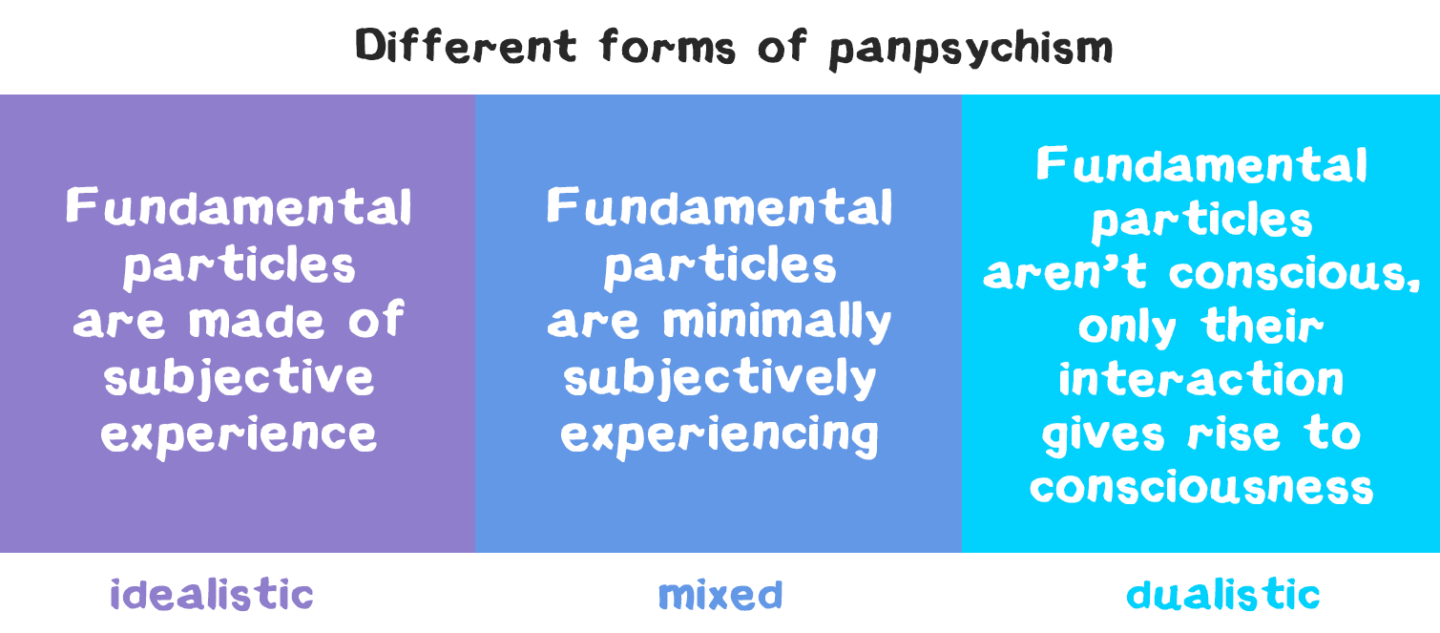
Towards the left there are views such as idealistic panpsychism and towards the right are views such as the integrated information theory. Let’s briefly look at these as well.
Idealistic panpsychism
Idealistic panpsychism is a theory that says subjective experience is not a property of physical matter, it is what physical matter actually is from the inside. Matter is made of subjective experience.
Here’s how the thinking goes.
Suppose you wanted to know what a rock is, perhaps a piece of limestone. The first answer science can give you is that it’s a bunch of calcium, oxygen, and carbon atoms. Great, then you ask what atoms are. You learn the atoms themselves are made of protons, neutrons, and electrons. Ok, then you ask what an electron is. Physics can tell you it’s a fundamental particle, a wave in the electromagnetic field, meaning it’s not made of other smaller components. Rather, according to Einstein’s famous theory E=mc2, it’s actually made of energy. This sounds bizarre, but we know it’s true from practical observations. For example, when one 1000g of uranium-235 is split in a nuclear reactor, only 999g come out on the other side. One gram of the original mass was converted into heat and other forms of energy, equivalent to the amount you get from burning 190 tonnes of crude oil. Likewise, the sun converts around 4.4 million tonnes of matter into energy every second and some of that energy reaches the Earth. What we call sunlight used to be hydrogen atoms. The sun essentially loses around 4.4 million tonnes of its mass every second due to nuclear fusion and that original mass energy spreads out in the universe as other forms of energy, mostly electromagnetic energy. Ok, so finally you ask what energy is. Well, that’s where the story stops. Physics cannot tell you that. The brilliant physicist Richard Feynman admitted this with disarming honesty in his 1963 Lectures on physics. He said:
It is important to realize that in physics today, we have no knowledge of what energy is. We do not have a picture that energy comes in little blobs of a definite amount. It is not that way. However, there are formulas for calculating some numerical quantity… It is an abstract thing in that it does not tell us the mechanism or the reasons for the various formulas.
This is where idealistic panpsychists come in. They see something interesting.
On one hand subjective experience doesn’t seem to fit into the physical world. On the other hand we’ve got a hole in our understanding of the physical world which is that we don’t know what energy is.
Hmmm. What if subjective experience fits into that hole? What if the intrinsic nature of energy is sensation? What if our subjective experience is the one place where we can observe matter from the inside? Yes, complicated equations on blackboards tell us what matter and energy do; but this – subjective experience – is what they actually are.
You may have heard of something called “neural correlates of consciousness”. Those are the body and brain states that can be observed by neuroscientists while a person is experiencing something. For example a person might report being in pain and a neuroscientist might scan which neurons are firing during that experience. That particular body and brain state revealed during the scan would be a neural correlate of pain. Idealistic panpsychists say that the neural correlates of consciousness are like the equations we use to describe matter and energy. They describe the phenomena in various words and numbers but they don’t reveal what they actually are. They propose that pain is the true nature of that particular body and brain state. I take that to mean that those neurons that are firing are actually made of pain. And we can only realize this is true by being that body and brain state because an observer can only describe our experience with words and equations. There’s more to matter than what science tells us. Matter, from the inside, is constituted of subjective experience. And that’s why we’re conscious: we’re subjectively experiencing the physical matter we’re made of.
From this starting point they expand the theory to the whole Universe. If we know that at least some matter, namely our brain states, are made of subjective experience, it must mean that all matter is made of subjective experience but we can’t detect it because we’re not made of it. Perhaps color is what photon energy is made of, which incidentally correlates with wavelength. Perhaps spiciness is what the capsaicin molecules in chilli peppers are made of. Perhaps cold is what molecules at low levels of vibration are made of. Perhaps even what we call mass, charge, and spin are actually subjective experiences.
One of the biggest modern proponents on this version of panpsychism is Philip Goff. Here’s how he explains it:
“I mean let’s just pretend particles are the simplest things for the sake of simplicity. I think the same point works with fields, or strings, or what have you. But you know, what does physics tell us about an electron? Well, it has negative charge; what does that mean? Very roughly it repels other things with negative charge and attracts things with positive charge. That’s just about what it does. Or it has mass; how do we characterize mass? Well it’s about attracting other things with mass and resisting acceleration. This is all about what it does. That’s it. So it’s like just telling us what a chess piece does, you know, how the knight moves but not telling you what it is, what it’s made of.”
The resulting theory is a king of panpsychism, just matter or just physical stuff, fields maybe. There’s nothing spiritual or supernatural, but physical reality can be described as it were from two perspectives. Physical science describes it as it were from the outside; tells us rich information about its behavior. But as it were from the inside, its intrinsic nature is constituted of forms of consciousness. So this is a beautifully simple, elegant, unified way of integrating consciousness into our scientific worldview. And in contrast to dualism it’s consistent with everything we know empirically.
This form of idealistic panpsychism is close to full blown idealism. Idealism says we should be more baffled by the idea of physical matter rather than subjective experience. The philosophers who hold this view think subjective experience is in fact the only thing in the universe that is not a mystery, the only thing we truly understand without numbers and equations. In their view, it is physical matter that should be considered mysterious because we have no understanding of what it is. The only thing we really know about the stuff described by physics is that it takes the form of subjective experience.
And so they think we might very well be hallucinating the physical world. If all of reality was a dream (like in the movies Inception or The Matrix), it wouldn’t make any difference to the way we experience the world. The absence of physical matter would not be a problem. What is indispensable is subjective experience. For this reason they think physical reality might not exist at all outside of subjective experience.
Limited panpsychism: Integrated Information Theory
A version of panpsychism that leans more towards dualism is the integrated information theory developed by Giulio Tononi and endorsed by Christoph Koch.
IIT accepts the basic panpsychist idea that subjective experience is a fundamental aspect of reality but it rejects that it is the intrinsic nature of energy and it also rejects that individual fundamental particles such as photons and electrons are subjectively experiencing entities. Instead, IIT proposes that subjective experience arises when elementary particles interact with one another in such a way that they integrate information in a system.
A system is said to contain integrated information when we can’t break the system into a group of smaller sub-systems without destroying the chain of causation of the whole. The more a system is resistant to being understood as a mere collection of subsystems, the more it is consciousness, according to IIT.
Now I’ll be honest with you, I’ve read Cristof Koch’s book The Feeling of Life Itself, I’ve watched several presentations by Giulio Tononi and others, and I’ve read a few of their papers, but I still don’t think I understand this theory. That’s because I don’t know how to think about what information is and I don’t clearly understand what counts as integration either. Both these concepts are abstract to me.
However, in his book, Christof explains it somewhat more clearly. At least for me. He says a system is conscious if it has causal power over itself. That is, its current state must be influenced by its past and it must be able to influence its future. I take that to mean that for a system to experience its own existence, it has to include loops in its internal chains of causality.
One key aspect of the theory is that the material the system is made of and the type of information it transmits through itself doesn’t matter. A subjectively experiencing system could be made of neurons causing one another to fire in complex neural loops. It could be made of wires and transistors causing each other to exchange electrons like in a computer. Or even a solar panel connected to a memory unit that can switch a lightbulb on or off. According to IIT such a system would at least be able to feel a distinction between one state and the other.
Integrated information theory says anything with a non-zero level of integrated information is conscious. The quantity of consciousness is equal to the level of integrated information and the quality of subjective experience (whether you feel back pain, the color yellow, or the sound of a violin) is determined by the shape of the physical cause-effect structure.
The richness and complexity of subjective experience in nature thus takes the form of a spectrum.
The things which are totally non-conscious are the indivisible elementary particles. But as these particles interact in various systems they give rise to subjective experience. Cristof speculates that the simplest forms of subjective experience are found in protons and neutrons which per the standard model of physics, are made out of three quarks with fractional electrical charge. The interaction of the three quarks would make the proton as a whole slightly conscious. Then higher up on the scale of complexity you’ve got atoms. The interaction between the protons, neutrons, and electrons would make the atom as a whole conscious. This means a small hydrogen atom would be less conscious than a large uranium atom and the quality of subjective experience would also be different between the two because they have different shapes. Molecules would be even more conscious because they integrate multiple atoms. Still higher you have: conventional computers, bacteria, plants, the internet, various animals, humans, and beyond us perhaps cyborgs of the future, or very advanced artificial intelligences.
Consciousness builds up this way because IIT says only the maximal level of integration in a system correlates with a subjective experience. When the atoms come together in the form of a brain, their little integrated information systems combine into a single large and complex integrated information network. And because there is more information at the higher level than at the atomic level, they lose their individual subjective experiences. The whole gains its consciousness at the expense of the individual parts. This is said to explain why we have only one subjective experience of our entire body instead of having trillions of individual experiences for each atom that makes up our body.
And this combination doesn’t happen in any object (like chairs, spoons, and rocks) because not all objects integrate information. Water sitting in a glass does not have causal power over itself. For this reason, it is not subjectively experiencing itself as a whole. The maximal level of integrated information of water sitting in a glass is still at the level of its molecules. So only its individual molecules are experiencing their existence. But I guess if you were to set up a complex system of cups of water exchanging drops with one another in a loop, then the consciousnesses of the molecules would combine into a single complex consciousness for the system as a whole? I don’t know, that’s what it sounds like to me!
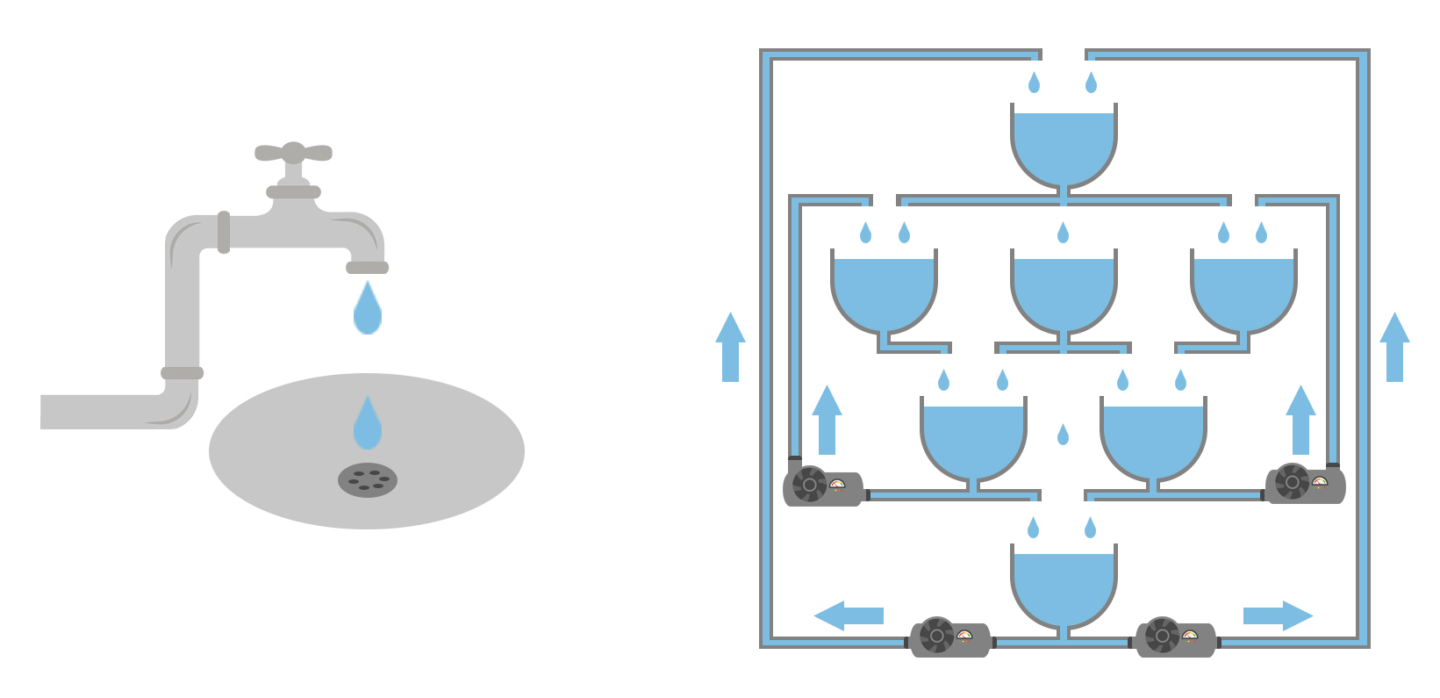
In his book, Cristof says a purely feed-forward system does not exist for itself because it is not integrated. I take that to mean something like a running tap is not a conscious system. But it seems to me, according to IIT, a simple network of cups dripping water into one another in a loop should be subjectively experiencing a tiny bit because the system has some causal power over itself.
And of course, the opposite is true as well. If you split a large integrated information network into two smaller networks, you also split the subjective experience in two. IIT says this is why split brain patients end up with two different consciousnesses in the same head or why we lose consciousness during sleep. During sleep, some neurons don’t fire and this disrupts the integration of information in the brain. The cortical whole breaks down, shattering into small regions of interacting neurons. Each one has only a bit of integrated information. According to IIT, your consciousness vanishes in deep sleep and is replaced by a myriad of tiny consciousnesses, none of which is remembered upon awakening because they disappear into a single large consciousness.
Physicalist neurobiological theories
Physicalist theories reject that there is a hard problem of consciousness. These theories say it only seems to us that subjective experience is a real thing made of non-physical stuff or an observable phenomenon of the natural world like electromagnetism or gravity, but subjective experience doesn’t actually exist at the fundamental level of physical reality. Deep down, sensations and feelings are not real, so they are not out of place in the physical world.
One subgroup of physicalist theories, the neurobiological theories, say the true reason you are conscious is because organisms have evolved ways to keep track of the state of their body and events in your environment.
Physicalist neuroscientists and biologists think there are many similarities between the hard problem of consciousness and the old problem of life. Up until the 20th century, many biologists believed living organisms were fundamentally different from non-living entities because they contained some non-physical element or were governed by different principles than inorganic chemistry. They couldn’t explain how the same elements found in dirt, water and air could arrange themselves into a living creature. Something was missing. They insisted life was not explicable in purely physicalist terms but required an extra ingredient of some kind – a kind of life force to animate inorganic matter.
But then scientists realized they were thinking of life the wrong way. Life isn’t a thing. It’s not a property of matter either. Rather, life is a type of uniquely organized chemistry. The word life describes chemical systems with three main characteristics:
- Closure: a wall or membrane that separates a stable internal environment from the external world
- Metabolism: going against entropy by taking in energy and materials from the external environment for self-maintenance and growth
- Reproduction: possession of an information system stored in stable chemical molecules (for instance DNA) that enable multiplication and guide the manufacturing of its own constituents
If a chemical system has these characteristics – (closure, metabolism, stability, information-carrying chemical molecules (DNA and RNA), self-production, growth and multiplication, subject to natural selection, hereditary system enabling open-ended evolution) – it falls under the category of living systems. That’s it. It turned out that life was best understood as a level of organization; a collection of structures and functions. Life is not a special ingredient that creates a sharp divide between dead chemistry and living chemistry. We don’t need to postulate aliveness as a fundamental property of matter. Rather, we can see biology as a natural continuation of chemistry on a spectrum.
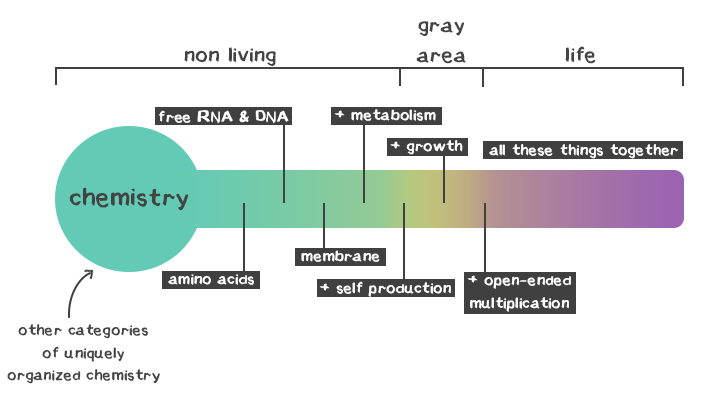
On one end we have chemical systems that have none of the characteristics of life. Those are clearly non-living systems. Further along the spectrum we have chemical systems that have only one or a few of the characteristics of life (amino-acids, a membrane, metabolism, RNA molecules, and so on). These are one step closer to what we call life. Over evolutionary time, through combination or perhaps gradual accumulation, a system eventually gains all the characteristics of a given definition of life and at that point we find it appropriate to say that system is alive. But the transition from non-life to life is gradual. The sharp divide exists only in our heads. It’s not like a lightbulb turning on, but rather like a very sensitive dimmer.
But the reason it’s hard to see things this way is because the term life makes us think of it as a thing with distinct and independent existence. Something that a system has rather than is. And this leaves the door open for dualism – the belief that life is a thing that exists on a different plane than the physical world. I imagine a few hundred years ago people used to ask questions like: Why are some things accompanied by life while others are not? Why does life arise out of certain chemical processes? How is life created from dead things? What makes a cell alive if all its components are dead? When you ask these sorts of questions, life seems to be a kind of essence that emerges from chemistry. And this creates an unbridgeable explanatory gap. No matter how much we understand the mechanisms that constitute a cell we can never understand the mysterious, holistic essence of life that emerges when you combine them.
At the time, people could conceive of only two ways to solve the problem of life: vitalism or hylozoism.
Vitalism proposed that life is a non-physical element that accompanies living creatures and gives them life force. It’s similar to the religious concept of the soul. For instance in christianity, God made a clay human and then breathed life into it. Life was a thing that could inhabit a body or not. Similar to the idea of souls, vitalists saw life as an immaterial essence that existed outside of the known physical reality.
Hylozoism on the other hand proposed that all matter is in some sense alive. Those who held this view did not necessarily mean that dirt, water, and air had a life or identity of their own. Rather they meant that all material objects had life – an intelligent force that informed matter how to arrange itself into living creatures and accounted for the existence of goals, purpose and function in biology.
But these two views are now recognized as wrong ways to look at life. Life isn’t a property of physical matter. It’s not something that matter does, like mass, charge, and spin. It’s also not a thing that accompanies a cell or emerges from a cell. Life is the cell. It is the term we use to describe the collection of cell systems working together. When scientists looked at it this way, the problem of life dissolved.
Physicalist scientists and philosophers think we’re repeating the same mistakes now when we’re trying to explain subjective experience. Most of us still think of consciousness as a thing with distinct and independent existence: something a creature has. Something in addition to its body and brain. This is reflected in the types of questions we ask. For instance: Do plants have subjective experiences? Why are certain brain states accompanied by consciousness while others are not? How does the brain produce subjective experience? Could I upload my consciousness into a computer? When you ask these sorts of questions, you think of consciousness as a thing or a natural force and stumble on endless problems that cannot be resolved. In this view, dualism is similar to vitalism and panpsychism is similar to hylozoism.
Physicalists thus propose we should stop thinking of subjective experience this way and instead think of subjective experience in the way we think about life. They propose subjective experience is best understood as a level of organization – a collection of mechanisms working together.
For example, Simona Ginsburg and Eva Jablonka, in their book The Evolution Of The Sensitive Soul, define subjective experience in a way similar to how life is defined, that is as a list of cognitive features:
- Global activity and accessibility
- Binding and unification
- Selection, plasticity, learning, attention
- Intentionality (aboutness)
- Temporal thickness (sensory persistence)
- Values, emotions, goals
- Embodiment, agency, and a notion of “self”
They say these features are what many physicalist neurobiologists and philosophers currently deem individually necessary and jointly sufficient for subjective experience.
Todd Feinberg and Jon Mallat provide a similar list of features and they arrange them in a hierarchical order. They propose that the general biological features of life are the foundation for consciousness because they account for key aspects of subjective experience such as embodiment, senses, and the goal of self-preservation without which there could not exist the notion of good or bad. To the general features of life are added nervous systems which account for reflexes and regulate basic survival behaviors. These neural systems, while not enough for subjective experience, are indispensable for the development of what they call the special neurobiological features of consciousness. These features they believe are found only in subjectively experiencing creatures.
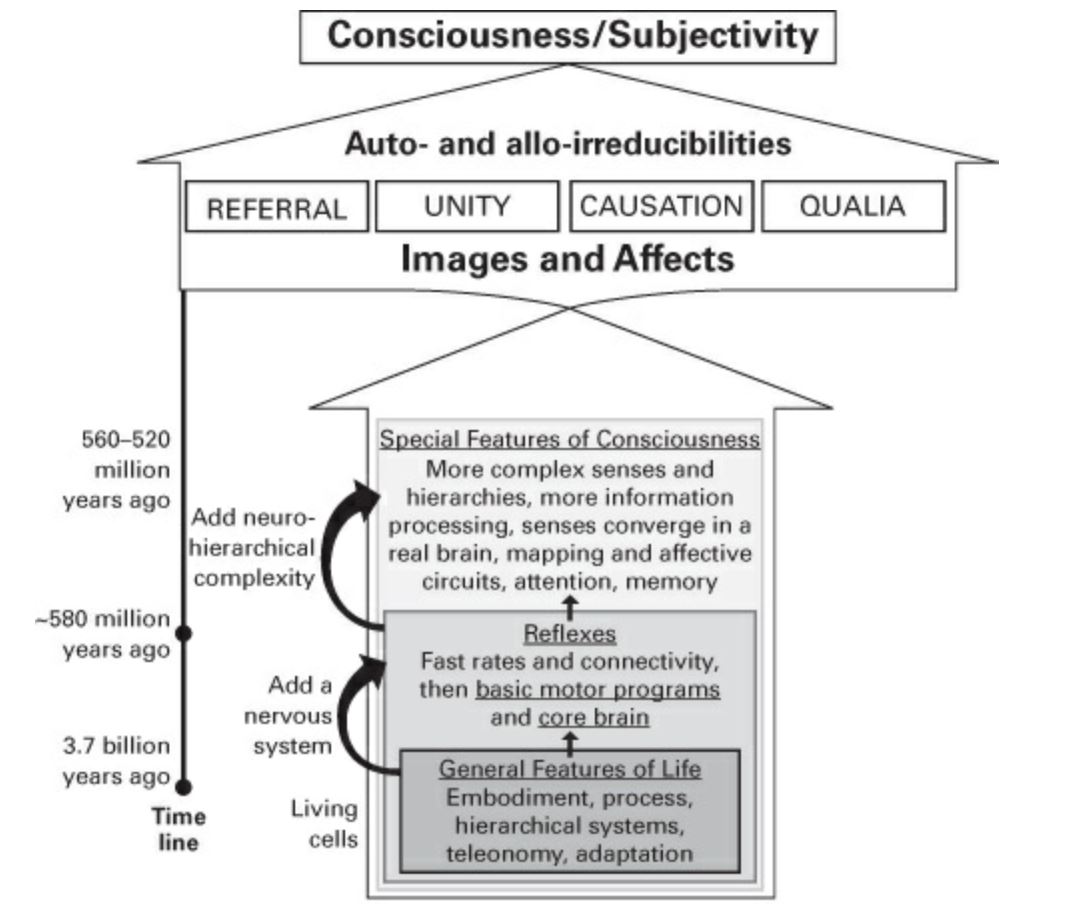
Of course, these lists are very likely wrong or incomplete because the science of consciousness is in its infancy. But the overall message is that we should think about subjective experience as a collection of parts rather than a unitary thing. Trying to solve subjective experience as a whole in terms of brain processes seems an impossible task. But explaining the brain process that constitutes each component seems doable, or at least much more promising.
Each of these functions by itself is non-conscious, we can even create some of them in computers. But when you put them all together, you get a conscious being. This is how you get a mind from physical matter.
In response to this someone could ask: whoa, whoa, wait a second, why is it that when you put all these functions together they are accompanied by subjective experience? Physicalists say that’s a bad question. Just like asking if all the components of a cell are dead why is the whole cell accompanied by life. Subjective experience is not a thing that accompanies these functions. It is the collection of functions itself. These functions together are what constitutes subjective experience. Simona Ginsburg and Eva Jablonka call it a mode of being. It’s a level of organization that is composed of a collection of cognitive systems. Physicalists think that when you look at it this way you realize that perhaps the explanatory gap isn’t unbridgeable after all. What we need to figure out is what features constitute subjective experience, how they work, and how they evolved.
Major problems with all theories
In the previous section, I’ve described some of the major consciousness theories currently on the table. You might have really liked one of them and thought that’s probably the one most likely to be true. Well, now I’ll tell you why none of them is universally accepted. They all have major problems.
Extra-property panpsychism
Extra-property panpsychism has the problem of combination.
Suppose it is true that consciousness is one of the properties of physical matter, such that one of the things fundamental particles do is feel. The problem is how do you get thousands of different complex sensations and feelings at the human level from a single type of experience at the fundamental level. In the case of all the other fundamental properties, when particles interact with one another in a complex system, what they do stays the same, there’s just more of it.
Take the property of charge for example. A negatively charged particle attracts a positively charged particle a very tiny bit. When the charge of a lot of charged particles combine, like in a magnet, the magnet attracts oppositely charged objects a lot. The combination of many small charges does the same thing, there’s just more of it.
It’s the same with mass. A little bit of mass (like a baseball in space) bends spacetime a little bit, leading to a little bit of what we call gravity. A large amount of matter (like a star in space) bends spacetime a lot, leading to a lot of gravity. So when the mass of many fundamental particles combine, the overall mass is the same, there’s just more of it.
But this is not the case with the property of consciousness. Suppose fundamental particles feel pure awareness, something like humans achieve in deep meditation. Suppose that’s the state of consciousness at the fundamental level of reality. Electrons might have pure awareness -1, photons pure awareness +1, neutrons have pure awareness 0 and so on, just like in the case of the other fundamental properties. When these particles combine their pure awarenesses, the result should be a large pure awareness; the same thing, just more of it. It should be identical in quality to its components, just larger.
But that’s not the case in extra-property panpsychism. When these particles combine their pure awarenesses in the form of a human body and brain, the result is colors, back pain, joy, the taste of coffee, the smell of fresh popcorn, orgasms, and anger. And each of these in turn has an incredible variety of intensities and contexts. How can these sensations emerge from the combination of a single, totally different type of subjective experience? How can the taste of coffee for example emerge from the combination of many little subjective experiences of pure awareness? It’s like saying that if you combine my subjective experience of back pain with your subjective experience of back pain we can produce a collective subjective experience of the color yellow.
If extra-property panpsychists can prove the existence of the property of consciousness and formulate physical laws that explain how it builds up in complex systems…well…then that would be great. It would be a huge step towards explaining subjective experience.
But some impatient panpsychists now respond to the combination problem by saying that each fundamental particle actually feels an enormous number of fundamental micro-experiences, one corresponding to every basic quality we find in any animal experience. That means photons and electrons don’t just feel one subjective experience, like that of pure awareness, but they feel many very faint subjective experiences that when combined can produce every feeling you can imagine: color, sounds, taste, pain, orgasms, everything. Well if that’s the case, we’ve left the possibly-scientific-extra-property theory behind and crossed the line into a sort of substance dualism.
In the case of the other fundamental properties, particles don’t have an enormous variety of masses, charges, and spins. Just one. Saying that electrons and photons feel every basic sensation we find in any animal experience is virtually the same as saying electrons and photons experience a sort of infinite fundamental consciousness. It means fundamental particles have richer subjective experiences than humans or any other complex animal on earth because they feel a faint form of every possible experience. In this scenario, consciousness is no longer a modest fundamental property of matter like the rest, it’s so much more. It’s a sort of infinite fundamental consciousness that is actually restricted when it takes a human form. This is no longer a physical theory, it fits better in a religious book.
Idealistic panpsychism
Idealistic panpsychism faces the combination problem as well. Suppose it is true that energy, from the inside, feels like subjective experience. Each fundamental particle described by physics would perhaps correspond to one basic form of experience. Unlike property dualism, where the property of consciousness is the same across all particles, in this case the form of subjective experience could be different depending on the particle and the energy it carries. These would be the basic ingredients for constructing more complex forms of subjective experience.
But even in this case we need to ask: how can thousands of different human sensations and feelings emerge from the combination of a few basic subjective experiences of a different character? This time it’s like saying that if you combine my experience of back pain with your experience of the taste of coffee and your friend’s experience of a sneeze, we can create the overall sensation of the sound of a violin.
We also need to ask under what circumstances the little subjective experiences combine. Presumably, the little subjective experiences of the fundamental particles that make up my body combine to construct my big subjective experience. Physical laws need to be formulated to explain how that happens. Those explanations are necessary because if the fundamental experiences tend to combine into one large experience, one might ask why doesn’t a city have a single subjective experience at the expense of the individual experiences of its inhabitants? Why not the planet? Why not the solar system? Or even the entire galaxy? These are all self-organizing systems in which fundamental particles interact with one another in complex ways. The question is: how do physical particles need to interact for their subjective experiences to combine and create a completely new experience?
There are also big issues related to identifying which physical system corresponds to a certain sensation. For example, is the taste of coffee the inner nature of the matter that makes up the coffee, my tongue with coffee on it, or the charged atoms moving in and out of neurons in my brain?
I guess it has to be the neurons in the brain, because some brain tumors have been shown to cause sensory hallucinations, like the smell of burned rubber and metallic taste. If someone with a brain tumor were to constantly experience the taste of coffee when there is no coffee bean anywhere to be found near them, the taste of coffee must be what his neurons are made of.
But then how can we know whether the matter that makes up coffee feels like anything? If sensations can be simulated in the brain by brain tumors or electrical stimulation, on what grounds can we extend subjective experience to all matter in the universe?
One could say perhaps each atom on the periodic table has a specific type of subjective experience constituted of the subjective experiences of its fundamental particles. And when the atoms combine into molecules, their subjective experiences combine to produce a subjective experience specific to that molecule. So perhaps various atoms of carbon, oxygen, nitrogen, and other elements combine their individual subjective experiences into molecules that have new subjective experiences which correspond to the various parts of the taste of coffee. In this scenario, a coffee bean would be made of the subjective experience of the full taste of coffee because it contains all those chemical compounds.
Ok, but then you might ask how come animals need sensory organs and nervous systems to experience sensations. If a coffee bean is actively experiencing the taste of coffee because that’s what it’s made of at the fundamental level, how come humans aren’t actively experiencing the taste of flesh and blood and brains and poop and everything else we’re made of? How come humans need a tongue to experience taste? What’s special about the mouth? How come we don’t experience the taste of coffee when we put a coffee bean in our ear? How come you only experience the taste for a few seconds when the coffee is on your tongue and it goes away as soon as it goes down your throat?
Besides the combination problem, it seems another major problem of all forms of panpsychism is that these theories completely ignore the importance of sensory organs in subjective experience. If idealistic panpsychism was true, it seems to me it should be impossible for us to be unconscious. We’re always made of matter which in turn is supposed to be made of subjective experience, so how come we can be completely non-experiencing during deep sleep or general anesthesia? The brain is still active yet nothing is experienced. As long as we’re alive it should be impossible to be unconscious. In fact, why should life make a difference? Dead people are made of matter too, why wouldn’t they keep on subjectively experiencing? These types of questions pose serious problems for idealistic panpsychism.
Limited panpsychism: Integrated Information Theory
The integrated information theory is said to solve panpsychism’s combination problem: subjective experience grows in relation to the maximal level of integrated information. If a system integrates information, the individual subjective experiences of its components disappear and are replaced by one subjective experience of the whole. This is what happens in the brain of animals. On the other hand, in systems that don’t have causal power over themselves, the maximal level of integrated information is still at the level of its molecules and so the individual subjective experiences don’t combine. This is what happens in ordinary objects like tables and chairs.
But critics point out this view has several problems.
The main one is that IIT makes some very weird predictions. The quantum physicist and computer scientist Scott Aaronson is the official critic of this theory. He argues that IIT must be wrong because it predicts vast amounts of consciousness in physical systems that no sane person would regard as intelligent, let alone conscious.
Error correcting code implemented in DVD players integrates a lot of information but there is no reason to believe that every time you turn on your DVD player you’re lighting the fires of consciousness. It doesn’t even hint at such a thing. All it tells us is that you can have integrated information without consciousness (or even intelligence)—just like you can have computation without consciousness, and unpredictability without consciousness, and electricity without consciousness.
There’s an even simpler counterexample. This is just a huge grid of XOR gates. Just by getting a big enough uniform grid of XOR gates you could easily get a phi that vastly exceeds the human brain. So the question now is: is this XOR-grid to humans as humans are to bacteria? It vastly dominates us in phi. As far as phi is concerned this is a superintelligence.
Scott Aaronson
Something similar applies to my example of the water cups exchanging drops. It’s very hard to believe that a system is conscious just because it has causal power over itself and cannot be explained at the level of its components. Could feedback loops really be enough to cause individual atoms to fuse their little consciousnesses together into a single large subjective experience of the whole system?
Upon hearing Scott’s criticism, the authors of IIT defended the theory’s predictions:
Absolutely. If anything integrates information, it’s conscious. If it’s larger than the brain, that grid of XOR gates, it is thousands or millions of times more conscious than you and me. Who are you to say otherwise? You’re privileging your personal intuitions over our best scientific theory, IIT!
Julio Tononi
Scott’s response was that at this extremely early stage of research, common-sense is the only thing we can judge consciousness theories against. And if a theory predicts that your DVD player is conscious, perhaps the best thing to do is to replace the theory.
The trouble is, what are the observable facts when it comes to consciousness? The anti-common-sense view gets all its force by pretending that we’re in a relatively late stage of research—namely, the stage of taking an agreed-upon scientific definition of consciousness, and applying it to test our intuitions—rather than in an extremely early stage, of agreeing on what the word “consciousness” is even supposed to mean.
Scott Aaronson
On their part, philosophers criticise IIT on other grounds.
Some point out that the metaphysical status of IIT is unclear. The theory seems to endorse a dualistic version of panpsychism. They ask, if elementary particles aren’t subjectively experiencing, how come when they interact with one another they give rise to subjective experience? Do the elementary particles themselves experience, or is the experience independent of the atoms? IIT says consciousness is not the same as the activity of the brain, it is something else. Does that mean consciousness exists outside of the known reality? If so, where?
Others point out that the theory has a very limited role for aboutness – which seems to be a key feature of our subjective experience. No subjective experience is about the brain itself. Instead, every experience is about something out in the world or someplace on or within the body. Experiences are externalized away from the neurons in the brain. For example the images I see are about the objects in front of me, not about my eyes, my retina, my neurons, or electric currents. In fact, we don’t experience our brains or internal organs at all.
In IIT, it seems conscious systems are supposed to experience themselves, since they don’t need external sensory organs. So our brains should be experiencing themselves rather than images, sounds, smells and other events in the environment. In fact, this is a problem of all panpsychist theories. If you want to say that an atom experiences itself, that must be a sort of subjective experience very different from ours because we don’t really experience ourselves – rather it seems we gain our sense of self precisely because we have external senses and interact with the environment.
However, even the critics of IIT think there are aspects of the theory that are valuable. The problems are all related to the fact that the theory wants to be a full, stand-alone explanation of what makes a physical system conscious. This doesn’t work because integrated information does not seem to be sufficient for subjective experience.
Instead, the theory might be able to tell us which humans are conscious and which aren’t because in human brains integrated information appears to correlate with subjective experience. For example, the brains of sleeping humans indeed integrate less information than those of people who are awake and conscious. Likewise, the extent to which a zap from an external magnetic pulse reverberates across the human brain can be used to infer with complete accuracy whether the person is in deep sleep, dreaming, under the influence of drugs, or unconscious due to surgical-level anesthesia. Integrated information thus seems to be a necessary component of subjective experience.
Critics say that if IIT would scale back its claims and ambitions, from explaining why physical systems are conscious to explaining some important features of brains and the activities within living animals, then it might turn out to be very useful.
Physicalist theories
Physicalist theories are by far the most successful theories of the bunch. Although still in the very early stages, neurobiologists can explain in broad terms most of the functional and behavioral aspects of subjective experience.
For example they have a general idea of:
- How animals are able to differentiate between their own bodies and the external world
- How the nervous system processes sensory information in a way that allows recognition of specific patterns such as faces or landmarks in the environment
- How animals make decisions when presented with attractive and noxious stimuli at the same time
- How is it that certain stimuli are perceived consciously while others affect us unconsciously
- How memory works
- How attention works
- How certain sensations such as tastes are perceived as attractive while others as repulsive
- And many, many more
However, what physicalist theories cannot explain at all, at least for now, is what philosophers call phenomenal consciousness and qualia.
Phenomenal consciousness refers to sensations without comprehension, attention, memory, sense of self, or any other behavioral function; the basic difference in how it feels to be awake compared to dreamless sleep. Qualia is part of phenomenal consciousness but refers more to the felt qualities of sensory experiences. Imagine someone asked you: How is feeling pain different from feeling the color yellow? You don’t even know how to describe it. You might say well pain feels like something bad in my body and yellow is a sort of stuff on the surface of objects. If the person you were talking to wasn’t able to feel these things as well, they’d have no idea what you’re talking about. The painfulness of pain and the yellowness of yellow are examples of qualia; the term refers to the indescribable felt qualities that characterise sensations in such a way that you can make the difference between them.
David Chalmers says that explaining the functional and behavioral aspects of subjective experience, like the ones physicalist theories can explain, are the easy problems of consciousness. The word easy is used in a tongue-in-cheek manner here because everyone is well aware they’re not actually easy at all. But at least neuroscientists have a general idea of how to approach them and how the brain systems might work. What needs to be explained is function and behavior and these can be described as complicated chains of causation and processing in the nervous system.
On the other hand, Chalmers says explaining phenomenal consciousness or qualia is the hard problem of consciousness.
Let me illustrate the difference between the two in the case of vision. The easy problems are how it is that you can detect object edges, how it is that you can recognize my face, how you detect motion and keep track of moving objects, and how it is that you feel like a cohesive self observing your screen and the space around you as distinct from your body. These are all functions and behaviors neuroscience can explain or at least has some idea of how they work.
The hard problem of consciousness is how it is that you can see at all. What the hard problem demands explaining is how you get visual images and colors from atoms moving in and out of neurons in your brain. And of course, how it is that you feel all the other sensations: sound, hunger, pain, tastes, and so on.
Explaining phenomenal consciousness and qualia are considered by many philosophers to be the holy grail of explaining consciousness because they are the most mysterious. And critics of physicalism say this is precisely where physicalist theories fail. No one has yet been able to produce a plausible explanation of how pain and color can be reduced to the interaction of electrically charged atoms in the neurons in our heads.
At the moment, it appears the only way to accommodate sensations and qualia in our understanding of the universe without revolutionizing physics is to assume that they are some sort of internal models living organisms have developed to make sense of themselves and the external world; but the sensations don’t exist at the fundamental level of reality. The philosophers who present this view most clearly are Daniel Dennett and Keith Frankish. They say phenomenal consciousness and qualia are illusory in nature. You can’t find pain and colors anywhere in the physical world because they don’t exist in the way that we intuitively think they are supposed to exist.
David Chalmers: There is this very interesting view that consciousness itself is an introspective illusion. In fact, we’re not conscious. But the brain has these introspective models of itself or oversimplifies everything and represents itself as having these special properties of consciousness. It’s a really simple way to kind of keep track of itself and so on. And then on the illusionist view, yeah, that’s just an illusion. I find this view implausible but I do find it very attractive in some ways because it’s easier to tell some story of how the brain would create introspective models of its own consciousness of its own free will as a way of simplifying yourself. I mean it’s a similar way when we perceive the external world. We perceive it as having these colors that maybe it doesn’t really have because that’s a really useful way of keeping track.
Lex Friedman: Did you say that you find it not very plausible? Because I find it both plausible and attractive in some sense because that kind of view is one that has the minimum amount of mystery around it. You can kind of understand that kind of view. Everything else says we don’t understand so much of this picture.
David Chalmers in conversation with Lex Friedman’s (podcast)
To explain this illusionist view I’m going to use a computer analogy. Keep in mind this is almost certainly a mistake. People have always tried to explain the mind by comparing it with the most advanced technology of the time because they assumed it must work according to similar principles but in every case the brain turned out to be a very different type of machine. A few hundred years ago, the mind was explained as if it was a clock with internal gears and springs. If you found it difficult to concentrate you might have said “my gears need oiling” or if you found someone annoying you might have said “stop grinding my gears”. Later on the mind was compared with steam engines. Your thoughts and emotions were perceived to be the product of pipes, cylinders, valves and pistons that build and release pressure. If someone got angry you might have said “He’s built a lot of pressure inside and needs to blow off some steam”. Later on the mind was compared with the radio. The brain was conceived of as a broadcasting and receiving station and thoughts were like radio waves. If you didn’t like someone you might have said “we’re not on the same frequency” or “he brings down the vibration in the room with his negative thoughts”. And now of course we’re comparing the brain with a computer that processes data and makes calculations and we’re comparing the mind with the software. Considering the historical trend, this analogy is almost certainly wrong. But I’m going to use it anyway because I think it can make this view easier to understand.
Consider this question: what is a computer game? Our first reaction is to say it’s the visual images moving on the screen and the sound coming out of the speakers. But what if I turn off the monitor and sound? The game is still running. You could play the game like that. So what actually is the game? The answer is: the game is the hardware in a certain state. The game can be reduced to the electricity moving through the physical circuits of the processor, graphics card, RAM memory, and all the other components in the computer. So at the fundamental level of reality, the game doesn’t exist. It’s just atoms and electrons obeying the laws of physics.
But here’s what’s interesting. Even though these characters and objects and the colors in the game don’t exist at the foundational level of reality, they do exist as patterns that can be detected and used by other computers.
As you probably know, there are now computer programs which can correctly color objects, reconstruct the sound in a room based on the vibrations of a bag of chips filmed with a video camera, solve 3D puzzles, recognize human faces and body movements, remove or fill in details in videos and so much more.
Suppose instead of outputting the game to a monitor and speakers, we made the game the input of other computers running some of these AI systems. And we asked one AI system to turn the game from grayscale to color and another to count the number of NPCs passing by the main character. They would be able to do it. But how? The game doesn’t exist. These NPCs and objects are nothing but electrons moving through circuits. How can another computer detect and use something that doesn’t exist at the fundamental level of reality? The answer is that what computers actually detect are patterns of electricity which are interpreted as colors, people, buildings and so on.
Those who favor an illusionist explanation of consciousness think something like this is going on in the human brain. You’ve got different brain systems that specialize in different tasks and they work together to create models of your inner states and the external environment. So for example, when you feel pain what actually happens is that your brain thinks it’s in pain and that’s useful because you’re more motivated to protect yourself.
Since this view is the least mysterious, illusionists encourage scientists to focus on this one first until proved wrong instead of embracing even weirder views like idealism, dualism, or panpsychism.
We philosophical illusionists say that before you run off half cocked with theories about consciousness as one sort or another of ‘real magic’, you should try to explain it all as an illusion engendered by nature.
Daniel Dennett
David Chalmers has also encouraged this research programme with an article he called the meta-problem of consciousness which is the problem of explaining why we intuitively think sensations are real and don’t fit into the physical world. If such a research program would reveal that our intuitions about subjective experience are wrong, it might dissolve the hard problem of consciousness.
I recently wrote an article all about this kind of issue called the meta-problem of consciousness. The hard problem is how does the brain give you consciousness. The meta-problem is why are we puzzled by the hard problem of consciousness? Because our being puzzled by it, that’s ultimately a bit of behavior. We might be able to explain that bit of behavior as one of the easy problems. Maybe there’ll be some computation model that explains why we’re puzzled by consciousness. The meta-problem has come out of that model and I’ve been thinking about that a lot lately. There are some interesting stories you can tell about why the right kind of computation system might develop these introspective models of itself that attribute itself these special properties. So that meta-problem is a research program for everyone; and then if you’ve got attraction to sort of simple views, desert landscapes and so on, then you can go all the way with what people call illusionism and say in fact consciousness itself is not real, what is real is just these introspective models we have that tell us that we’re conscious. So the view is very simple, very attractive, very powerful; the trouble is of course it has to say that deep down consciousness is not real, we’re not experiencing right now and it looks like it’s just contradicting a fundamental datum of our existence. And this is why most people find this view crazy. Just as they find panpsychism crazy in one way, people find illusionism crazy in another way. On the other hand, the view developed right, might be able to explain why we find it unbelievable. Because these models are deeply hardwired into our head…and they’re all integrated so you can’t escape the illusion.
How I understand subjective experience
To sum up this section so far, we currently don’t know what sensations are and where they come from. Some of the functions and behaviors that are part of subjective experience can be explained by neuroscience, but the main things that can’t be explained are phenomenal consciousness and qualia: how it is that you can get sensations and the specific character of sensations (pain, colors, tastes, etc.) from atoms moving around in your brain. This conundrum has led some scientists and philosophers to suggest that we’re going to have to revolutionize our understanding of physics to explain qualia while others think we’ll be able to do it in the scientific framework we currently use.
I don’t know which view is correct. If I had to bet, I’d say that physicalist theories will be able to explain all aspects of consciousness eventually.
But in my opinion, explaining phenomenal consciousness and qualia is not essential for guiding our moral decisions when it comes to other species. That’s because it seems to me that what we value is not sensation itself, but rather subjective experience as a whole.
When we refer to ‘sentience’, we’re not talking about isolated sensation – that is sensation somehow existing by itself independent of a creature. We’re referring to an organism’s holistic experience that includes a sense of self, the ability to map its environment, feelings of its own bodily state, the capacity to compare the present with past moments, reactions to various stimuli, the ability to learn, and the sense of agency, among other things. In my perspective, subjective experience is a composite of all these aspects, and the absence of even a single element alters the entirety of what we comprehend as subjective experience.
To explain what I mean by this, I’ll explain how I understand subjective experience.
In this section I’ll explain how I understand subjective experience. I’d like to note that I don’t know if this view is correct. It’s possible I’ll say something stupid because the truth is I barely know anything about neuroscience and biology. Still, this is what makes the most sense to me.
***
I personally think of subjective experience as a collection of abilities and functions. It’s not a unitary entity; it’s made of many different components, one of them being phenomenal consciousness and qualia which might as well be fundamental to nature.
—— Radu’s list of the components of consciousness ——
* Phenomenal consciousness and qualia
* Widespread communication between cognitive systems
* Sensory mapping of world and body
* Sensory integration (point of view)
* Sensory persistence (memory)
* Reinforcement system (feeling sensations as good or bad)
* Plasticity in responding to what is sensed (agency)
* Sensorimotor loops involving the body and the world (sense of self)
To see that subjective experience can really be best understood as a collection of functional systems, I personally imagine what it would be like for a sentient creature to lose one of these systems while retaining the rest.
Let’s imagine for instance what it would be like to lose sensory persistence and working memory. A big part of what constitutes the stream of consciousness as we understand it, is the ability to compare what’s happening right now to what was happening a moment ago. Imagine you didn’t have sensory persistence and the lights in the room you are in suddenly go out. Would you notice it? I say you wouldn’t. You wouldn’t notice because you cannot compare the present moment when it got dark with the moment a fraction of a second ago when it was light. From your perspective, it was always the way it is right now. This moment right now is the only thing you can know. Sure, you would still be forming visual images (phenomenal consciousness) and you would still have qualia. But if you can’t notice the passing of time and compare the present to the immediate past, is that subjective experience? In my opinion it’s not.
Let’s imagine another scenario. You lack sensory persistence and you are strapped to an electric chair. Someone suddenly turns it on. Would you experience pain? I say you wouldn’t. The nervous system would respond to the noxious stimulus but since you cannot compare the current moment when the body detects tissue damage with the previous moment when it didn’t detect tissue damage, you can’t notice a difference. From your perspective, it was always like this. And if for you the world is just a continuous present moment, you cannot experience pain because by definition the act of experiencing has a temporal component. So as I see it, eliminating sensory persistence would eliminate subjective experience as well.
I looked online to see if I could find any condition similar to this. I found something called absence seizures which seems somehow similar to what I described here. Wikipedia says absence seizures are characterized by an abrupt and sudden-onset loss of consciousness, interruption of ongoing activities, a blank stare, and possibly a brief upward rotation of the eyes. If the patient is speaking, speech is slowed or interrupted; if walking, they stand transfixed; if eating, the food will stop on its way to the mouth. Usually, the patient will be unresponsive when addressed. This is how I imagine someone without sensory persistence would act. Absence seizures are believed to be caused by various neurophysiological defects that might include the loss of attention mechanisms, altered sensory integration or a global inability of cortical and subcortical networks to process information and produce conscious experience. What I found interesting is that in a recent study, researchers scanned the brains of patients while undergoing absence seizures and they found evidence that external inputs can still access the cerebral cortex and be processed by local networks and neurons. I imagine this means the eyes and visual cortex continue to form visual images but without subjective experience. In my mind this is an example in which some of the systems that compose subjective experience (such as mapping the external environment through sight) are still working, but others are disrupted (perhaps attention or sensory integration) and as a result subjective experience is lost. But remember, I may be totally misinterpreting this condition because I have no idea what I’m talking about.
Now let’s imagine deleting the reinforcement system. By reinforcement system I mean all of the body’s and brain’s methods of assigning value to stimuli. Later on I’ll call this sensory evaluation. This might include cognitive systems as simple as those that make bacteria move towards or away from chemicals or much more complex forms. Your brain has a way of detecting the value of the stimuli you sense and directing your attention towards the most important in that particular situation. As far as I understand, the rules by which value is assigned are built into our genes and also learned based on past experience. And based on those rules we learn what everything in our world means and how stuff is useful to us. Now, because a reinforcement system is built into every form of life we know of, I don’t think it’s something you can lose, but imagine that somehow you didn’t have it, yet everything else about you was healthy. Would you be subjectively experiencing? I say you wouldn’t. That’s because without those built-in rules for distinguishing desirable from undesirable stimuli, you couldn’t learn anything about your body and your environment. Nothing would mean anything to you. You wouldn’t be able to assign any meaning to anything you sense. You wouldn’t care about the difference between day and night, a blank wall and a painting, music or silence, tissue damage or orgasms. Your body would just kind of be there with no goal, no desire, no motivation, no dissatisfaction, and no reason to do anything. As I see it, that would not qualify as subjective experience. Again, you might still have phenomenal consciousness and qualia. I imagine you’d still be able to form visual images, hear sounds, feel temperature, and so on but those stimuli would mean nothing without a system that assigns value or meaning to them.
Now let’s imagine deleting your sensorimotor loops involving the body and the world. I’ll talk about this in depth in the next section but for now I’ll try to explain it in short. Some neuroscientists think that the reason we have a sense of self is because our bodies interact with the world and constantly compensate for the effects our movements have on our senses. These sensorimotor loops give us the sense of shape of our bodies and the feeling of being placed in the environment as agents which can act on objects.
If you’ve ever practiced deep meditation you know that if you stay still for a long period of time, the shape of your body dissolves into a cloud of sensations and you can no longer say where your body ends and the world begins. Alternatively, you can experience this feeling by spending some time in an isolation tank. This is a pod filled with water heated to body temperature so you don’t feel it, the water is very, very salty so you float in it and you don’t feel any touch, it’s pitch black inside so you don’t see anything, and it’s very well insulated so you don’t hear any sounds. People who use these tanks report losing any sense of the shape of their bodies and perceive only the thoughts in their heads. That loss of the sense of self may happen because you don’t interact with the environment.
Imagine you were like this since birth and you never had the chance to form an idea of what a body feels like or what it feels like to interact with the environment, so you couldn’t even imagine these things. However your senses would work. But it would be just input: images you can’t use to orient yourself, sounds without a sense of direction, touches without location on your body and so on. Would that be subjective experience? In my opinion it would not. You would presumably still have phenomenal consciousness and qualia but without a feeling of embodiment I don’t think that would qualify as subjective experience.
I’ll give you one final example. Let’s imagine deleting sensory integration. It’s fascinating to realize that our experience of the world is that of a unified scene. The brain takes sights, sounds, smells, touch, temperature, and internal sensations such as hunger, pain, fatigue, emotions, thoughts and moods and merges them all into a unified experience. It feels as if all sensations appear in the same place. It also feels like we perceive all sensations from the same spatial location, from a single point of view. Sight and sound are obviously perceived from the same perspective, in the head, but if you pay attention you notice that even taste or touch are perceived from the same spatial location inside your head. For example the sensation of a light touch to a finger is experienced as located in the finger, but it’s not experienced from the finger, but from about the same spatial location from which the finger is seen. The tap on the finger feels way over there while a tap on the forehead feels right here. Some neuroscientists think we perceive the world as a unified scene from a single point of view because sensory information from different senses converge on the same interneurons. The information is integrated. I’ll talk about this more in the next section.
Now, imagine you didn’t have sensory integration but everything else about you would be healthy. In this scenario your senses would exist independently and each would be experienced from the perspective of the organ which detects the specific stimulus. For example, every touch on your body would be experienced from the body part which is touched – a touch on the finger would be experienced from the finger. Taste would be experienced from the tongue. Each eye and ear would work by itself. In such a scenario, would you be subjectively experiencing? I say you wouldn’t. Without sensory integration I imagine you wouldn’t be able to notice sensations because you would have nothing to compare them to.
This makes me think about achromatopsia, which is a condition in which people somehow damage the color center of their brains and subsequently can no longer perceive colors. They see the world only in shades of gray. Apparently this can also be done in the lab. A person that suffers such an injury is obviously still subjectively experiencing. They just don’t perceive colors. But let’s now imagine the opposite scenario.
Suppose there is a person that has damaged every part of the cortex except the color center. And let’s suppose that part of the brain now continually perceives colors. Just colors. Would you say that’s subjective experience? After all, colors are qualia. I say it’s not subjective experience because without all the other functions that constitute subjective experience, color is meaningless. If all your sensations would be perceived individually, then you would not be able to relate or understand them in any way.
So to me it makes sense to think of subjective experience as a collection of many functional systems working together. I think that if we were to eliminate any one of these (and there may be many more on this list), we could no longer understand the whole as subjectively experiencing. It’s similar to how we need all the characteristics of life to say a chemical system is living.
You can now probably guess how the authors I’ve referenced make the distinction between sentient and non-sentient organisms.
They propose that sentient organisms are those that possess all the features on their lists of what is necessary for subjective experience. Many of these features are found in all living organisms – for example sensory persistence, reinforcement system, plasticity in sensing and responding to stimuli, and basic forms of learning. But others are found only in more complex organisms. So they propose that one way we can differentiate non-sentient from sentient organisms is by studying which ones seem to lack one or more of these features.
Of course, one major drawback of this approach is that the lists of criteria necessary for subjective experience are mostly based on the human case. We can’t be sure they apply to all living organisms. However, as I’ll explain later on, these criteria hold pretty well even when we consider cases such as bees and octopuses. The last common ancestor we share with insects and cephalopods lived half a billion years ago. It was probably a sort of worm-like creature, similar to those that lived during the Ediacaran. Presumably, that common ancestor wasn’t complex enough to be sentient. And yet despite their independent evolutionary path, arthropods and cephalopods have constructed subjective experience in a way similar to us on the vertebrate line. It’s remarkable how relatable their behavior is to our own.
Here’s how Peter Godfrey-Smith puts it in Other Minds: Cephalopods are an island of mental complexity in the sea of invertebrate animals. Because our most recent common ancestor was so simple and lies so far back, cephalopods are an independent experiment in the evolution of large brains and complex behavior. If we can make contact with cephalopods as sentient beings, it is not because of a shared history, not because of kinship, but because evolution built minds twice over. This is probably the closest we will come to meeting an intelligent alien.
So if three independent experiments in the evolution of minds have ended up using some of the same building blocks as we did, it gives us confidence that we can use these features as criteria for the presence of subjective experience in other organisms very different from us.
I’m going to propose that three features are indispensable for subjective experience and don’t seem to be found in all living things: subjectivity, the ability to form neural representations, and sensory evaluation.
These seemed to me to be the main features that can tell us whether a creature is subjectively experiencing or not. In the next three sections I’ll address each one in depth and explain why it seems they are so important and why they are not universally present.
The indicators of conscious creatures
One of the features that seems to be indispensable to subjective experience is subjectivity: perceiving the world from a first person perspective and having a sense of self.
Could you experience something without having a point of view? Can there be subjective experience without continuously distinguishing your own body from the rest of the world? The answer seems to be no. This is important for our discussion because there is reason to believe that not all living creatures perceive the world from a single point of view for the entire organism and have a sense of self. Let’s see why.
One of the best theories so far that tries to explain what biological systems account for subjectivity was put forward by the Swedish neuroscientist Björn Merker. He proposed that the first person perspective and sense of self have appeared from the evolution of sensing and acting in ancient moving visual animals and their primary function was to match opportunities with needs in a central motion-stabilized body-world interface organized around an ego-center.
Peter Godfrey Smith explains this idea in his book Other Minds. From the beginning of life on Earth until the end of the Ediacaran period around 540 million years ago, life forms were very simple. Based on fossils from this period, most Ediacaran organisms were imobile and fed by filtering water, like today’s sponges, while those that moved only crawled on the seafloor feeding on bacteria and other microbes. These animals (if we can call them that) seem to have had only very basic senses and reflexes. Their fossils show no sign of large eyes, antennae, claws, spikes or shells and for this reason most biologists think predation was not common in the Ediacaran (animals were not eating each other yet) so having sophisticated sensory organs and weapons and shields didn’t provide an evolutionary advantage. The thinking goes that these animals were unlikely to be subjectively experiencing their worlds because not much was happening around them. Complex sensory processing and awareness of the environment wouldn’t have provided an evolutionary advantage in that peaceful environment, so those features wouldn’t have been favored by natural selection.
But then animals started eating each other. This might have begun with scavenging. Animals went from feeding on microbial mats to feeding on the dead, and then began hunting the living. This makes sense. Imagine a world in which nutrition is spread out evenly in the form of edible microbial mats. Slow-moving grazers wander over the mats, consuming this rather uniform resource. In doing so, their bodies accumulate nutrients, and when they die, their remains become a concentrated source of food. A new type of resource. Upon stumbling on these dead bodies, some grazers might have started consuming them in addition to microbial mats and were thus more likely to survive and pass on their genes. Many generations later, their offspring may have begun consuming imobile animals in addition to the dead and then escalated to eating other mobile and imobile animals. Scavenging became predation.
And predation drastically changed the animal world. Having sophisticated sensory organs and being highly alert of your environment became a huge evolutionary advantage. The prey animals that could somehow sense a predator was approaching and took evasive action were far more likely to survive and reproduce than those who didn’t. Likewise, the predators that had a better ability to track and subdue their prey were more likely to pass on their genes.
But sophisticated sensory organs on mobile animals create a huge problem: distinguishing between stimuli produced by the external world and stimuli produced by their own movements.
Consider the case of an earthworm. It has the reflex to withdraw when something touches it because the touch might be a threat. But everytime the worm crawls forward it causes a part of its body to be touched in just the same way. How can it tell the difference between the two? What the worm does affects what it senses and it is vital to know whether the change in what is perceived is due to something important happening outside or whether the change is the outcome of its own actions.
Or take the case of vision. How can you tell the difference between something moving in the external world and a movement of your head? Put your finger in front of your face and move it to the left. Then keep your finger stationary and move your head to the right. The image of your finger travels across the retina in your eyes in just the same way as it does when the finger remains static and you move your head to the right. And yet the brain knows the difference. How? How can we distinguish between a stimulus produced by the external world – a touch, a sound, a change in our visual field – from one produced by the movement of our bodies?
It turns out our brains continually compensate for the effects our movements have on our senses by using something called efference copies – also called reafference. When the brain sends a command of some sort to a muscle, it also sends a faint copy of it to the neurons that deals with the senses that could be affected by that movement. The result is that the brain “knows” the change in perception was self-caused.
What we understand as the sense of self likely emerges from a complex reafference mechanism. When a moving animal has to make a lot of sensory compensation, it gains the ability to differentiate it’s own body from the external world.
What’s equally interesting is that we are capable of “transferring” our sense of self from our real body to a video game character if we interact with the environment using the video game character. If we just look at the video game character without playing that doesn’t happen. These changes in the feeling of body ownership show that it’s not only the brain that is important for generating a self-model, it is the body-brain-world relationship that constructs a model of reality, and the richness of this model is proportional to this relation.
Here’s how Peter Godfrey-Smith explains it:
In the absence of this sort of reafference structure, there is a one-way flow from input to output. When we think about perception, that feedforward shape is one in which the subject itself might seem to “go missing.” But once animals start to accommodate and utilize reafference, the character of sensing changes. The animal is now not only open to the world, but open to the world as the world, as distinct from self. This feature has probably evolved several times in mobile animals.
But also contributing to the sense of self is the ability to feel multiple sensations about the state of your body at the same time you feel multiple sensations from the external world. For example, you might feel hungry and tired at the same time you’re reading this text. All those sensations are merged together into a single experience. This is likely caused by sensory integration and Merker thinks this feature evolved to allow organisms to make decisions based on opportunities in the environment and internal needs. For example, if you were to detect the smell of pizza in this scenario you might decide to stop reading and go eat instead.
Sensory integration is not an inevitable consequence of having different sensory organs attached to the same organism but rather a consequence of a particular body plan – one with a central nervous system. Sensory information arising from within the body and sensory information from the environment has to converge on the same groups of neurons in order to be integrated.
Perhaps one of the simplest examples of this can be found in the nematode Caenorhabditis elegans. C elegans has only 959 cells out of which 302 are neurons and scientists have discovered how they all connect together to form the nervous system. As of 2019, it is the only organism for which we have a complete map of all its neural connections.
Researchers have discovered that despite its very small nervous system, this tiny worm is able to integrate multiple streams of information from its senses in order to make decisions. For example, Ghosh and colleagues surrounded C elegans with a noxious chemical barrier and placed the smell of food outside of the barrier. Recently fed worms showed strong avoidance of the noxious barrier and stayed in the circle. But worms deprived of food for a few hours pushed through the barrier and followed the smell of food. I’ll be honest, I’m not sure I understood the neural explanation of how this happens, you can read the study yourself if you’re interested. But as far as I understood, the model used in this study suggests that 2 sensory neurons (AWA and ASH), one interneuron (RIM) and two motor neurons (DMN and VMN) are involved.
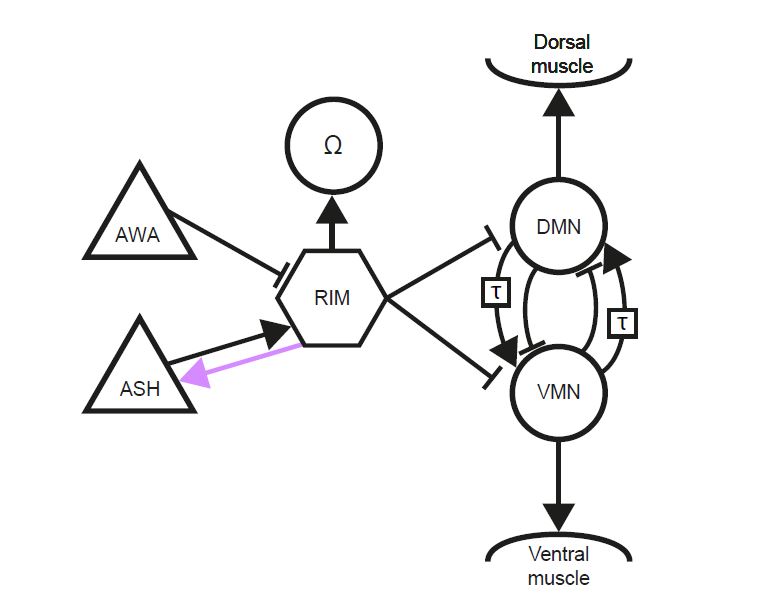
The sensory neuron ASH detects the noxious barrier. The sensory neuron AWA detects the smell of food. Both ASH and AWA connect to the interneuron RIM. This in turn connects to the motor neurons DMN and VMN which control the direction the worm moves towards by flexing the muscles on either the left or the right side of the body.
When the worm is inside the barrier, the ASH neuron detects the noxious substance and stimulates RIM to turn the body around and move away from it. But at the same time AWA detects the smell of food and tries to inhibit RIM in order to keep the body moving towards it. So RIM receives conflicting signals. When the worm is fed, the ASH signal wins and the worm avoids the barrier. However, as the worm begins to starve, the levels of a substance called tyramine in its tissues begin to decrease. And tyramine is involved in the communication between ASH and RIM. As tyramine levels decrease, the activity of ASH and RIM goes down as well and as a result the worm’s tolerance for the noxious substance is progressively increased. Eventually, the activity of ASH and RIM goes low enough that the AWA signal wins and the worm pushes through the noxious barrier to pursue the smell of food. This video shows the movements of the worm and the activity of the neurons:
This is a simple example of sensory integration where a single interneuron integrates information arising from within the body (tyramine levels) with two streams of sensory information from the environment (noxious barrier and smell of food) and dictates the behavior of the organism depending on its most urgent needs.
But in more complex animals, as sensors multiply and actions become more elaborate, sensory integration improves to the point where virtually all sensory inputs can be accessed at the same time and compared to guide decisions. Not just hunger and smell, but all the sensations from all parts of the body: vision, touch, sounds, smell, tastes, hunger, energy levels, pain, moods – all can be accessed together in a large network of neurons. At that point the animal can be said to have a single point of view for the entire organism. C Elegans doesn’t seem to be quite at this level. The partial sensory integration we see in them may be considered a precursor to the whole-body integration we see in more complex animals. Sort of like how a photoreceptor cell is a precursor to a complex eye. Bjorn Merker proposes that in vertebrates the midbrain is most likely responsible for this integration and other researchers such as Andrew Baron and Colin Klein have identified similar structures in the brains of arthropods, such as fruit flies and honeybees.
So through an efference copy mechanism and complex sensory integration, a mobile animal acquires what Merker calls a motion-stabilized body-world interface organized around an ego-center.

This is an adaptation that allows animals to assume a stable first-person perspective and creates a “self” which can differentiate its own body from the external world. Thus the animal shifts from being an object to being a subject. If Merker is right, a nonconscious animal with this type of neural reality model that enables it to distinguish between world-generated and self-generated sensory perceptions, was a precondition for the evolution of a conscious self.
There is a physical world, in that world is a physical body, inside that physical body there is a physical brain. All of this is forever cloaked in total and utter unconsciousness. Inside that brain there is a neural reality model, divided into the neural world and the neural body, nested around the ego center in the center of the head. This is the locus of conscious experience in the brain and nothing else.
So based on this theory (at least to the extent of my ability to understand it) for an organism to be a subject it needs:
- A mobile body
- Complex senses that can detect the physical world as well as bodily movements
- Sensory integration (probably achieved through a central nervous system)
- Reafference implemented in the context of sensory integration
Some of these features seem to be absent in organisms such as bacteria, protists, fungi, plants, sponges, or corals. Consider the case of plants. Plants are way more intelligent and sophisticated than we give them credit for (as I’ll explain later on), but they don’t seem to be subjects. Where would the point of view of a plant be? What structure would account for the sense of self of the entire organism? How would sensations on different parts of the plant be integrated into a single experience? Unlike animals, plants don’t seem to perceive the world from a single perspective but rather they have a modular design, made of small units which have partial independence and seem to respond to stimuli on their own. Could different parts of a plant have unstructured washes of feeling? Maybe. But it seems very unlikely that the organism as a whole is subjectively experiencing the world with the point-of-view structure we associate with consciousness.
One might object to this by saying: Well then how do we explain subjective experience during total locked-in syndrome? This is a very rare condition in which following nervous system damage, patients are fully conscious but all muscles in their body, including the eyes, are paralyzed so they have no way to interact with the outside world. Doctors have managed to communicate with such patients by placing them in a brain scanner and asking them a series of personal questions. If the answer was yes, the doctors asked the patient to imagine playing tennis and if the answer was no they asked the patient to imagine visiting each room in their home. These two tasks selectively increase blood flow to one of two distinct regions of the brain. The doctors found that a few of the patients could hear and understand the questions and were able to answer correctly which means they retained their memories and identity. How can this be? If reafference and interacting with the environment are so important for subjective experience, why do these patients still have a sense of self?
Ginsburg and Jablonka offer an answer to this question towards the end of their book. They point out that all humans, whether their present state is normal or pathological, develop a functional nervous system during their ontogeny (ontogeny means growing up), and what we know about normal neural development suggests that this requires motor and sensory stimulation and feedback, even in utero. It is certainly remarkable and significant that, once formed, representations that humans and other animals acquire through interactions among the sensory, perceptual, and motor systems can persist in the absence of exogenous sensorimotor stimulation. However, this does not mean that consciousness is possible without sensorimotor loops involving the body and the world because such loops are always part of an individual’s developmental history. Taking an explicitly developmental perspective (evolutionary as well as ontogenetic) makes the necessity of a body-and-agent-based view of consciousness self-evident.
Neural representations: the content of experiences
Like subjectivity, another feature that is not found in all living organisms and seems to be indispensable for subjective experience is something we might call neural representations of the world and body or sensory mapping of the world and body. This essentially means using stimuli from the environment or body to construct models of reality in the brain. We do that through our senses.
Here are a few examples:
- Photons of different frequencies bouncing off objects in the world are received by the eyes and then interpreted by the brain as an image with the position, shape, brightness, and color of those objects in space.
- The surface of your body is covered with pressure, temperature, and pain sensors that allow your brain to create a neural map of the body and 3D models of the shape and texture of objects we touch.
- Your ears pick up vibrations in the environment and the brain interprets them as sounds coming from different directions and different types of objects.
I should note here that the word ‘representation’ is problematic because it implies dualism. It sounds like on one hand you’ve got the activity of the neurons and on the other hand you’ve got the representation of an image, sound, or smell that exists by itself somewhere and is a different sort of thing than the activity of the neurons. This is not the case but I don’t know what other word to use. By neural representation I mean the sensory content the brain constructs from stimuli in the environment, like visual images, sounds, pain and so on. Essentially what you lose when you become blind, deaf, or paralyzed. You don’t lose your sense of self or your subjectivity; you lose some of the content that used to be part of your subjective experience. That content I call neural representation.
My naive intuition would be that all living creatures should be able to construct such sensory content because they all have senses. After all, even bacteria and unicellular organisms are able to detect a number of environmental stimuli, such as chemicals, physical contact, light, and temperature, and respond to these stimuli with different behaviors depending on the situation. It’s intuitive to think that when you poke an unicellular organism and it moves away, it does so because it feels a touch. Or that bacteria avoid noxious chemicals because they don’t like the taste or smell of those chemicals. Or that plants move towards sunlight because they feel its warmth and see its brightness. However, there’s reason to believe that such creatures cannot construct representations of their environments and bodies. Rather, their senses dictate their behaviors through reflexes or action programmes.
In their two books, Consciousness Demystified and The Ancient Origins of Consciousness, Todd Feinberg and Jon Mallatt propose that a marker for the ability to construct neural representations is the presence of complex chains of neurons in sensory pathways. They think that only organisms that process stimuli through neural hierarchies can map their bodies and environments in the form of neural representations we understand as visual images, sounds, tastes, smells, touches, and perhaps even internal states like pain and hunger. Because of this, they propose that multiple layers of neurons in sensory pathways can be used as a marker for which creatures have the potential to be sentient and which don’t. If an organism doesn’t have a nervous system or displays only reflex arcs, that organism cannot be sentient in the way we understand it because it cannot construct the “content” that makes up subjective experience. If on the other hand, an organism displays multiple layers of neurons in sensory pathways it likely can form neural representations. The ability to form neural representations doesn’t necessarily entail subjective experience because the organism might lack some of the other features necessary for sentience. However, the ability to construct neural representations seems to be a precondition for sentience.
Let me try to explain why.
Feinberg and Mallatt propose that neural representations likely evolved from reflexes. They say reflexes were the vital “royal road” to the evolution of conscious sensations. One of the earliest functions of nervous systems may have been making the body move towards or away from a stimulus, or making an organ react in a certain way in response to a stimulus. That can be accomplished with just a few neurons arranged in a simple reflex arc.


They show what that would look like in these two figures from their books Consciousness Demystified and The Ancient Origins of Consciousness.
The first figure shows a case of body movement: a stimulus acts on a sensory neuron which acts on an interneuron which acts on a motor neuron that makes a muscle contract (although the actual explanation is much more complex than that).
The second figure shows the reflex of the pupil of the eye contracting or dilating in response to light intensity.
Reflex arcs like these don’t construct content for our subjective experience. We know that because we don’t feel them while we’re awake but also because they still work to some extent in people in a coma or brain death. For example, brain dead patients sometimes clench their toes or fingers, change facial expression, withdraw their limbs, or even briefly raise their arms and drop them crossed on their chests. The presence of spinal reflexes such as these can make the family and even medical staff think the patient is still alive and minimally conscious.
Reflexes can also be observed in the lower limbs of rats which had their spinal cord cut in the middle section to interrupt sensory communication between those limbs and the brain. For example, if heat is applied to the tail of a rat whose lower body has been paralyzed with this procedure, the tail will still withdraw to protect itself. But the rat doesn’t feel pain, touch, or temperature because the cut spinal cord doesn’t allow sensory signals to reach the brain.
In fact, in mammals, the spinal neurons that make up reflex arcs are so sophisticated that they can even support simple forms of learning and organize relatively complex behaviors. Here’s a paragraph from a review by James Grau:
A dramatic example of this is seen in cats after a complete thoracic transection (that means cutting the spinal cord somewhere below the upper limbs). As expected, this injury induces a paraplegia that disrupts voluntary hindlimb motor behavior. But if the cat is then placed in a harness and suspended over a moving treadmill, it can be trained to step (Edgerton, Roy, de Leon, Tillakaratne, & Hodgson, 1997; Edgerton, Tillakaratne, Bigbee, de Leon, & Roy, 2004). Moreover, with training, hindlimb stepping improves and becomes sensitive to treadmill speed. If an obstacle is then positioned so that the cat’s paw strikes the object as it lifts the paw forward (swing phase), neurons within the spinal cord will adjust step height to minimize contact with the obstacle. Notice too that the maintenance of rhythmic behavior suggests that the lower (lumbosacral) spinal cord contains a central pattern generator (CPG; Grillner & Zangger, 1979).
Feinberg and Mallatt think that these types of reflex arcs can explain the behavior of some small neural organisms. They give the example of the tiny worm C Elegans. C Elegans has only 959 cells out of which 302 are neurons and scientists have discovered how they all connect together to form the nervous system. As of 2019, it is the only organism for which we have a complete map of all its neural connections. Among many other behaviors, C Elegans displays escape movements when something makes contact with it. If you tap its head, it swims backwards to withdraw from the threatening stimulus in front of it. If you poke its tail, it swims forwards so that it moves away from the threatening stimulus behind it.

Figure 6.2 from Consciousness Demystified shows how this escape behavior is controlled by expanded reflex arcs. A tap to the front of the body deforms certain proteins in a sensory neuron and produces an inward electric current. This sensory neuron then inhibits the activity of the interneurons which initiate forward locomotion (this is what the minus signs represent) and stimulate the interneurons that stimulate backward locomotion. Similarly, a tap to the posterior body produces an electric current in a sensory neuron which inhibits the chain of neurons that initiate backward locomotion and stimulate the chain that produces forward locomotion. The result is that the worm moves appropriately depending on which part of the body is tapped.
Feinberg and Mallatt propose that in this scenario, the tap isn’t represented as what we call a touch. Turning physical contact into the perception of touch is not as simple as activating a sensory neuron. Instead, the signals from the sensory neuron need to be passed on through multiple points within a sensory pathway made up of several layers of specialized neurons. Also, the animal likely needs a neural map of its body. That means the surface of the body needs to be mapped in the nervous system so that the tap can be recognized as located on the part of the body which comes into contact with the object.
For example, in humans and other mammals, contact with the surface of the body is processed in four layers of specialized neurons.

First, in the skin, several types of nerve endings detect different stimuli. You can see them in this figure. Some are responsible for detecting light touch and texture, others vibration, others pressure, shape, stretch, temperature or tissue damage. When these nerve endings are deformed by their specific stimulus they produce an electric current that travels along the sensory neurons onto which they are attached and stimulate other neurons in the brainstem. Those neurons in turn stimulate neurons in the thalamus which finally stimulates neurons in the cortex. There are four levels in the sensory hierarchy and the stimulus is processed at each level. As far as I understood, what seems to be most important is that a neural map of the body is preserved at each level of the hierarchy. That means if two nerve endings are located right next to each other at the level of the skin, they connect to neurons that are right next to each other at the level of the brain stem, thalamus, and cortex as well. The result is point-for-point correspondence of an area of the body to a specific point on the central nervous system. You can think of it like this: if you were to spread out the surface of the body like a carpet, you’d find that carpet represented at the level of the cortex as well, such as that adjoining areas of the body are represented in adjoining areas of the cortex.
This arrangement seems to be crucial for representing physical contact as perceptions of touch, vibration, temperature, or tissue damage. So for this reason, Feinberg and Mallatt think that if organisms like C Elegans respond to physical contact only through reflexes, they likely can’t represent it as a touch located on a specific part of the body.
But what about other senses? What about sight?
Many single-celled organisms, marine plankton, and small animals have tiny eyespots or photoreceptor cells that allow them to move towards or away from light. For example, single-celled green algae from the genus Chlamydomonas use their tiny flagella to inhabit the ideal water depth for photosynthesis. When it’s too dark they swim towards light and when it’s too bright they swim away from it. You can see them in this video.
Another example is the larva of the marine worm Platynereis dumerilii. In the early larval stage, it swims towards light to be close to the water surface and after it matures a bit a few days later, it swims away from light and migrates to the benthic zone, close to the bottom of the water body. C Elegans also uses light to navigate. This animal lives in darkness and is very sensitive to damage from ultraviolet (UV) light so whenever it detects short wave light on its body it moves in the opposite direction.
My naive intuition would be that the reason these organisms move towards or away from light is because they see it. When their eyespots or photoreceptor cells face the sun, they see something like white and when they face away from the sun they see something like black. But again, there is reason to believe this is not the case. Rather, their behavior in response to light is triggered by direct connections between eyespots or photoreceptor neurons and their organs of locomotion (flagella, cilia, or muscles).
In the case of green algae from the genus Chlamydomonas, photons absorbed by proteins in the eyespot triggers the formation of an electric current that acts directly on the flagella. The intensity and duration of the light control the flagella beating frequency and whether the organism moves towards or away from light. That is because the influx of current is different in the flagellum closest to the eyespot and the one further away from it. This creates a steering system for swimming towards light. Watch this video to see how it works.
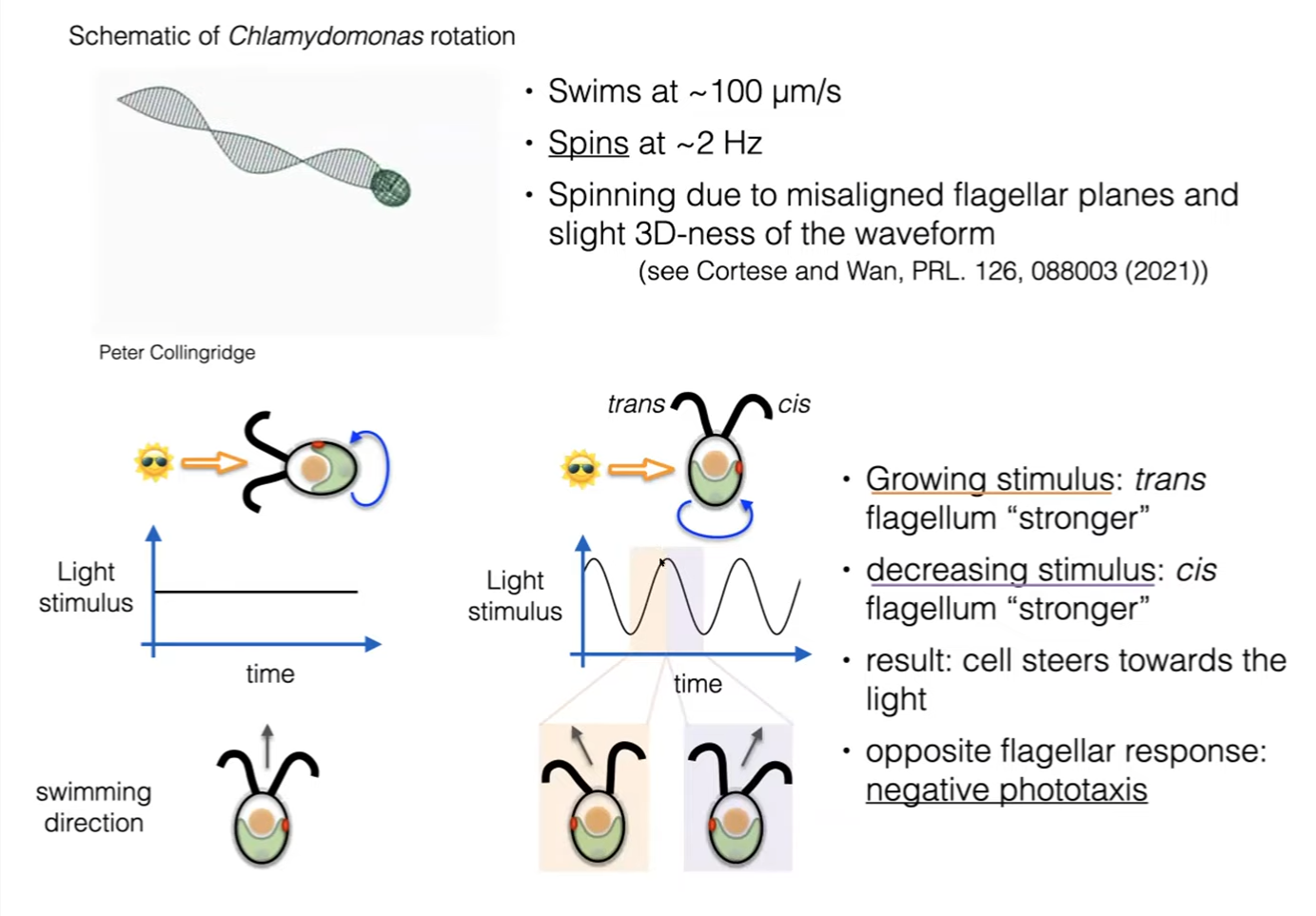
A similar system is used in one day old larva of the worm Platynereis dumerilii. Jékely and colleagues (2008) studied the larvae with electron microscopes and found that their two photoreceptor neurons are connected directly to the ciliated cells next to them. They found that when one of the photoreceptors is exposed to light, it slows down the beating of the cilia near it, while the other cilia on the opposite side of the body and at the bottom beat normally. The result is that the larva steers towards the light. It works sort of like how you steer a boat. If you reduce rowing speed on the left side and keep rowing normally on the right side, the boat will steer left because the left side is slowed down more than the right side.
In the case of C Elegans, the mechanism for light avoidance is believed to be similar to the reflex arc that controls withdrawal from physical contact. C Elegans does not have distinguishable eyespots but some of its sensory neurons contain a protein called LITE-1 that can absorb photons and trigger electrical currents that stimulate interneurons. Appiah and colleagues propose that the neural pathway that controls light avoidance in C Elegans looks similar to the reflex arc for physical contact withdrawal and includes some of the same interneurons and motors neurons.
These examples show that organisms can use light to navigate their environments without having to see. Representing light as what we call white or brightness is not as simple as creating an electric current in a sensory neuron through proteins that absorb photons. More neural complexity is required.
Randel, Jékely and colleagues propose that for a creature to be able to represent light as brightness and the absence of light as darkness, it requires at least two photoreceptors and a neural circuitry capable of making a comparison between the two photoreceptor inputs without body movement. They proposed this idea after studying all the neural connections of slightly older larvae of the worm Platynereis dumerilii. As we talked about earlier, in one day old larvae, the photoreceptor cells are linked directly to the ciliated cells. The eyespots are autonomous sensory–motor organs and even if there is one on each side of the body, there is no informational exchange between them. But in three day old larvae things are different. In addition to these eyespots, the larvae develop 4 more photoreceptors, two on each side of the body, and these photoreceptors are wired to each other through an intricate network of interneurons. And because some of the interneurons receive inputs from both sides of the body, the authors think that they are able to “compare” light levels and thus construct a very basic 2 pixel spatial visual field. They think this is one of the most simple neural circuits that can construct the visual image of darkness at the bottom of the ocean and the visual image of brightness at the top.
These visual images however still serve as part of reflexes. The researchers restrained the larvae and selectively illuminated just one of the eyes. They found that the light signal triggered body bending on either the opposite or the same side of the body. This acts as a steering system and is controlled by the internal state of the organism. That shows there is some basic sensory integration involved. If the larva bends the same side of the body on which the light is flashed it moves towards light and if it bends the opposite side it moves away from light. And if the eyes on one side of the body are destroyed with a laser, the researchers found that the larvae continuously swim in circles when illuminated. Their steering system gets broken. So even if the organism can distinguish light from dark, it doesn’t necessarily mean it subjectively sees light or dark. But what I want to suggest is that their neural system may be capable of constructing a visual image that could become the content of subjective experience if the organism possessed all the other features of consciousness as well.
You might find this last statement very weird. Doesn’t the ability to form visual images automatically entail conscious sight? A subjective experience? Is it possible to form visual images but to not see them?
Yes, it seems that’s possible. In humans this happens in the case of a medical condition called blindsight. Blindsight is the ability of people who are cortically blind to detect and use visual images to guide behavior despite not being able to consciously see them. To make sense of how this could be possible, I need to quickly say a few things about how the visual pathway works in humans.
It all starts with photons of different frequencies that are reflected by objects in the world. These photons enter the eyes and are focused by the lens into an image that falls on the retina. Depending on their frequency, the photons are absorbed by different photoreceptors located in the retina (the difference in photon frequency is important because that is later represented by the brain as color). When these proteins absorb photons, they change their shape and trigger the formation of a small electric current in the photoreceptor cell. These photoreceptors stimulate several layers of neurons that make up the retina, which process and compress the signals and then send them up the optic tract to some structures called lateral geniculate nucleus, pulvinar, and superior colliculus. Some further processing happens at this stage (that I don’t understand enough to explain) and then the signals are passed on to the primary visual cortex where they are assembled into visual images. What’s important is that, just like in the case of our touch sensory system, the arrangement of the signals is preserved at every stage of the journey. That means if two photoreceptors are located right next to each other in the retina, they stimulate neurons that are located right next to each other in the thalamus and the primary visual cortex as well.
Researchers have determined this is true in many different ways but I’ll just give you two vivid examples. The first is an experiment done on monkeys in 1982. The researchers anesthetized a monkey and restrained its head in such a way as to look at a visual pattern. As the monkey was looking at the pattern, it was injected with a substance called deoxyglucose. This substance is uptaken by cells that are metabolically active. The cells think it’s glucose and absorb it for fuel but then it gets stuck in those cells because it can’t be broken down like glucose. And if you put a radioactive tracer on deoxyglucose, then you can use a scanner and determine which cells were active while the substance was injected. The researchers then euthanized the monkey, dissected its brain, looked at the primary visual cortex and they saw the same pattern in the brain! Neurons in the visual cortex were firing in the same pattern as the shape the monkey was looking at.
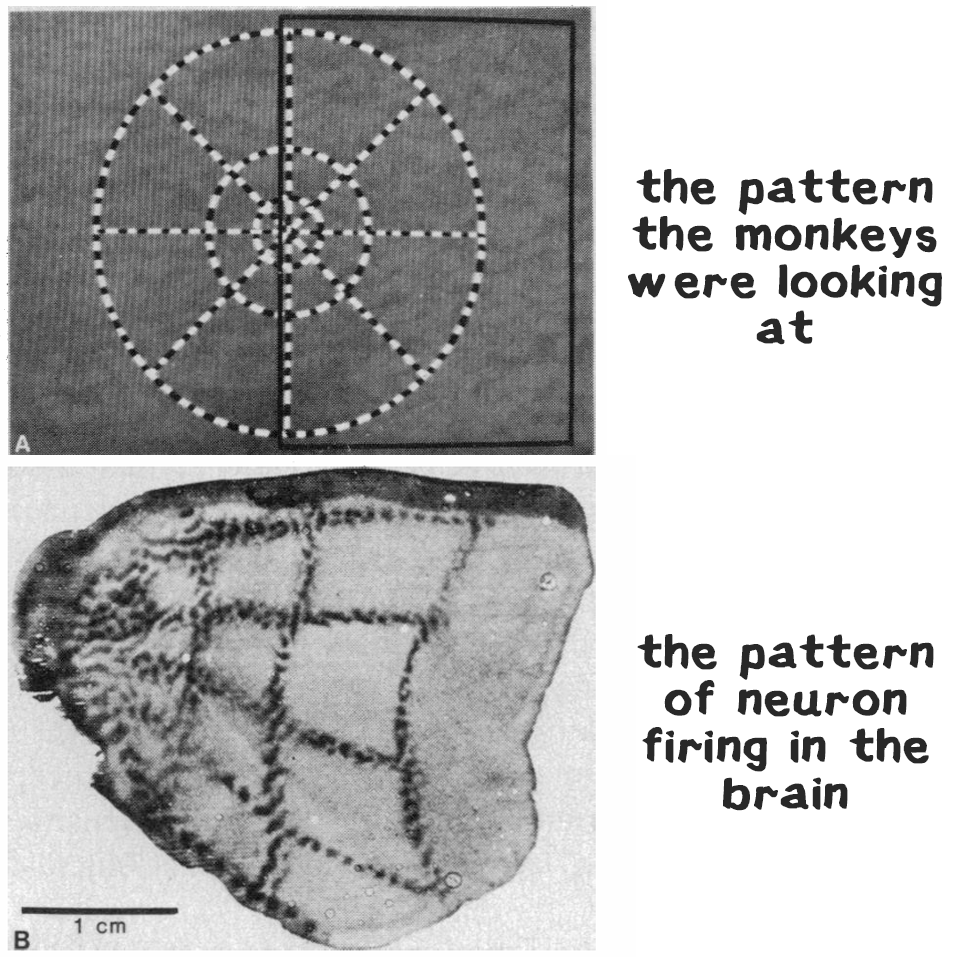
Another experiment that shows visual mapping in the cortex was done on humans using high resolution fMRI. The researchers had volunteers look at the letter M and with the high resolution fMRI they were able to see that the letter M also appeared in their primary visual cortex.
So when you now look at a shape, for example a square, there is literally a square of neurons in your retina, thalamus, and primary visual cortex that are firing differently than the rest (although the shape is distorted because of the distribution density of photoreceptors in the retina and the wrinkles of the brain).
But back to the pathway… After the primary visual cortex, the signals move to various other areas of the visual cortex that understand details of what is being seen or guide motor actions based on what is being seen. For example, an area of the cortex plays an important role in recognizing faces, another in recognizing motion, another in adding in colors, and other areas in recognizing individual features of objects. Researchers found this out because they noticed that when some people had injured one of those areas they also lost the visual ability for which it was responsible. For example there are people who can’t detect visual motion (this is called akinetopsia). Or there are people who can’t recognize objects but can recognize faces (a condition called visual agnosia) and there are other people who can recognize objects but can’t recognize faces (a condition called prosopagnosia). Now researchers can even induce this effect temporarily in the lab. For example they can reduce your ability to perceive dots moving on a screen by stimulating a small part of your brain called V5 with a strong magnetic field. Or they can stimulate another part of your brain and reduce your ability to recognize human faces (watch this video).
So our day to day visual experience is not a single unitary phenomenon, but a collection of many visual abilities working together.
You could say that human vision is almost like a product that is constructed on an assembly line. In the earliest part of the visual-processing pathway, a scene in the world is perhaps represented as just a bunch of colorless individual pixels. Then, higher in the hierarchy, the outline of objects is formed and the assembled parts are becoming more complex. Then, later in the pathway colors and motion are added and individual objects are understood as individual objects and are assigned meaning and motivation value. Now, keep in mind that while this idea is useful, it’s actually a wrong way to think of the process because it implies that the experience of vision is a thing that is constructed and exists independently of the neurons. This is not the case. But the point is that our experience of vision really is a collection of many different systems working together.
And now we can talk about blindsight. Blindsight occurs in a small percentage of people that sustain damage to their primary visual cortex due to a stroke, lack of oxygen, or other injuries, but the rest of the visual pathway remains intact. So it’s important that the damage is in the primary visual cortex and not in the eyes, the optic tract, or thalamus. These people become blind. They consciously don’t see anything across a region of their visual field or their whole visual field, depending on the extent of the damage. (note that in the case of partial blindness, they don’t see black in that region. They don’t see anything. Just like if you close one eye you don’t see black with that eye, you don’t see anything).
However, their brains are still able to process and use visual images from their blind visual field to guide behavior. Neuroscientists have discovered that is because not all visual pathways go through the primary visual cortex. Instead, the lateral geniculate nucleus, pulvinar, and superior colliculus relay some information from the eyes directly to the parts of the brain that account for specific visual abilities like detecting motion, faces, shapes, color, or human body language. So while the primary visual cortex which is essential for conscious sight is broken in people with blindsight, the other parts of the brain can still process visual images. As a result, these blind people retain remarkable visual abilities that they’re not even aware of until the researchers reveal them through experiments.
I’ll give you a few examples.
In one type of experiment, researchers ask a person with blindsight if he can adjust his hand grip in the way needed to grasp a certain object located in his blind visual field (for example a mug).
Researcher: Can you grasp this object?
Subject: No, I can’t. I’m blind. I don’t see anything on my left side.
Researcher: Ok. But try to grasp it anyway. Just guess.
And then something remarkable happens. Despite not being able to see the object, the person is able to correctly reach for the location of the object, adjust their hand grip mid-air to its particular shape, and grasp it almost as easily as a seeing person.
In another type of experiment, the researchers set up a target area for the person to touch as fast as possible after a sound command but placed obstacles between the person’s hand and the target. The person cannot see some of the obstacles because they are placed in his blind visual field. And yet, they successfully touch the target while also avoiding the obstacles.
And perhaps most remarkably, one blindsight patient was even able to avoid obstacles while walking. This is a video from a study by de Gelder and colleagues (2008) which shows a blind man successfully navigating an obstacle course that was set up for him.
Take a moment to appreciate what’s going on there. That man cannot see. And yet he walks around obstacles because the part of the brain that controls his muscles can still detect the obstacles. According to Wikipedia, after navigating through the hallway, the man reported that he was just walking the way he wanted to, not because he knew anything was there.
Blindsight patients can possess other cool visual abilities as well. For example they can identify the orientation of lines projected in front of them. Point towards dots of light. Detect when a hand is waved in front of them. Distinguish emotional faces (especially fearful or angry faces) from neutral faces at a level higher than chance because of activation of the amygdala – which is a part of the brain that processes emotional response. Or they can distinguish threatening or happy human body language from neutral body language based on the emotions they feel. But importantly, they can only do these things as long as the stimulus is on the retina. If you show them the stimulus, wait a second or two and then ask them to perform the action, they can no longer do it. The action must happen in real-time, as the stimulus is in front of them.
These results show that it is possible for organisms to form visual images and use them to guide behavior without perceiving the images in the way we call sight. It appears there is a difference between vision-for-action and vision-for-perception. Eyes aren’t just good for seeing. In the case of vision-for-action, certain groups of neurons can be specialized in detecting certain features of visual stimuli like shape, orientation, color, or movement and then guide behavior based on those stimuli in an unconscious manner.
It’s possible something like this takes place in small neural organisms that have eyespots or photoreceptors such as the 3 day old larvae of Platynereis dumerilii. A vision-for-action system almost certainly preceded the vision-for-perception system in evolution and could be implemented with fewer neurons.
Alright, so let’s sum up this section and my argument.
Constructing the contents of a subjective experience isn’t as simple as having a cell respond to a stimulus. It takes a more complex neural circuit, and for this reason Todd Feinberg and Jon Mallatt think that the presence of complex chains of neurons in sensory pathways can be used as a marker for the ability to construct neural representations. Of course, the authors recognize it’s not just about the number of neural layers, it’s about information processing. But the presence of several layers of neurons in the sensory pathways of an animal is a good indicator that information processing is taking place. If an organism displays only simple or expanded reflex arcs then it is almost certainly not sentient because it cannot construct the content of subjective experience. If on the other hand an organism does process sensory stimuli through several layers of specialized neurons then it likely can construct neural representations. However, this isn’t an automatic sign that the creature is sentient. Rather, it is a sign that the creature has the potential to be sentient. The ability to form neural representations is just one of the features necessary for subjective experience. It’s just a part of the package. Those neural representations can become subjectively experienced if the organism also has all the other abilities that make up subjective experience.
Put simply, the ability to construct neural representations is necessary for sentience but not sufficient. And so organisms such as protozoans, plants, fungi, and many phyla of small neural animals are likely not sentient because they lack this feature; at least as far as we can tell right now.
Sensory evaluation: the feeling of good and bad
Besides subjectivity and the ability to construct neural representations, another key component of subjective experience that doesn’t seem to be found in all living creatures is something I’ll call sensory evaluation. This refers to the ability to assign meaning to sensory sensations from the world or inside the body in the form of feelings of pleasure or displeasure, attractive or repulsive, like or dislike. In other words, by sensory evaluation I mean the ability to feel whether something we sense is good or bad.
For example, touching a wound feels bad. It feels painful. On the other hand, touching your sexual organs feels good. If you do it long enough it might even lead to an orgasm. You might think that in the first case you’ve got “pain nerves” that send pain signals up to the brain and in the second case you’ve got “pleasure nerves” that send pleasure signals up to the brain. But this isn’t so. In both cases, a stimulus activates nerve endings in your skin but those signals feel pleasant or unpleasant because that’s how they are interpreted by the brain. In other words, pleasure and pain only exist in the brain – they are evaluations of a sensory experience.
This applies to the other senses as well. Some tastes, smells, sounds, and bodily sensations are pleasant (like the flavor of chocolate, the smell of fresh bread, the sound of music, and the sensation of quenching your thirst) while others are very unpleasant (like the taste of spoiled food, the smell of garbage, the sound of crying babies, or the sensation of hunger).
How does this happen? How come some sensory sensations are pleasant while others are unpleasant? What accounts for the badness or goodness of a sensation?
To the best of my ability to understand, theleadingtheory in neuroscience is that the pleasure or displeasure aspect of a sensation is not built into the sensation. Smells, tastes, touches and other sensory experiences aren’t inherently good or bad. For example, recognizing the smell of vomit is not the same thing as disliking it. Rather, the liking or disliking aspect is added onto sensory sensations by specialized brain areas that aren’t part of the sensory pathways.
In the case of pleasure, neuroscientists have identified structures in the brain they call hedonic hotspots. It appears that these hotspots form a unitary pleasure system in the brain that gives all sensory sensations their positive valence, even though the final experience of each seems otherwise unique. Liking the taste of chocolate and liking the sound of music feel very different but the current evidence suggests the same pleasure system accounts for both.

What makes sensations displeasurable wasn’t as straightforward for me. Based on what I read, it seems that a similar network of subregions in the brain is involved, although it might not be a uniform system and could vary depending on the specific sensation.
The important point is that the liking and disliking of a sensory sensation is separate from the sensation itself. I’ve seen some authors use the analogy of “hedonic gloss” to explain this. They say these brain systems add a “pleasure or displeasure gloss” onto a sensory sensation similar to how a varnish is added on top of a dull object to make it shiny.
This may sound weird to you. You probably can’t imagine the smell of vomit feeling any other way than disgusting. Your disliking of that smell seems to be the same as your recognition of the smell. You can’t seem to separate the two aspects; you can’t perceive the smell of vomit without also feeling disgust. But this intuition appears to be wrong. I’m going to give you a few examples from research that seem to prove that the liking or disliking of sensory sensations really is different from the sensory sensation itself.
In one study, Tindell and colleagues looked at how rats react when sugary or salty liquid is dripped directly into their mouths through a cannula implant. They found that when rats were given the sugary liquid they displayed positive reactions such as tongue protrusions and paw licking. Hedonic hotspots also light up in their brains. They took this to mean that the rats were liking the sugary liquid. One minute later, the rats were given a very salty liquid (3 times as salty as seawater). In response to this liquid rats displayed negative reactions such as gapes, headshakes, forelimb flails, face washing, and chin rubs and the hedonic hotspots in their brains no longer showed high activity. The researchers interpreted this as evidence that the rats disliked the salty liquid.
But then they did something clever. A few days later, they injected the rats with two substances which cause the kidneys to excrete sodium out of the body, and as a result induce salt appetite. And then they repeated the experiment. In response to the sugary liquid, the rats displayed the same liking behavior and high activity in their reward centers in the brain as before. But now in a sodium depleted state, the rats displayed the same liking behavior to the salty liquid as well! The rats were liking their lips and their reward centers showed as much firing rate as in response to sugar. The researchers believed this to suggest that the rats were now liking the salty liquid just as much as they liked the sugary one, maybe even more.
The important thing to highlight here is that the taste didn’t change. The researchers point out that sodium-depleted rats remain able to differentiate between salty, sugary, sour, or bitter tastes. What changes is how the taste of salt is evaluated. Under normal conditions, very salty liquids are strongly disliked by rats, but in a sodium-depleted state, the same salty liquid is strongly liked. The hedonic gloss is flipped from negative to positive. This seems to show that the ability to recognize a taste and the like-or-dislike reaction to that taste are separate things. So salt can become as nice as sugar when the two sensations get the same neuronal hedonic gloss.
There is some evidence that the same effect applies to humans as well. The most dramatic scientific report of salt appetite in humans dates back to 1940 and tells of a young boy with adrenal gland dysfunction who insisted on eating handfuls of salt each day and preferred it to candy or other sweet foods. The boy liked salt so much that it was one of the first words he learned. Another telling case report describes a 33 year old woman who consumed salt by the shaker full and did not find it offensive.
The effect of severe sodium depletion on the pleasantness of salty tastes hasn’t been tested in healthy humans due to ethical concerns. But moderate depletion was tried. A 1990 study by Beauchamp and colleagues induced moderate sodium depletion in 10 healthy volunteers by feeding them very-low-sodium diets and giving them diuretics for 10 days. The results showed that when the subjects were in a sodium depleted state they rated salty foods more desirable and rated sweet foods less desirable than before the study.
These results and case reports seem to suggest that tastes aren’t inherently good or bad. Rather, the liking or disliking of a taste is determined by homeostatic utility, that is the overall needs of the body. An unpleasant sensation can sometimes transform into a pleasant one, and conversely, a pleasant sensation may turn unpleasant.
I’ll now give you a few examples of experiments which showed that the valence of a sensation can be flipped from positive to negative.
In a 1983 study, Pelchat and colleagues split rats into two groups and gave them sugar water. While the rats were consuming the sugar solution, both groups were displaying liking reactions: tongue protrusion and rhythmic mouth movements and swallowing. But both groups of rats also received a punishment. Immediately after drinking, the first group received an electric shock and the second group were force fed a dose of lithium chloride; a substance that induces nausea and vomiting in mammals. The rats that were electrocuted jumped in pain for a moment and that was it. In contrast, the group that received lithium chloride got severely ill afterwards. The researchers wanted those rates to associate the sweet taste of the sugar water with feeling unwell.
A few days later, after the sick rats recovered, the researchers gave both groups the sugar solution again. The first group, despite being electrocuted last time, continued to enjoy the taste – although the rats were more likely to spontaneously jump away from the feeding tube as if expecting another electric shock. But the group that got sick now displayed disliking reactions to the sugar water, such as chin rubbing, head shaking, paw rubbing and face washing. It seemed that the evaluation of the sweet taste changed in the second group and the rats were finding the sugar solution distasteful. The researchers noted: Thus, both shock and lithium chloride produced changes in the response to sucrose, but these changes were not along the same dimension. Shocked animals came to behave as if they were frightened when presented with sucrose, and lithium chloride-poisoned animals came to behave as if they were consuming quinine (which is a known unpleasant taste for rats). So the rats were still perceiving the taste as sweet but they no longer liked it, at least not as much as before. These results were replicated by other studies, most recently by Schier and colleagues in 2019.
You’ve probably noticed this phenomenon yourself. If you fell ill after consuming a particular food, your preference for it likely diminished. For instance, you might have once enjoyed pepperoni pizza, but if you once experienced nausea and threw up after eating it, the scent and flavor lost their appeal. Although your ability to recognize the scent and flavor remains unchanged, the associated pleasure and attractiveness have shifted. Now, pepperoni pizza no longer holds the same appeal for you.
Pelchat and colleagues conducted a survey in 1982 and found that people consistently rated foods as less enjoyable after they experienced nausea related to that food. But interestingly, if they experienced another negative symptom other than nausea, they rated the flavor just as enjoyable. For example, if someone got a skin rash after eating shrimp, they still enjoyed the flavor as much as before but they learned to avoid shrimp because of the allergy. Nausea thus seems to play a special role in telling the brain it should no longer like a particular food and flavor (at least for a while).
And I’ll give you one more example of sensory evaluation, this time related to sounds. There are sounds we like and sounds we dislike, but our preferences are not inherent to our perception of the sound. Rather, it seems that our preferences are linked to higher-order features of the sound such as its source, meaning, social context, and interpretation. To prove this point, I’ll describe an experiment done by Samermit and colleagues. (full paper)
A group of students listened to eight sounds that are commonly regarded as some of the most annoying and then rated those sounds in terms of discomfort, unpleasantness, and bodily sensations. Click here and listen to the sounds yourself.
The researchers then split the students into two groups and showed them videos that appeared to reveal the sources of those sounds. One of the groups saw the original videos while the other groups saw other videos intended to make the sounds more tolerable. Click here to see the originals and click here to see the fakes.
The study found that the perceived source of the sounds changed their aversiveness. The first group, the one that heard the annoying sounds and also saw the original videos rated them as even more repulsive than before. But the second group, the one that saw the fake videos, rated the sounds as less repulsive.
This shows that liking or disliking is not just about hearing of the sound. The “hedonic gloss” of the sound is added onto the sensation by other parts of the brain separate from the auditory pathway.
This is also shown by two somewhat opposite conditions called misophonia and autonomous sensory meridian response (ASMR). On one end of the spectrum is misophonia, which literally translates to “hatred of sound”. This is a chronic brain condition in which a person experiences intense irritation, anxiety, disgust, and even negative bodily sensations when exposed to certain human sounds which you and I might find more or less neutral or just mildly annoying – such as other people chewing, coughing, breathing, finger tapping, pen clicking, or lip smacking. Misophonics say that for them, hearing someone chewing with their mouth open is like hearing nails on a chalkboard, or maybe even worse than that because they describe physical reactions in response to those sounds such as pressure in their chest or head, tense muscles, increased heart rate, blood pressure and body temperature, and even difficulty breathing. Misophonics are essentially having a fight-or-flight response. Some also report intense hate, anger, and rage towards the person producing the sounds. It makes them want to punch them in the face. However, what’s remarkable is that the source of the sound affects how annoying or tolerable it is. Many misophonics report that those same sounds don’t bother them at all or not nearly as much when they are made by babies or disabled people. That’s probably because they realize babies and disabled people can’t help but make those sounds while healthy adults are just inconsiderate.
On the other end of the spectrum there are people who experience ASMR. These people love some of the same sounds that drive mosophonics insane. They experience a low-grade euphoria, tingling sensations in their scalp and shivers down the spine when they hear people whispering, chewing, breathing, or lip smacking. I imagine they feel the same sensation we sometimes get from hearing a really epic movie score like the music from the Interstellar docking scene or Dr Manhattan’s transformation from Watchmen. If you go on YouTube and search for ASMR, you’ll find videos with tens of millions of views, so I take it that there are a lot of people who enjoy these sounds. I don’t know about you but to me these sounds are mildly annoying.
Anyway, the point I’m making here is that you and I, people with misophonia, and people with ASMR all hear the same thing. We can all recognize the same sound. It sounds the same. But the pleasure and displeasure associated with that sound is very different, which suggests the hedonic aspect of the sensation is separate from the perception of the sound.
Determining which creatures are capable of sensory evaluation is critical to our moral systems. This is because the ability of an organism to experience suffering or wellbeing greatly influences the moral value and rights we might assign to it. The capacity to experience physical pain and emotional distress is particularly significant. And there is reason to believe that the unpleasant aspect of physical pain falls in this category of sensory evaluation as well.
Remarkably, the amount of physical pain we feel is not a direct consequence of the level of tissue damage we sustain. Rather, the amount of pain we experience and its unpleasant aspects are determined to a large degree by our expectations, memories, moods, social context, and our perceived level of safety.
Pain is an opinion on the organism’s state of health rather than a mere reflective response to an injury. There is no direct hotline from pain receptors to “pain centers” in the brain.
~ Phantoms in the brain, by VS Ramachandran and Sandra Blakeslee
Neuroscientists make a distinction between nociception and pain.
In a previous section I’ve shown you this picture of the different nerve endings responsible for our sensations of touch.

The sensory neurons responsible for detecting noxious stimuli that can lead to tissue damage (such as sharp edges, hot and cold temperatures, or noxious chemicals) have free nerve endings and are called nociceptors. These free nerve endings are much harder to stimulate than the other nerve endings which is what you want for tissue damage detection. It takes something to scrape or penetrate the skin or to apply heavy pressure in order to stimulate them. Nociceptors are also found inside the body in a variety of organs, such as the muscles, the joints, the bladder, the gut, or the digestive tract.
The signal sent up by nociceptors can cause defense responses without registering as a conscious experience, such as secretion of stress hormones, sweating, increased heart rate, increased blood pressure, or withdrawal reflexes. The case of the paraplegic rat that still withdraws its tail in response to high temperature is one example of a withdrawal reflex initiated by nociceptors without the involvement of the brain and without subjective experience. This unconscious processing of noxious stimuli and the automatic responses to them is what researchers call nociception.
Pain on the other hand is a sensation constructed by the brain based on the nociceptive signals. It is a separate system. Here’s how author Paul Ingraham explains it:
A nociceptor should never be called a “pain” nerve. It doesn’t detect “pain.” It only detects some kind of stimulus in the tissue…and the brain decides what to make of it, how to feel about it, and what to do about it, if anything.
Pain is not injury; the quality of pain experiences must not be confused with the physical event of breaking skin or bone. Warmth and cold are not ‘out there’; temperature changes occur ‘out there’, but the qualities of experience must be generated by structures in the brain. There are no external equivalents to stinging, smarting, tickling, itch; these qualities are produced by built-in neuromodules whose neurosignatures innately produce the qualities.

Research shows that the severity of pain corresponds poorly with the nociceptive signals. It is possible for weak nociceptive signals to be evaluated as very painful and for strong nociceptive signals to be evaluated as tolerable. I’ll give you a few examples.
Perhaps the most telling example is central sensitization in chronic pain. This is a condition that is thought to develop when tissue damage such as knee problems or lower back problems remain untreated for long periods of time. The constant nociceptive signals sent up to the brain and spinal cord produce physical changes to these structures and they start evaluating nociceptive signals as much more painful than they should be. As a result, sensitized patients feel more pain than healthy people in response to the same noxious stimulus. They sometimes even feel pain in response to ordinary touch and pressure. Central sensitization is like an exaggerated interpretation of something that would hurt even if you weren’t sensitized. It’s as if the volume knob of pain were turned all the way up and jammed there permanently and even weak or moderate nociceptive signals are evaluated as very painful.
Another telling example is the case of phantom limb pain. The majority of people who have a limb amputated due to injury or disease, continue to experience intense episodes of pain throughout that missing limb – as if the limb is still present!
One theory says that the reason this happens is because the nerves that used to pass tissue damage signals from that part of the body to the brain continue to be active and go haywire as a result of being cut along with the limb. However, what’s remarkable is that the majority of amputees report reductions in pain intensity after using mirror therapy, virtual reality, or a prosthetic to see their missing limb.

In the case of mirror therapy, the patient places a mirror next to their healthy limb in such a way as to make it seem that the amputated limb is there as well. And then they command the missing limb to move the same way as the healthy limb while having visual feedback that this is indeed taking place. The first randomized sham-controlled trial of mirror therapy found that it was effective in reducing pain in 93% of participants. With virtual reality therapy, the patients see a virtual image of a limb enacting various movements and they command their missing limb to match those movements. A 2009 study by Mercier and colleagues found that this resulted in an average 38% reduction in phantom limb pain! This is mind blowing. Somehow, if the brain sees that the limb is ok, it makes it hurt less.
Placebo analgesia is a phenomenon in which a patient is made to believe that a placebo (for example a fake medication) will help reduce his pain – and it actually does. The patients report significant pain relief despite the medical procedure being fake. It also works the other way around. Nocebo hyperalgesia is the opposite phenomenon. When patients are made to believe that something will increase their pain, they actually feel more pain despite not sustaining more tissue damage. Apparently, one famous example is abdominal pain after eating beets and using the toilet. If people see the water in the toilet is red, they think it’s blood and start experiencing abdominal pain. This shows that our expectations influence the intensity of pain.
Other weird examples include:
- couples experiencing less pain when holding hands
- soldiers hospitalized after being wounded in battle experiencing much less pain than would be expected based on the severity of their wounds (probably because they are happy to be away from the battlefield)
- physical pain following a breakup or betrayal (what we call “broken heart”)
- physical pain caused by misophonia
- pain intensity correlating with visual input. An experiment by Moseley and colleagues found that if a patient looked at a hurting body part through a distortion lens that made it appear smaller or bigger, they actually felt less or more pain in that body part depending on the visual input. If the body part looked smaller, it felt less painful. If it looked bigger, it felt more painful.
So, because the sensation of pain and the strength of the nociceptive signals can vary so much, the current scientific understanding is that they are separate systems. The nociceptive signals are evaluated by the brain based on expectations, memories, moods, social context, and perceived level of safety and then they are assigned what the brain thinks is an appropriate level of pain.
Nociception seems to me to be the older, more basic detection system for body damage on which the sensation of pain is based. I imagine this in contrast to vision. On an evolutionary timeline, the sensation of vision might have evolved something like this:
- chemical reaction triggered by absorbing photons → non-visual phototaxis → visual phototaxis → visual images made by image-forming eyes → non-conscious recognition of individual elements and features in a visual image (something like blindsight in humans) → conscious sight
In the case of pain, the scenario might be similar:
- chemical reaction triggered by noxious stimulus → tissue damage detection → withdrawal reflexes → fight-or-flight response (heart rate increase, adrenaline release, breathing rate acceleration, etc.) → conscious pain
The sensation of pain would be the last step in the evolutionary timeline.
As I’ve said earlier, understanding which creatures are able to perform sensory evaluation (and in particular feel pain and suffering) is crucial to our ability to make moral decisions. But unfortunately, right now we barely understand these brain systems in humans and a few other mammals. The nervous systems of most creatures who are very different from us are poorly studied and the further we move away from the mammalian body plan, the more difficult it becomes to infer pain in other species.
So the question is: are there other ways we can figure out whether organisms very different from us can perform sensory evaluation?
The authors I’ve read think the answer is yes. In their view, pleasure and displeasure must have offered an evolutionary advantage in evolution. These affective states did not arise from the mere running of a biological organism, but rather from the modulation of its state, from registering things that matter. And they propose that sensory evaluation has the role of modifying animal behavior beyond immediate reflexes in order to enhance long-term protection from harmful stimuli and also long-term attraction towards resources based on memory of their unpleasant or pleasant nature. If this is true, then we should be able to infer the presence of these states in different species by studying their behavior.
Animal behaviors indicative of sensory evaluation (especially pain)
The behaviors that researchers think are most likely to be indicative of sensory evaluation are:
- operant conditioning
- complex stimulus evaluation
- protective behaviors
- changes in motivational states after experiencing an event
- value-based cost-benefit decisions
- self-administration of analgesics
If an organism is observed performing these behaviors, it’s reasonable to assume it evaluates sensory sensations as positive or negative and likely experiences pain-like states in response to tissue damage.
I’m going to tell you right away that vertebrates meet all of these criteria. Mammals, birds, reptiles, amphibians, and fish have been observed performing all these behaviors. Plus, they possess brain structures similar enough to humans that we can infer these creatures are capable of sensory evaluation. For this reason, I’m not going to describe many behavioral experiments done on vertebrates, especially mammals. I’ve already told you about the experiment with the rats that find tastes pleasurable or displeasurable depending on the circumstances, and it’s obvious that they are very similar to us. I mean, if we can develop antidepressant or antianxiety medications for humans based on experiments done on rats, it’s pretty safe to assume that other mammals have affective states and even emotions similar to our own.
Instead, I’ll focus on behaviors observed in invertebrates and sometimes on the more underrated vertebrates: birds, reptiles, amphibians, and fish.
Operant conditioning
Todd Feinberg, Jon Mallatt and Peter Godfrey-Smith think that operant conditioning is a sign of sophisticated sensory evaluation.
Operant conditioning means learning that a specific positive or negative consequence is produced by a specific voluntary behavior. For example, if a rat gets an electric shock when it touches a metal rod, it will quickly learn to no longer touch the metal rod. The rat has learned that there are negative consequences to that action.
The consequence could also be positive. For example rats may learn that if they press a lever they receive food.
Operant conditioning is thought to be a reasonably advanced type of learning because the animal’s actions are voluntary rather than reflexive – not all living creatures are capable of this. And operant conditioning is also considered to indicate the presence of sensory evaluation because the actions have to be evaluated as pleasurable or displeasurable in order for those choices to be reinforced in the long term.
According to a 2013 review by Perry, Barron, and Cheng, not all invertebrates can do operant conditioning. Of the invertebrates tested until 2013, the only groups that could do it were insects, crustaceans, cephalopods, and gastropods. Of course, this isn’t evidence that of all the world’s invertebrates only these four groups can learn in an operant manner. As the authors point out, more than 95% of the species of animals on the planet are invertebrates and only a small number of them have been extensively studied in learning experiments. But the point is that some of the species that were tested failed to learn operantly, at least with the experiment designs tried so far.
To illustrate why operant conditioning is considered a marker for the presence of sensory evaluation I’ll give you a comparison with the other, more basic types of learning.
Individual prokaryotes, such as a single bacterium, cannot learn over their lifespan. Only the group as a whole can learn on a phylogenetic time scale through natural selection.
But apart from prokaryotes, virtually every life form on Earth is capable of what is called non-associative learning – which includes habituation or sensitization.
The simplest organisms in which habituation is experimentally verified are single celled protists, such as the species Stentor coeruleus. These organisms feed by taking the shape of trumpets and directing algae, bacteria, or other organisms towards their mouths through the movement of cilia (watch video here). When a stentor is extended in this way, other predators will try to eat it, and so it has evolved an escape mechanism whereby when anything touches the cell, it rapidly contracts into a ball (watch video here).
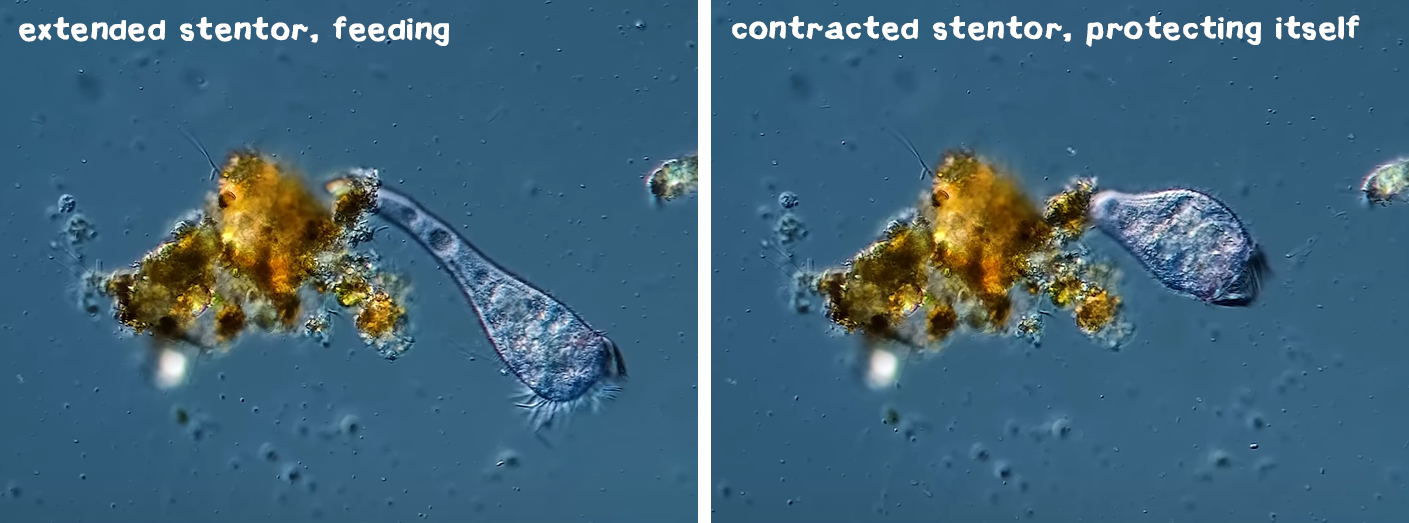
However, once contracted, the cell needs to re-extend in order to feed, therefore it needs to differentiate between potentially dangerous touches and non-threatening objects that might bump into it. When a Stentor cell is touched repeatedly with a constant level of force, for example if it is bumped again and again by an algal filament, it becomes less and less likely to contract until eventually the touch has no detectable effect on the organism’s behaviour. The cell stays extended despite the touch. It has learned that this particular touch is not dangerous. This is an example of habituation.
And here’s an example of sensitization in a related species, Stentor roeselii. When researchers placed particles of noxious chemicals (carmine or plastic beads) around the organism, they noticed it started to twist and bend in random directions with the apparent goal of steering the mouth away from the chemicals.
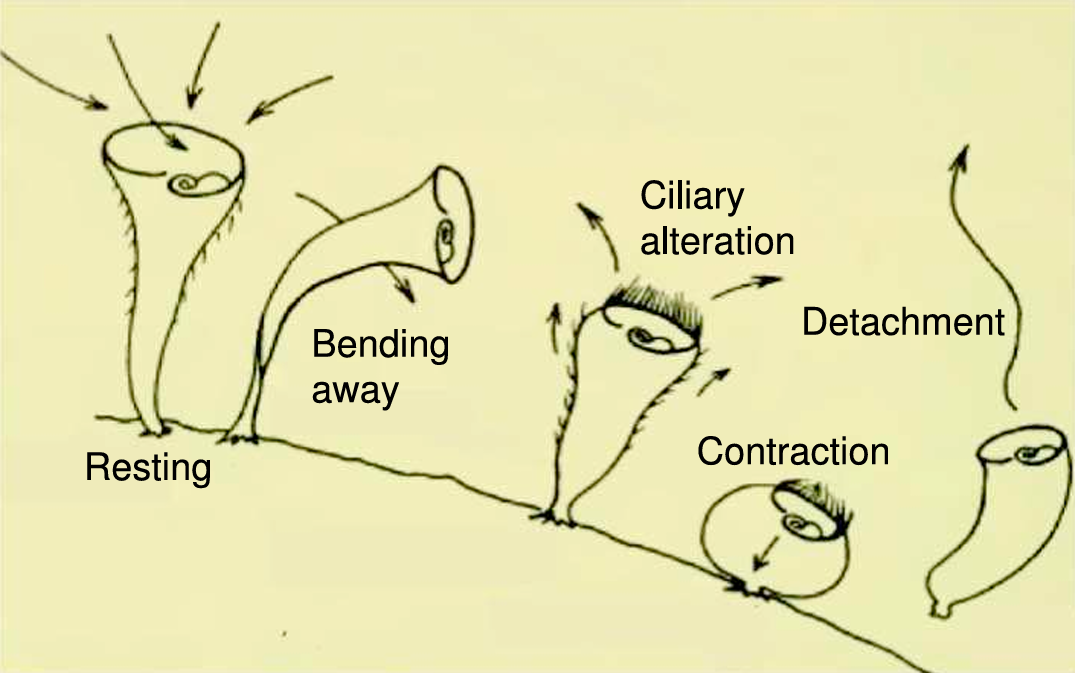
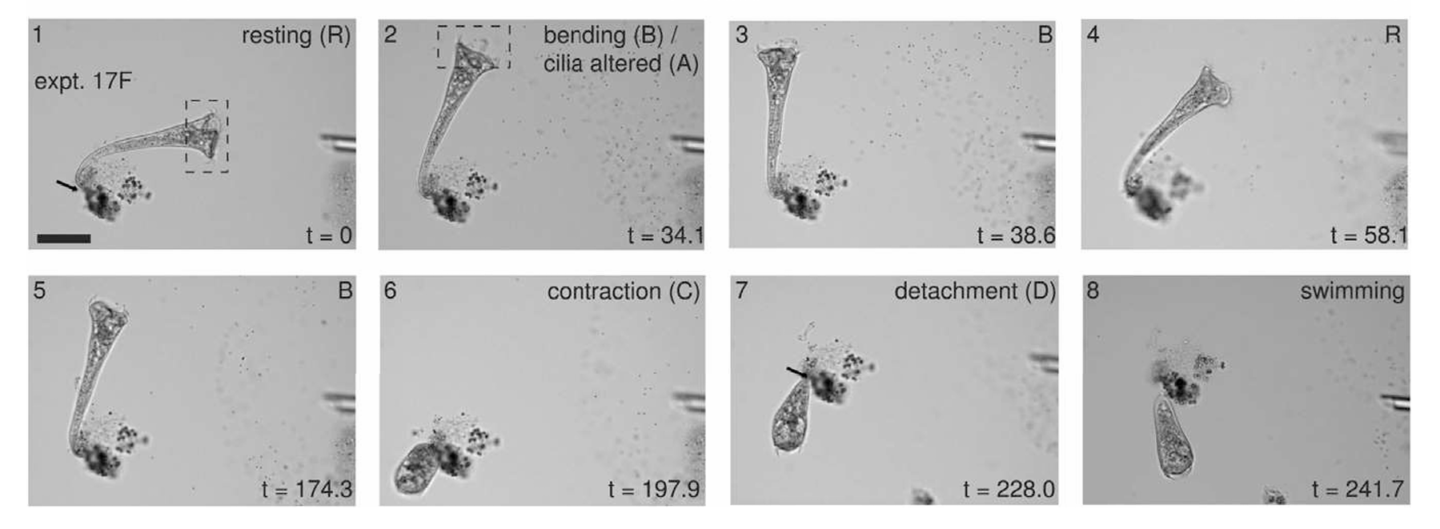
If that didn’t work, the organism then reversed the direction of their ciliary movement with the apparent goal of pushing away the chemicals. If that didn’t work either, the stentor contracted into a ball, just like if it was touched. What’s interesting is that if after the organism re-extended the researchers placed noxious chemicals around it again, it no longer tried to twist and bend but immediately contracted into a ball. This is an example of sensitization. The organism has learned to respond more robustly to a potentially harmful stimulus.
Like I said earlier, sensitization and habituation have been observed in essentially all eukaryotes that have been tested, from single cell organisms, to plants, to humans.
A more complex type of learning that isn’t observed in all eukaryotes is classical conditioning (aka Pavlovian conditioning). Classical conditioning is considered the simplest form of ‘true learning’ since unlike habituation and sensitization, which are modifications of existing responses, Pavlovian conditioning enables organisms to detect associations between different stimuli. The most famous examples of this type of learning are the experiments with Pavlov’s dogs. Food makes a dog salivate. If you ring a bell every time before presenting the dog with food, after a while the dog learns to associate the sound of the bell with feeding. And eventually, only the ringing of the bell can make the dog salivate.
Classical conditioning is also very common in nature and has been observed in microorganisms, plants, and almost all multicellular animals.
The simplest organism for which we have credible evidence of classical conditioning is the unicellular protist Paramecium. A 1972 study found that when Paramecium were exposed to a 500 Hz vibration immediately followed by an electric shock, after three or more training cycles, the cells would begin to trigger the same escape movement in response to the vibration alone. They seemed to learn that the vibration predicts the electric shock. Two more recent experiments done in 2006 have found that Paramecium can also learn to associate illumination level with an electric shock. If the cells were shocked in the light half of a tube they learned to spend less time in the light and if they were shocked in the dark half of the tube they learned to spend more time in the light.
Plants have also been shown to be capable of pavlovian learning. In an ingenious experiment, Gagliano and colleagues showed that plants can learn to associate wind with a source of light. This is a very important experiment for how we think about the cognitive abilities of plants so I’ll spend some time describing it in detail.
The researchers covered the pots of 45 garden peas seedlings with Y-shaped PVC pipes and split them into two groups. For the first group of seedlings a light bulb and a fan were placed together at one of the openings of the PVC pipe. For the second group, a light bulb was placed at one opening of the PVC pipe and a fan at the other. All plants were kept in the dark but three times a day the lightbulb was turned on for one hour at one of the pipe openings. The fan was turned on one hour before the light and was kept running half an hour as the light was on. Thus in the first group the fan predicted which end of the PVC pipe the light would be coming from and in the second group it predicted which end it would not be coming from. The researchers even changed the position of the light and the fan for each of the 3 daily sessions, so that the plants couldn’t just grow in one direction, which would make the experiment useless.
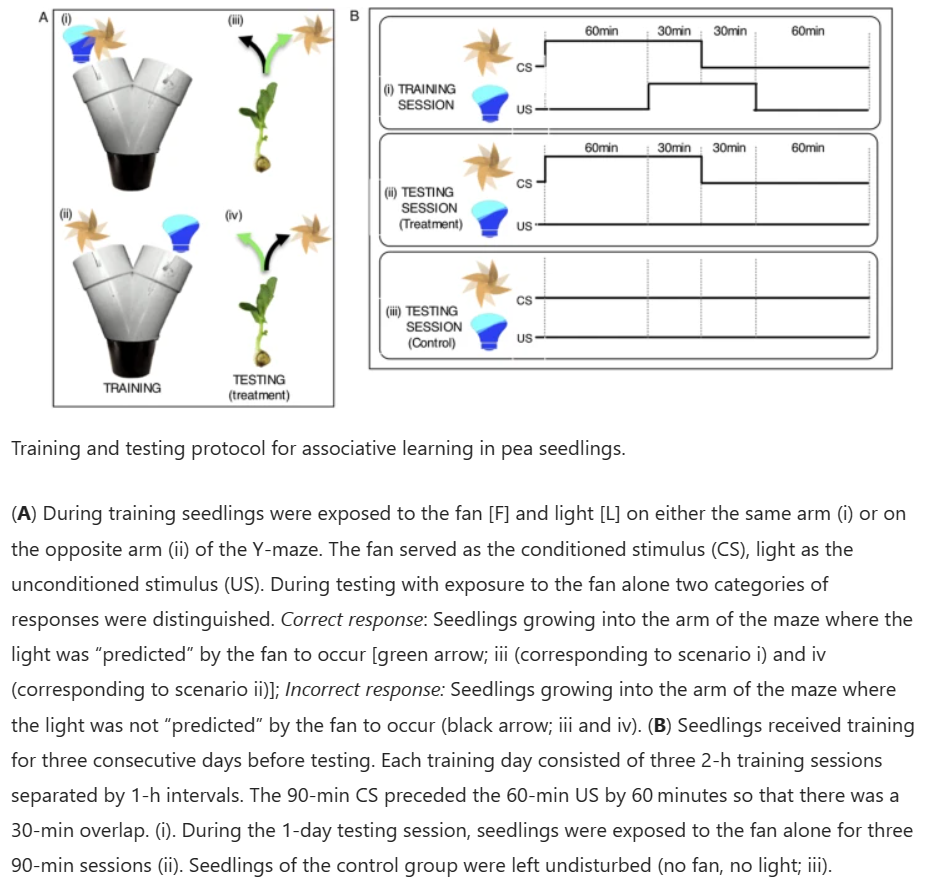
At the end of the first three days the plants grew right up to the fork in the pipe and had to “choose” which direction to grow in. That’s when they split the plants into three groups, (two experiment groups and one control) and conducted the final experiment. On the fourth day the light wasn’t turned on at all, only the fan was turned on. For the control group the fan wasn’t turned on either and the position of the fan was placed opposite to the opening from which the plants were exposed to light the very last time. What happened?
62% of the plants for which the light and fan were placed on the same opening grew towards the fan. 69% of the plants for which the light and fan were placed on opposite openings grew away from the fan. At first glance this may not seem significant. But 100% of the plants in the control group for which the fan wasn’t turned on at all grew towards the opening from which they were exposed to light the very last time. The control group wasn’t 50-50. All of the plants in the control group grew towards the last known source of light. That means in the experimental groups 60-70% of the plants overcame their “instinctual” response and grow towards or away from the fan, depending on their training. The authors state this is unequivocal evidence of associative learning in plants.
These experiments suggest that pavlovian learning, which entails predicting a stimulus based on another, is relatively easy to do and is very common in nature. Operant conditioning on the other hand is less common. It’s not found in most creatures. It’s only observed in organisms with more complex nervous systems. This type of learning is believed to require more sophisticated sensory evaluation because the organism learns by attending to the good or bad consequences of its actions. It emphasizes motivation whereas classical conditioning emphasizes sensory association. Changing behavior in response to a consequence is thought to indicate something more than mere reflexes and is consistent with the experience of pleasure and displeasure.
So what are some examples of operant conditioning in invertebrates? I’ll describe some of the best experiments I could find.
Olli Loukola and colleagues have shown that bumblebees can be taught that if a ball is carried into a yellow circle, the cup beneath the ball fills up with nectar and they get a drink. At first, the researchers show the bumblebee how the game works by pushing the ball into the circle with a stick colored like a bee. And they get it! The bumblebees immediately learn to carry the balls themselves and get the reward. Watch these videos.
Untrained bumblebees also learn to do this if they observe a trained bumblebee pushing the ball into the circle and getting the reward. They even choose the ball closest to the circle to minimize effort, even if the researchers used one of the more distant balls to teach them the game. (additional material here)
Another example comes from Wiggin and colleagues. They have shown that fruit flies can learn where to consistently find food based on their previous location. The researchers designed a Y shaped maze and placed a servomotor at each arm of the maze that had two filter paper slots, one for a sucrose-soaked filter paper (the reward) and one for a water-soaked filter paper. The servomotors could rotate and present the sugar or the water, depending on the fly behavior. The rule was that after a fly found a sugar reward at the end of one arm, it was allowed to consume it for 10 seconds and then it was replaced with water and the sugar reward would be presented on the arm left of the fly’s current location. And they found that the flies could learn this rule. With training, the flies turned to the left arm of the maze more often than they turned right or back.
Here’s another fun experiment: Abramson and Feinman have shown that crabs can be trained to press a lever to receive food – similar to rats. The crabs learned to hold a feeding tube in their mouths with one claw and pressed the lever with their other claw. They were also able to distinguish between an active lever and an inactive lever even when the researchers reversed their positions. Lily Strassberg has also shown that crabs can be taught to push against a hanging object in order to receive food.
This review by Perry, Barron, and Cheng shows that up until 2013 the only groups of invertebrates that could do operant conditioning were insects, crustaceans, cephalopods, and gastropods. Does this mean all the other groups can’t learn the consequences of their actions? Not necessarily. It’s possible these animals just haven’t been tested the right way. But it’s also possible that operant conditioning really is restricted to only the most complex animals. It has not been observed in organisms without nervous systems like single celled protists, plants or sponges and neither in organisms with small nervous systems like nematodes, jellyfish, tardigrades, or rotifers.
Complex stimulus evaluation
Some invertebrates seem to perceive and appreciate complex patterns and this is a behavior that indicates sensory evaluation.
For example male puffer fish construct large geometric circular structures on the seabed to attract females. And male jumping spiders perform a complex and colorful dance in front of a female to prove they are worthy of mating. Presumably the females are able to perceive and appreciate these patterns, indicating the existence of visual subjective experience and also evaluation. They can either like the show and mate with the male or dislike the show and refuse to mate.
Bees are also capable of evaluating complex stimuli. Wu and colleagues have shown that honeybees can discriminate between Monet and Picasso painting purely based on painting style!
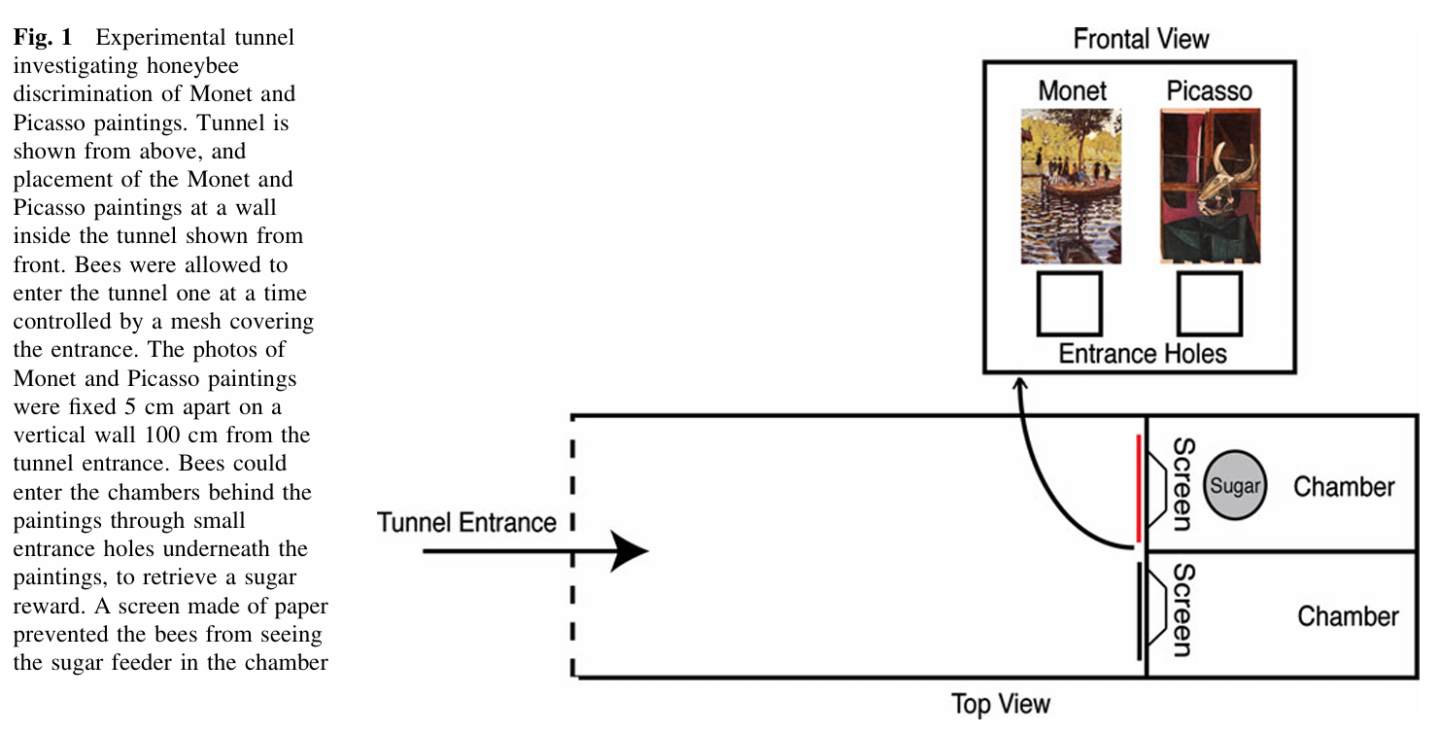
On a vertical wall at the end of the tunnel, bees were shown photographic prints of a Monet and a Picasso painting. Directly underneath each painting was a hole through which the bees could enter into chambers behind the paintings. One of the chambers contained a feeder with a sugar solution (this was the rewarded painting) and the other chamber was empty. A screen behind each entrance hole prevented bees from seeing the feeder before entering the chamber. As a result the only visual information that was available for the bees to base their choice on was the difference between the two paintings. Importantly, the researchers did their best to match the two paintings in terms of color, luminance, object orientation and distribution. The pictures below show the pairs of paintings used in the study.
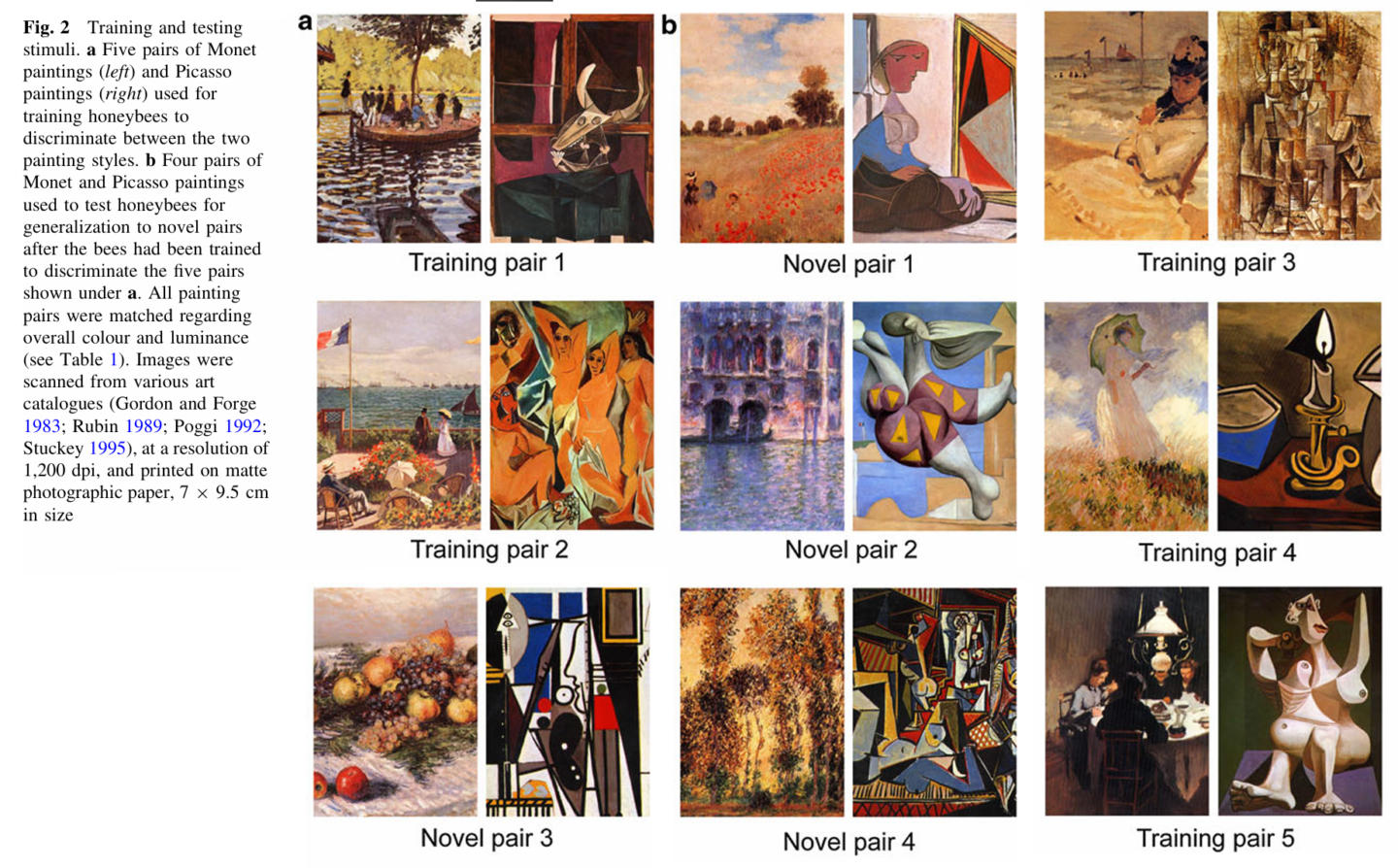
The bees did well! The ones that were given the sugar reward behind Monet paintings consistently preferred the Monet paintings and those that were given the sugar reward being Picasso paintings, preferred Picasso instead. The bees could also differentiate the paintings when they were presented in black and white. And what’s most impressive is this: after many rounds of training, when the bees got used to the two paintings they were presented with, the researchers replaced them with two new paintings by Monet and Picasso that the bees had never seen before. The researchers wanted to see if the bees would still choose Monet or Picasso, depending on their previous training. And they did, although statistically they made more mistakes. The bees seemed to discriminate the two paintings partly based on the style, rather than purely based on memory, color, or position. In fact, the bees that were trained with Picasso did just as well, possibly because the abstract style is more easy to recognize.
And the final example I want to tell you about involves cephalopods. In Other Minds, Peter Godfrey-Smith describes how octopuses that are held in aquariums can learn to recognize individual humans and shoot water at the people they dislike.
- In a lab in New Zealand, an octopus took a dislike to one member of the lab staff, for no obvious reason, and whenever that person passed by on the walkway behind the tank she received a jet of half a gallon of water in the back of her neck.
- Shelley Adamo, of Dalhousie University, had one cuttlefish who reliably squirted streams of water at all new visitors to the lab, and not at people who were often around.
- In 2010, an experiment confirmed that giant Pacific octopuses can indeed recognize individual humans, and can do this even when the humans are wearing identical uniforms.
This should be an example of sensory evaluation because the octopuses not only recognize different humans but they assign a positive or negative meaning to them. Thus, the octopus might be annoyed by some humans while the cuttlefish might dislike strangers.
Protective behaviors
Wounded humans and other vertebrates perform behaviors intended to protect their wounded body part and prevent further damage. Typical examples are rubbing of the hurting body part, guarding of wounds, and limping. These behaviors are interpreted as being consistent with the sensation of pain rather than simple nociceptive reflexes.
Some examples of similar behaviors have been reported for invertebrates.
For example, crabs that have one of their claws forcibly ripped off can be observed touching their wound and picking at the broken exoskeleton with their remaining claw and sometimes show a “shuddering response”, similar to how vertebrates shudder when they touch an open wound. Male crabs also hold the remaining claw over the wound during mating competition with other crabs in a manner akin to guarding. These manually declawed crabs also show lower motivation to compete for the female and seem to be more engaged in self-defence compared to healthy crabs.
Similar behaviors can be observed in other crustaceans. For instance, if a noxious substance is applied to one of the antennae of glass prawns, the animals start repeatedly pulling that specific antenna through their small claws or through the mouth parts and they also rub the antenna against the side of the tank.
Alupay and colleagues studied the behavior of octopuses in response to injury. The researchers crushed one of their eight arms by forceps and found that the animals held the wounded area in their beak for at least 10 minutes following the injury. In the next few hours, the octopuses removed their injured arm from their beak but held it close to the body and adjacent arms curled around. This was interpreted as guarding behavior.
I’ll also give you an example in fish, even though they are vertebrates and the presence of protective behaviors in this group are to be expected.
Lynne Sneddon took 25 rainbow trouts and split them into 5 groups. The first group was injected with acetic acid, a substance known to produce pain in humans and other mammals. The second group was injected with acetic acid plus a dose of morphine – a powerful painkiller. The third group was injected with a benign saline solution. The fourth was given just morphine. And the fifth group was the control – the fish were just handled similarly with the other groups but weren’t injected anything. All the fish were injected into the lips.
The researcher found that the fish injected with acetic acid took a lot longer to resume feeding compared to the other groups and had significantly higher breathing rate (measured by the beating of the lids that cover their gills). This group also performed behaviors not seen in the other fish. They were observed rubbing their lips against the gravel and the sides of the tank and also displayed a rocking behavior where the fish sat on the frontal fins on the gravel at the bottom of the tank and rocked from left to right.
Importantly, these behaviors were not observed in the control group and the group injected with saline and there was significantly less rubbing and rocking behavior in the fish injected with acetic acid but were also given morphine. The author interprets these behaviors as indicative of pain. Rocking can be interpreted as a soothing behavior and the act of rubbing an injured area to ameliorate the intensity of pain is common in humans and other mammals.
Now what about insects?
Insects are weird. An influential paper from 1984 by Eisemann and colleagues, argued that insects do not feel pain, as all known insects appear completely unconcerned about even severe body damage. Wound-tending has never been seen in an insect, and after injury these animals just continue, as best they can, with the behavior appropriate to the circumstances.
They authors say: “Our experience has been that insects will continue with normal activities even after severe injury or removal of body parts. An insect walking with a crushed tarsus, for example, will continue applying it to the substrate with undiminished force. Among our other observations are those on a locust which continued to feed whilst itself being eaten by a mantis; aphids continuing to feed whilst being eaten by coccinellids; a tsetse fly which flew in to feed although half dissected; caterpillars which continue to feed whilst tachinid larvae bore into them; many insects which go about their normal life whilst being eaten by large internal parasitoids; and male mantids which continue to mate as they are eaten by their partners.”
Based on these observations, it’s possible insects do not have pain-like states in response to tissue damage. Instead, they might have negative mood-like or emotion-like states, as I’ll explain later.
And what about all the other invertebrates? As far as I understand, many invertebrate phyla haven’t yet been thoroughly studied and it’s not even clear what would count as protective behaviors in their case. Looking for wound guarding behaviors in some of these creatures isn’t really helpful because their body plants might not even permit wound tending. How would a jellyfish, a worm, or a slug tend to a wound? They probably can’t. But perhaps in these creatures we can look for changes in motivational states rather than protective behaviors.
Changes in motivational states after experiencing an event
Squid haven’t been seen tending to their wounds like octopuses do, but squid behave differently if they’re wounded. Crook and colleagues tested the survival rate of injured and healthy squid from the species Doryteuthis pealeii when placed in a tank with one of their predators, the fish black sea bass. They noticed that injured squid seemed to be aware of their injury and maintained a longer distance from the predator compared to the healthy squid, presumably as a protective measure. But the researchers also tested the behavior of injured and healthy squid given a local anesthetic. They found that anesthetized injured squid no longer maintained their distance, while anesthetized healthy squid behaved normally. This made anesthetized injured squid much more vulnerable to predation. Healthy squid had 80% survival rate, injured squid without anesthesia had 61%, but the anesthetized injured group had only 19% survival rate. Interestingly, the anesthetized healthy group had 75% survival rate; thus anesthesia alone did not significantly affect protective behaviors and survival. This suggests that squid experience some form of pain or negative mood in response to injury and it’s important for them to feel that because it makes the squid adopt a more defensive behavior which increases survival. If they are given anesthesia and presumably no longer experience the injury, they aren’t as careful and fall prey more often.
In the previous section I said that insects appear to not have pain-like states in response to tissue damage but instead might have emotion-like or mood-like states. This is based on observations that long-term motivational states can be induced in insects following positive or negative events.
For example, Perry and colleagues found that a sort of optimism can be induced in bumblebees if they encounter an unexpected sugar reward. They first trained bumblebees to know that a sugar reward was found beneath a card colored blue and that only water is found beneath a card colored green. Then they tested how two groups of bumblebees responded to an ambiguous green-blueish color. One group was given a tiny sample of sugar before entering the test chamber and the other group wasn’t given anything. The result was that the group that was given a tiny sample of sugar before the test were more likely to interpret the ambiguous color as predicting sugar compared to the other group. The researchers think that this might be because a positive state was induced in those bumblebees. This inference is based on similar experiments in humans and other mammals that show subjects in a positive emotion state tend to respond to ambiguous stimuli as though predicting a positive event.
The researchers also tested this a different way. They first trained bumblebees to know that after a short wait in a corridor, a door opens and they can feed on a sugar solution in a larger chamber. Then they split the trained bumblebees into two groups. One group received a tiny bit of sugar in the corridor and the other didn’t. Immediately afterwards, the researchers simulated a predator attack on both groups to see how they would react. A soft sponge was lowered on top of the bumblebees in the corridor and immobilized them for a few seconds as if they were trapped in the net of a spider. Then the sponge was lifted, the door was opened and the bumblebees were allowed into the test chamber. The researchers found that the bumblebees that were given some sugar in the corridor went to feed much sooner than the other group. It seemed that a sort of positive state was induced in the rewarded bumblebees and because of that they found it easier to get over the simulated predator attack. This inference is based on similar experiments in human babies that show infants receiving sugar water before a medical procedure tend to cry for a shorter duration and less loudly.
The time taken to resume feeding is considered significant also because bees normally are affected by a negative event for a reasonably long period of time. Here’s Andrew Barron talking about this. He’s one of the world’s leading researchers of the bee nervous system.
“If a bee experiences a noxious stimulus, every aspect of the bee’s behavior is changed. It shows a change in affect, so it doesn’t just change that it avoids the pain, it also doesn’t want to forage for a while, it devalues sugar rewards; there’s a complete change in the entire responses of the subject in response to a noxious stimulus.”
As Andrew explains here, negative motivational states can also be observed in insects. For example, Bateson and colleagues and Schlüns and colleagues found evidence of pessimism-like states in honeybees. But I want to tell you about an experiment done on fruit flies instead.
Gibson and colleagues found evidence of prolonged defensive states in fruit flies and they think these states can be interpreted as simple forms of fear or anxiety. Here’s what they did. The researchers trapped fruit flies in a plastic container over which they could repeatedly wave a paddle in such a way that it cast a shadow over the flies. They found that with each wave of the paddle, the fruit flies became increasingly more disturbed and continued to run and hop around in a defensive manner for a considerable period of time even after the paddle was stopped (watch the video here). This can be interpreted as the gradual buildup and subsequent decline of an anxiety or fear-like state. The flies weren’t just robotically responding to the shadow and then getting right back to behaving like nothing happened. The stimulus had a longer-term effect on them which indicates a change in motivational state.
The researchers also showed this with a different experiment. They first allowed a group of fruit flies to habituate to the moving paddle and shadow. You can see them in this video feeding on a solution in the middle of the container and showing little to no reaction to the paddle and shadow. But then the researchers activate a vibrating device beneath the container and startle the flies. Watch what happens next. After the sudden vibration, the flies are visibly disturbed by the next set of paddle movements and shadows. They also take a long time to calm down and resume feeding. The researchers think that a possible explanation is that the sudden vibration induced a negative motivational state in the flies (perhaps something like fear or anxiety) and because of that they interpreted the paddle and shadow as more dangerous than before.
And I can’t resist sharing another study on fruit flies. Shohat-Ophir and colleagues found that fruit flies that have been rejected by mating partners consume more alcohol afterwards! One interpretation of this finding is that rejection induced a negative emotion-like state in the flies that promoted reward-seeking – in this case consuming alcohol.
The point is, even if bees and flies, and other insects, don’t show behaviors indicative of pain in response to tissue damage, they still show long term changes in motivational state following positive or negative events. And those states can be interpreted as emotions or moods. As far as I understand, studies like these have been conducted almost exclusively on bees and flies. Other insect species are still an open question. But if we accept that closely related groups of species are likely to have the same capabilities, most insect species should also have emotion or mood-like states.
If you want to learn more about the possibility of emotion-like states in invertebrates, I recommend reading this 2017 review by Clint Perry.
Value-based cost-benefit decisions
Another indicator of sensory evaluation is the ability to make cost-benefit decisions. This is when an animal gives up a valuable resource (like food, sex, or shelter) in order to escape from a noxious stimulus or when it endures a noxious stimulus in order to retain or gain access to a valuable resource.
Elwood and colleagues have found great examples of this behavior in hermit crabs. But for their experiments to make sense, you need to know three things about hermit crabs.
- Unlike other crustaceans, hermit crabs have a soft and fragile abdomen and have adapted to protect themselves from predators by occupying empty mollusk shells.
- Because they are so vulnerable to predation, hermit crabs almost never leave their shells. They only get out when mating or when they upgrade their shells.
- Shells are a highly valuable resource to hermit crabs; so much so that they often fight over high quality shells and sometimes even kill a competitor to gain access to a shell they favour. They strongly prefer the shells of some mollusk species over others because of the internal shape.
So with these things in mind, here’s what Appel and Elwood did. They captured around 70 hermit crabs, cracked them out of their shells, and split them into two groups. They gave the first group shells from a species the crabs are known to like (Littorina obtusata) while the second group received shells from a less preferred species (Gibbula cineraria). But the researchers hid electrodes in the shells to see how strong of an electric shock is required to make the crabs leave the shell. They found that the crabs inhabiting the higher quality shells had to be shocked with a significantly higher voltage than the other group in order to motivate them to exit the shell: 18 volts on average, compared to 15 volts. The researchers think that this shows hermit crabs are making value-based cost-benefit decisions. Their behavior is not just a reflex. The crabs seem to be evaluating the badness of the electric current against the goodness of the shell. There was also evidence of long-term changes in motivational states because both groups of crabs showed an increased likelihood of changing shells in the next 24 hours, presumably to avoid the shell in which the shock was experienced.
More recently, Magee and Elwood conducted an even more interesting experiment on hermit crabs. They took 100 crabs, cracked them out of their shells, and this time gave all of them high quality shells from the same species of mollusk. Like in the previous experiment, all shells had electrodes implanted into them. The researchers then shocked some of the crabs in normal sea water, some in seawater in which they added the smell of a predator (the smell of shore crabs that feed on hermit crabs), and some in seawater in which they added the smell of non-predatory mussels. The result was that the crabs shocked while exposed to the smell of the predator were less likely to leave their shells compared to the other groups and had to be shocked at higher voltages to be motivated to leave. This suggests that the crabs were trading-off risk of predation with shock avoidance. They were enduring a noxious stimulus in order to retain a valuable resource (protection). The researchers think that this behavior is consistent with the experience of pain-like states or perhaps emotion or mood-like states.
Similar experiments were done with honeybees and ants. These social insects were shown to shift their preference from a high quality food to a lower quality option if a predator or some other danger is present around the higher quality food. Honeybees and ants thus evaluate food quality and predation risk, and seem to balance two conflicting motivations: the need to collect resources for the colony, and the need to avoid injury or death. These experiments suggest the presence of fear-like states in social insects.
Self-administration of analgesics
If a hurt animal is observed self-administering painkillers, that’s considered pretty strong evidence that the animal is experiencing some unpleasant sensation that it wants to alleviate. A few experiments have shown that injured animals will prefer food dosed with analgesics over normal food or that they will pay a price in order to access analgesics.
For example, Danbury and colleagues found that lame broiler chickens consumed significantly more drugged feed compared with healthy chickens, and as the severity of the lameness increased, they consumed a higher proportion of the drugged feed.
The researchers formed several groups of healthy and lame chickens and fed them either normal feed or drugged feed on alternate days for 6 days. The drugged feed was colored differently so the chickens were able to differentiate between them. After this training period, the chickens were provided with normal feed and drugged feed simultaneously for the following 4 days. The result was that the lame birds consumed one-and-a-half times more analgesic-treated food than untreated food. In contrast, the healthy chickens tended to avoid the drugged feed to a greater extent the more analgesic it contained. They preferred the lowest dose available. These results suggest that lame chickens experienced pain or discomfort due to their condition and learned to prefer the drugged food for its analgesic properties.
Sneddon and colleagues conducted a similar experiment in zebrafish. They gave a group of zebrafish access to two chambers: one chamber enriched with gravel, plants, and a live shoal behind a transparent barrier and one barren, brightly lit chamber. Fish consistently selected the enriched chamber to spend most time, indicating they preferred that environment. The researchers then took out the fish and split them into two groups. One group was injected with acetic acid (which is known to produce pain in humans and other mammals) and the other group was injected with a neutral saline solution. Half the fish in each group were then placed back into the tank and given access to the two chambers. Once again, all fish preferred to stay in the enriched chamber. But for the other half of each group, the researchers did something different. They dissolved an analgesic into the barren chamber before placing the fish into the tank. The fish injected with saline still preferred the enriched chamber. But the fish injected with acetic acid now spent more time in the barren, brightly lit chamber than the enriched one. Only the fish injected with acetic acid shifted their preference like this. The researchers think that this demonstrates that fish sought analgesia and were willing to pay the cost of being in a brightly, lit barren area where their pain was reduced. This is compelling evidence for negative pain-like states in fish.

Based on a 2019 review by Elwood, these types of experiments have not yet been tried on invertebrates; except for a single study on honeybees. Groening and colleagues did not find clear evidence for self-administration of analgesics in honeybees, despite having a limb partly amputated. The researchers provided healthy and amputated honeybees with two feeders: one filled with pure sucrose and the other one with sucrose + morphine. Based on the results of experiments done on vertebrates, the amputated honeybees were expected to consume more of the morphine solution compared with the healthy bees. But that wasn’t the case. Both groups consumed the morphine and pure sucrose solution in similar proportions. However, the injured honeybees consumed a significantly higher quantity from both solutions. That might be an important finding. But even so, the researchers concluded that their data does not support the hypothesis that bees experience their injury as painful and seek relief from it by self-administering analgesics.
Like I pointed out earlier, it’s possible that insects do not experience pain-like states in response to tissue damage but there is evidence they experience negative or positive mood-like states.
Which creatures are conscious?
Let’s quickly recap what we covered so far.
In previous sections I’ve explained that morality depends upon the existence of consciousness. Our intuitions about the moral status of different organisms are heavily influenced by whether we think they can experience pleasure and displeasure; and in particular pain and emotional suffering. So we’ve got to figure out which organisms on this planet are sentient in order to treat them better and minimize their suffering. The problem however is that scientists and philosophers don’t yet agree on what subjective experience is. Some think it’s a sort of soul-like essence that’s separate from the physical body. Others think it’s a fundamental property of physical matter, like charge or spin. And others think subjective experience is the true nature of physical matter – it’s what energy actually is, and everything in the Universe is conscious. Any one of these options might turn out to be correct but I’ve explained that based on the available evidence they’re very likely to be wrong, just like vitalism and hylozoism were wrong in explaining what life is.
Instead, I’ve explained that subjective experience is perhaps best understood as a collection of different systems working together. That means consciousness is most likely made of parts. If you think about it, it has to be made of parts because otherwise it couldn’t have appeared through natural selection. A biological feature without a primitive form defies evolution. It’s not yet clear what components constitute subjective experience, but Simona Ginsburg, Eva Jablonka, Todd Feinberg and Jon Mallatt have provided two lists of features that naturalistic philosophers and neurobiologists currently believe are individually necessary and jointly sufficient for subjective experience. I’ve provided such a list too, based on their work.
—— Radu’s list of the components of consciousness ——
* Phenomenal consciousness and qualia
* Widespread communication between cognitive systems
* Sensory mapping of world and body
* Sensory integration (point of view)
* Sensory persistence (memory)
* Reinforcement system (feeling sensations as good or bad)
* Plasticity in responding to what is sensed (agency)
* Sensorimotor loops involving the body and the world (sense of self)
Many of these features are found in all living organisms, but a few of them aren’t. So perhaps the way we can differentiate non-sentient from sentient organisms is by studying which ones seem to lack one or more of these features. I’ve suggested that three indispensable features of subjective experience that aren’t found in all living creatures are: subjectivity, the ability to form neural representations, and sensory evaluation. And in the previous section I’ve explained why that seems to be the case.
So now we can finally look at how the distribution of subjective experience might look like in the natural world. Based on everything I’ve read, I think it would look something like this:
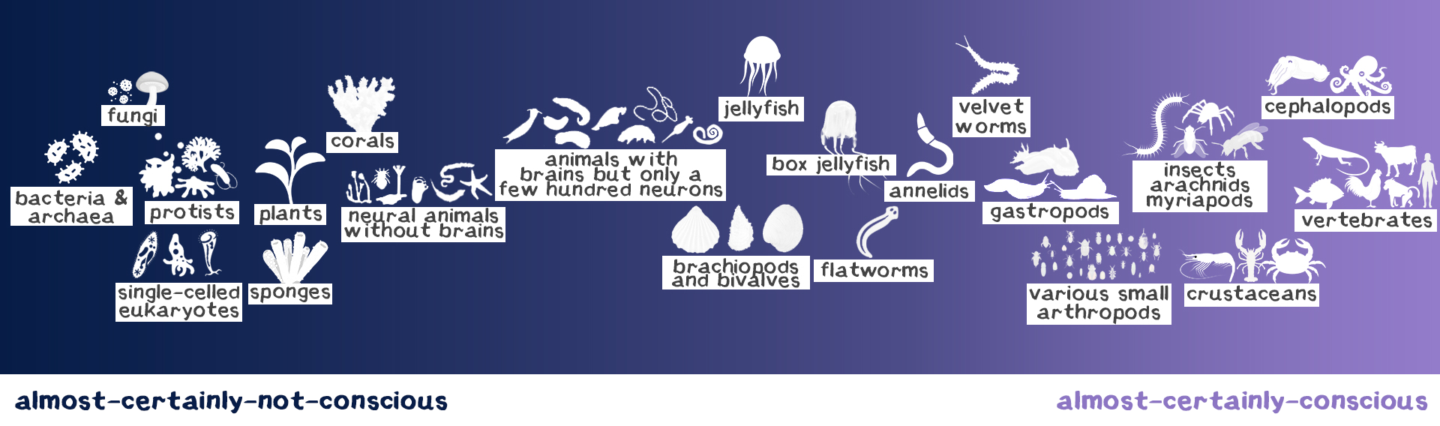
Legend:
- Animals without nervous systems: Porifera (sponges) and Placozoa (not shown).
- Corals are the simplest organisms with a nervous system; that’s why I placed them in a separate category, a bit more to the right compared to sponges but not quite at the same level with the neural animals without brains.
- Neural animals without brains (or cerebral ganglia): Entoprocta, Loricifera, Ectoprocta/Bryozoa, Urochordata, Kinorhyncha, Hemichordata, Echinodermata.
- Animals with brains but only a few hundred neurons: Gastrotricha, Xenacoelomorpha, Micrognathozoa, Gnathostomulida, Cycliophora, Tardigrada, Nemotomorpha, Rotifera, Nematoda.
The first thing I want to point out is that it’s probably best to think of organisms as existing on a spectrum of subjective experience, rather than in strict non-sentient and sentient categories. Our intuition that an animal is either sentient or not sentient, just as an animal is either alive or not alive. It seems that there is a sharp threshold between the two categories. But this intuition is misleading. Categories with strict borders don’t exist in evolution; we make them up based on what we agree are appropriate criteria. In evolution, it is possible for things to be halfway to life and for animals to be halfway to subjective experience!
If this sounds weird, consider the case of viruses. Are they alive or not-alive? One definition of minimal life is any chemical system that has the following characteristics:
- closure from the external environment via a membrane or shell
- metabolism
- stability
- information-carrying molecules (RNA or DNA)
- self-production
- growth
- replication
- subject to natural selection
- hereditary system enabling open-ended evolution.
Based on this definition, a bacterium is clearly a living organism – it has all these features. But viruses are a weird case. They have some of the characteristics of life but lack others. Viruses have closure from the external environment via a rigid shell, stability, information-carrying molecules (RNA or DNA), and they are subject to natural selection but they lack metabolism, self-production, growth, and a hereditary system enabling open-ended evolution. So are they alive or not alive? Well, neither. Viruses exist in the gray area between our definitions of life and non-life. They are almost life. Whether you want to categorize viruses as living or non-living depends on what criteria you think the definition of life should include.
If we imagine how life might have evolved, the existence of a gray area makes sense. Different chemical systems have only one or a few of the characteristics of life (a membrane, metabolism, DNA molecules, and so on). These are only halfway there on the journey. Then through combination or perhaps gradual accumulation, a system gains all the characteristics and we find it appropriate to say that chemical system is now alive. But the transition from non-life to life is gradual. It’s not like a lightbulb turning on, but rather like a very sensitive dimmer.
It’s likely the same with subjective experience. Considering subjective experience is a product of evolution, the transition from non-sentient to sentient organisms was almost certainly gradual and imperceptible. It’s impossible to find a sharp threshold and say this is the exact point where subjective experience begins. That’s because there are organisms that have some of the features of subjective experience but lack others. Such organisms are in the gray area. They are halfway to subjective experience. They could be categorized either way depending on what criteria you think the definition of subjective experience should include.
Perhaps the best biological example of this is the development of a human baby. A sperm and an egg cell are almost certainly not sentient. A few-month-old baby is sentient. At which point does the transition occur? It’s impossible to pinpoint exactly. All we can say is that for the first few weeks or months the embryo is almost certainly not sentient and for the final few weeks or months, when the baby is close to being fully developed, it almost certainly is. But the middle of the pregnancy is a gray area. During that stage of development the baby displays some brain structures and behaviors that indicate subjective experience but lacks others. Because of this, some researchers have suggested that the experiences of babies in that stage of development could be described as pre-consciousness. The babies are halfway to subjective experience.
So based on the books and studies I’ve read this is how I see the spectrum of subjective experience.
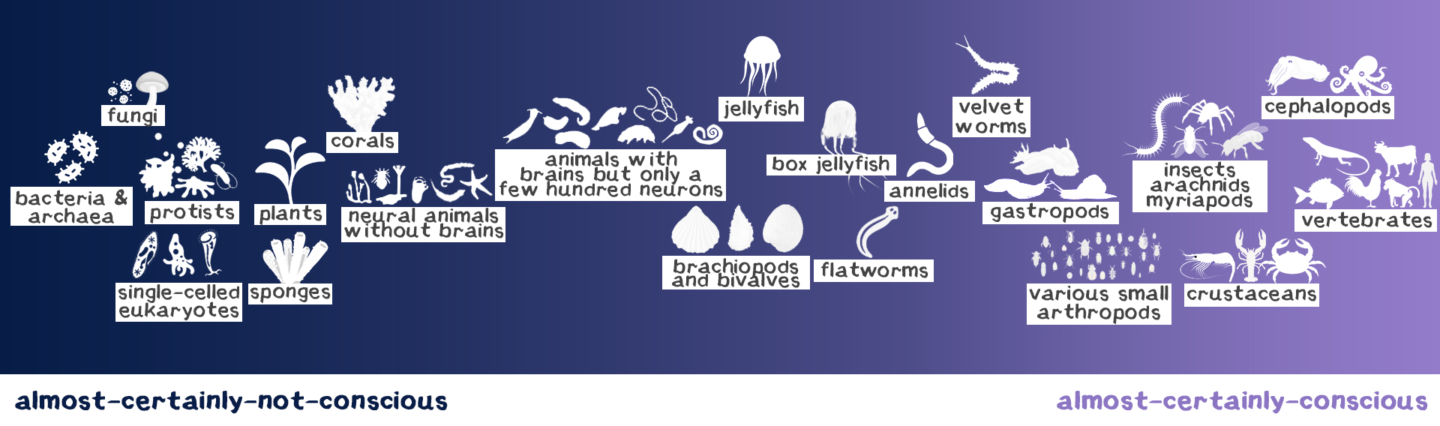
On the almost-certainly-sentient end we have all vertebrates (mammals, birds, reptiles, fish, amphibians), most arthropods (insects, arachnids, myriapods, crustaceans) and the cephalopod mollusks (octopuses, squid, cuttlefish, nautilus). On the almost-certainly-not-sentient end we have all prokaryotes (archaea, bacteria), all fungi, all protists, all plants, animals without nervous systems, and neural animals without brains. And in the gray zone, animals with brains but only a few hundred neurons, jellyfish, flatworms, brachiopods and bivalves, annelids (which include earthworms and leeches for example), velvet worms, gastropods, and various small marine and terrestrial arthropods.
I should point out that the reason some invertebrate phyla are placed in the gray zone is because they are poorly studied and have not been tested for subjective experience. Simona Ginsburg and Eva Jablonka make this point on the Big Biology Podcast.
We spent a year looking at the literature about learning in all kinds of animals (as a marker for consciousness). It was unbelievable how little we know about many, many phyla; just don’t know anything. We kept writing emails to various scientists who work on these totally unknown creatures. They were so happy that someone was interested in them, we got very long answers, and they usually said: no, no one has tried to check whether these animals can learn in any associative way.
So this spectrum will almost certainly turn out to be incorrect with future research. But in the meantime let me try to explain why I’ve ordered the organisms this way.
Almost-certainly sentient animals
Vertebrates, cephalopods, and most arthropods are in the almost-certainly sentient end of the spectrum because they fulfill all the features that neurobiologists and philosophers currently believe are individually necessary and jointly sufficient for subjective experience.
We can also attribute subjective experience to them based on comparisons with us. They are the most active animals on the planet and their complex navigation capabilities almost certainly require having a sense of self (that is distinguishing their own body from the external environment in real time and perceiving the world from a single first-person perspective for the entire organism). They have the most complex sets of sensory organs in the animal kingdom and the largest nervous systems. Their sensory pathways are made up of multiple layers of neurons, just like in us, which suggest they likely can form neural representations we call visual images, sounds, smells, tastes, and so on. Also, researchers have conducted various experiments on these animals and have found that they behave similar to how we would behave in those circumstances – and those behaviors cannot be explained by mere reflexes.
These animals show complex stimulus evaluation, long term changes in motivational states similar to emotions or moods, and protective behaviors and self-administration of analgesics which indicate pain-like states caused by tissue damage. This is a very strong case for sentience.
Almost-certainly-not sentient organisms
Making strong case for the lack of conscious experience in some organisms is not easy.
The challenge is that we don’t know what level of biological complexity counts as the minimal form of subjective experience. After all, even bacteria and single-celled protists sense their environment and do different things depending on the stimulus. For example, I told you about the behavior of the single celled organism Stentor roeseli that avoids noxious chemicals through an elaborate hierarchy of behaviors that start with moving the mouth away from the chemicals, reversing the beating of their cilia to push the noxious chemicals away, contracting into a ball, and eventually detaching and swimming to another area. These behaviors are induced by voltage-dependent and mechanosensitive ion channels similar to those in neurons. Can we be sure that those electrical signals don’t feel like something to these creatures? We cannot. All we can do is infer they don’t because similar action potentials aren’t felt in us, such as the electrical signals that control our muscle contractions. The contraction of your muscles is triggered by ions flowing in and out of the membrane of your muscle fibers, but that electrical signal is not felt as a subjective experience.
Or consider the case of plants. Recent studies have shown that individual leaves can detect other leaves from the same plant or different plants and arrange themselves in such a way as to minimize shading. The way they do that is by detecting the light spectrum that reflects from green surfaces – green absorbs red and reflects much of the other light frequencies. So plants are able to assess light quality through photoreceptors. Other studies have found that leaves can distinguish the vibration pattern produced by caterpillars feeding on them from other vibrations such as wind or grasshoppers singing. In response to the caterpillar vibration pattern, that leaf and other nearby leaves increase production of noxious chemicals that repel caterpillars or hinder their growth rate. This also occurs when researchers played that vibration pattern on speakers.
Some species have evolved even more ingenious defense mechanisms. When corn plants detect the oral secretions of caterpillars feeding on them, they emit volatile compounds that attract parasitic wasps which kill the caterpillars and lay their eggs in them. Other species don’t summon wasps but instead emit chemicals that are detected by nearby plants which respond by producing noxious chemicals in anticipation of insect damage.
Once again, these plant responses are triggered by fluxes of ions similar to those found in neurons: The mechanosensors cause fluxes of Ca2+, ROS, and H−, which trigger downstream responses that involve many plant hormones, and rapid expression of genes that respond early to many plant stresses. New findings suggest that VOCs may directly interact with cell membranes, which, through changes in cell membrane potentials, could induce endogenous signal transduction cascades or enter the cell and bind directly to nuclear proteins that act as co-repressors of stress-responsive genes.
Could the flow of ions that are involved in detecting specific light frequencies, vibration patterns, or chemicals feel like something for the plants? Maybe. We just think they don’t because such processes are not felt in our case.
Think about it. If we accept that single celled protists or plants are sentient, then we also need to accept that many individual cells of our body are also sentient. Take the case of white blood cells for example. They can sense bacteria in your blood, track them down and kill them. Are they subjectively experiencing the chemical traces of bacteria? It doesn’t seem that way. Or take the case of our gut. We’ve got a complex network of half a billion neurons in our gut that sense different chemicals in food, control the secretion of digestive enzymes, and contract muscles to push food along the intestines. Does that “second brain” subjectively experience the chemicals in food and the contraction of the muscles? It doesn’t seem that way. It appears that only the entire human organism is subjectively experiencing, while its individual cells and many internal processes sense stimuli and respond without subjective experience.
But even if it actually feels like something for bacteria or white blood cells to sense and move towards chemicals, I’m personally on the side of the group of biologists and neuroscientists who think that still wouldn’t qualify as subjective experience. As Simona Ginsburg and Eva Jablonka put it, one reason for denying many living entities sentience and consciousness is that for the distinctions between the conscious, unconscious, and nonconscious states to make sense, consciousness cannot be defined too broadly. They say one characteristic of sentience is that it’s losable. A sentient animal can lose consciousness under anesthesia for example. But the distinction between conscious and unconscious states makes no sense with bacteria and plants. What would it mean for a bacterium or plant to lose consciousness?
Peter Godfrey-Smith puts it another way. In his view, it’s a mistake to imagine the most basic form of feeling as being similar to the first-person perspective, rich and structured reality model we call subjective experience. He uses the term “washes of feeling” to describe what it might feel like for simple creatures to experience the world. It’s not even a sensation – it’s some other precursor form.
Ultimately, the only place we can observe subjective experience is within ourselves. And in the human case, I’ve argued that three features seem to be indispensable for subjective experience and I’ve covered them in depth in the previous videos: subjectivity, neural representations, and sensory evaluation.
Bacteria, stentors, and plants seem to lack all three of these features. They don’t have a central nervous system that ties the organism together in a way that seems to be required for subjectivity. They don’t have sensory integration which seems to be required for creating a single point of view and merging all sensations into a single experience. They don’t have reafferent sensorimotor loops involving the body and the world which seem to be required for the continued distinction between self and the world. They don’t have complex chains of neurons in sensory pathways that seem to be required for creating the content of subjective experiences (such as images, sounds, smells, and so on). And they don’t show behaviors that indicate complex sensory evaluation. These are the reasons why I’ve placed these organisms in the almost certainly not-sentient end of the spectrum.
But you might still have an objection. You might ask: what if these creatures are subjectively experiencing in a way that is totally different from us? Why should we think these features are always required for an organism to feel anything? Maybe there are different biological paths to subjective experience.
This is a very good point and could very well be true. But the case of the octopus is very informative in this instance. The last common ancestor we share with the octopus lived half a billion years ago. It was probably a simple worm-like creature, similar to those that lived during the Ediacaran, that almost certainly wouldn’t qualify as sentient. In fact, that same common ancestor has evolved into most of the animal phyla in the almost-certainly-not sentient end of my spectrum. And yet despite their independent evolutionary path, the cephalopods have constructed subjective experience in a way similar to vertebrates. It’s remarkable how relatable their behavior is to our own. Here’s how Peter Godfrey-Smith puts it in Other Minds:
Cephalopods are an island of mental complexity in the sea of invertebrate animals. Because our most recent common ancestor was so simple and lies so far back, cephalopods are an independent experiment in the evolution of large brains and complex behavior. If we can make contact with cephalopods as sentient beings, it is not because of a shared history, not because of kinship, but because evolution built minds twice over. This is probably the closest we will come to meeting an intelligent alien.
Peter Godfrey-Smith, Other Minds
So if an independent experiment in the evolution of minds has ended up using some of the same building blocks as we did, it makes us think we can use these features as criteria for the presence of subjective experience in other organisms very different from us. If other creatures stood out in the same way that cephalopods do, we would probably recognize them. Again, we can’t rule out that stentors or plants might feel something. It’s possible these organisms experience “washes of feeling” in response to stimuli. But I don’t think those experiences, if they exist, are similar to what we understand as subjective experience.
Animals in the gray zone
How is it possible for an animal to be only halfway to subjective experience? Intuitively that doesn’t make any sense. The lights are either on or off. No transition. But like I said, this intuition is probably wrong. The reason these animals are in the gray zone is because just like viruses in the case of life, they have some of the features of subjective experience but lack others. So what might it feel like to be one of these creatures? Let’s consider a few examples, starting with C. Elegans.
This tiny worm has only around 1000 cells and 300 neurons. But it has a nervous system that ties the whole organism together, a tiny brain, it can integrate multiple streams of information from its senses in order to make decisions, and it can distinguish its own body from the external world. In my opinion, C. Elegans qualifies as a subject, or at least as a proto-subject.
The partial sensory integration we see in them may be considered a precursor to the whole-body integration we see in more complex animals. But the behavior of C. Elegans seems to be entirely explained by reflexes. Because they are so small, researchers are generally able to track the exact neurons that trigger a specific behavior and what they find are simple reflex arcs where the sensory neurons act on the motor neurons through a chain that includes just one or two interneurons. In humans, the activity of these types of reflex arcs isn’t felt as a subjective experience. It takes complex chains of neurons for our sensory pathways to construct images, sounds, touches and other sensations. So it would seem that C. Elegans are not able to model the space around them with their senses. As Barron and Klein point out, there is no evidence that nematodes can actively hunt for things beyond their immediate sensory environment. Hungry nematodes respond to starvation with increased locomotion and dispersal in a random, rather than directed, search. They lack the egocentric modeling of the environment that is required for subjective experience. Further, it is because they lack the capacity to make such models that they are unable to do a variety of tasks that vertebrates and insects handle with ease.
C. Elegans also do not show signs of complex sensory evaluation. They have not been shown to learn operantly, they don’t show long term changes in motivational states after experiencing an event, and they don’t make value-based cost-benefit decisions. So in my mind, nematodes are definitely closer to subjective experience compared to stentors or plants but they’re not quite there either. It probably doesn’t feel like anything to be a C. Elegans. I imagine them as subjects or proto-subjects without experiences.
Another example to consider is the box jellyfish. This is a very interesting halfway case. Box jellyfish are the most sophisticated class of jellyfish and they are the only ones to possess image-forming eyes, complete with retinas, corneas and lenses – eyes very similar to our own. The only species of box jellyfish which was well studied at the time of writing this text (late 2020), was Tripedalia cystophora. This species lives in and around mangrove swamps where swimming is obstructed by the roots of aquatic trees. Anders Garm and colleagues were able to determine that these jellyfish are able to navigate and feed in this complex environment due to their advanced vision. For example, they know not to swim away from the swamp because they can distinguish the contrast line between the bright open sky and the darker canopy of the trees above the water. They can distinguish light from shadow in the water column between the roots and stay in the light water shafts in order to hunt crustaceans attracted to sunlight. And they can detect tree roots while swimming and successfully avoid colliding with them which would easily damage their thin membrane. Immediately we’re tempted to say: of course these creatures are subjectively experiencing! They clearly have the capacity to construct basic visual images! What more do you want?
But it’s more complicated than that.
Researchers don’t agree on whether box jellyfish qualify as subjects because they don’t have a brain. Rather, they have four small clusters of neurons distributed around their bell – inside structures called rhopalia. At its most complex their nervous system can be considered a series of local ganglia, each controlling its own part of the animal and making use of the common body wall for coordination. In their view, such a system is not enough to construct a unified agent or subjectivity. Andrew Barron: “If we take another system that I don’t think is able to support either unity or subjectivity, like a box jellyfish – you can give that an ouch. You can hit a part of its body wall and it will…that part of the body wall then changes how it fires that causes the whole organism to move away from the ouch. But if you silence just that part of the body wall that you give the ouch to, it will go straight back to where it was going before. There is no unified subject that has experienced the ouch, it is localized to one part of the body wall, one part of the rhopalium.
But other researchers disagree. They think the ring nerve that connects the four rhopalia allows enough communication between them to make the whole organism a unified agent. Avoiding tree roots underwater or navigating based on the tree canopy require interactions between muscle tissues and sensory organs and that suggests integration of multiple streams of information. Also, like all mobile animals, box jellyfish must have a reafference system that enables them to distinguish between sensations generated through their own movements and sensations generated from events in the world. These things may be enough to create something like a self-model. So box jellyfish may qualify as subjects after all.
Ginsburg and Jablonka have analyzed box jellyfish in a section of their book and point out that these animals have many of the building blocks of subjective experience, but what keeps them from fully qualifying as sentient is that they seem to lack intentionality and attribution of values; emotions, goals – this is what I’ve been calling sensory evaluation. Box jellyfish seem to be motivationally rigid. Researchers have been unable to teach them anything in pavlovian or operant ways. You can’t teach a box jellyfish that a visual pattern is associated with food or that if it goes to a certain light shaft it will receive an electric shock (2023 research: actually maybe you can!). It only knows what it knows and it only values what it values. This suggests they don’t experience negative or positive states which can become associated with a certain stimuli or behavior. Rather, their sensory evaluation is fixed. What might that feel like?
I imagine something like having a vague sense of self and seeing very low resolution, out-of-focus, black and white shapes; but not understanding or assigning meaning to what is perceived. Ginsburg and Jablonka use the metaphor “white noise” to describe this – a kind of overall sensory buzz that gives the animal the feeling of existence. Now, depending on your intuition, you might already consider this minimal sentience. I personally do. But on the other hand, if those visual images aren’t evaluated by the box jellyfish beyond rigid reflexes, can they count as subjective experiences? If the animal doesn’t feel a positive or negative state towards the things it approaches or avoids, perhaps those sensory sensations aren’t experienced. Some degree of awareness, intentionality, and motivation seem to be indispensable to the way we understand subjective experience.
This is why box jellyfish are in the gray zone. They have some of the features of subjective experience and lack others. But because of their abilities to model the space around them by forming visual images and their more sophisticated interactions with the world, I placed box jellyfish further along the spectrum compared to C. Elegans.
And as for animals on the cusp of sentience, Ginsburg and Jablonka single out some species of annelids, velvet worms, and gastropods. Annelids include an enormous number of very diverse species but the ones most common to us are earthworms and leeches. Gastropods include land and aquatic snails and slugs. And velvet worms are rare tropical animals that are closely related to arthropods. Some species belonging to these groups have complex brains similar to those of arthropods and vertebrates, can integrate information coming from several sensory and motor neurons, can model a bit of the environment around them with their senses, and they appear to make simple value-based decisions. (The Evolution Of The Sensitive Soul – Table 7.2). However, these animals are still poorly studied. And considering they have much smaller nervous systems and even more rigid behaviors than arthropods, researchers don’t want to jump the gun and declare them sentient.
What I find encouraging is that ten years ago insects were denied subjective experience on the same grounds. Arthropods have much smaller nervous systems and much less flexible behaviors compared to vertebrates. Only thanks to recent ingenious experiments we’ve begun to recognize the remarkable abilities of insects and crustaceans. So perhaps with future research, some annelid and gastropod species and velvet worms, will too move from the gray area into the almost-certainly-sentient area.
I’ll now show you some of the evidence we have right now that suggests these animals could be conscious.
Sandhu and colleagues investigated cost-benefit decision-making in earthworms. Earthworms have a strong instinct to avoid light because it makes them visible to predators (such as birds) and because sunlight can kill them through dehydration. With this in mind, the researchers split earthworms into three groups: one group was fed every day, another wasn’t fed for 4 days, and another wasn’t fed for 7 days. Then the worms from each group were one by one placed between two patches of soil: a nutrient-rich compost which was exposed to a strong LED light and a nutrient-poor potting soil that was shaded by black opaque cloth. The researchers found that the 4 and 7 day starved worms were much more likely to risk feeding in the lit and nutritious soil patch compared to the well-fed worms. I think you can interpret this result in two ways.
On one hand you could say this is similar to the hermit crabs that had to be shocked at higher voltages to be motivated to leave their shell while exposed to the smell of a predator. These earthworms were making a value-based cost-benefit decision.
But on the other hand you could say this is more similar to the way C. Elegans make decisions. In a previous section I told you about an experiment where starved C. Elegans were more likely to push through a noxious barrier to follow the smell of food compared to fed worms. In that case the explanation was very simple. The worms were not making a value-based cost-benefit decision. Rather, food deprivation decreased the level of tyrosine in the worm, the substance that enabled the functioning of the neuronal pathway that made the worm back away from the noxious barrier. Starvation essentially desensitized the reflex to back away. No subjective experience was needed for that decision, at least as far as we can tell.
We don’t know which of these two explanations fits the earthworm experiment better. Maybe neither. The earthworm decision making process may fit well in the gray area between the two: more sophisticated than C. Elegans but not quite at the level of hermit crabs.
You reach a similar dilemma when you try to interpret the results of Dill and Fraser. They studied decision making in Serpula vermicularis. These marine annelids live in calcareous tubes of their own construction fixed to rocks on the ocean floor and feed by filtering small particles from water using a sort of fan. When the worm is feeding, the fan is vulnerable to predators such as fish. So in response to shadows, to touch, or to water movement, the worm retracts quickly into its tube. But while in the tube, it cannot feed or breath. So the worm has to somehow balance the benefit of safety with the risk of re-emerging while a predator is still around and the cost of missing out on food.
In one of their experiments, the researchers placed Serpula vermicularis in two tanks. The animals in one tank were fed 1 ml of food per day and the animals in the other tank were fed 10 ml of food per day. This feeding protocol was kept for 5 days. During this time, while the worms were feeding, the researchers periodically produced a strong vibration in the tank. All the worms quickly withdrew into their tubes and the researchers measured how long it took for them to come back out. They found that the animals who were fed little took on average around 130 seconds to come back out while the animals who were fed more re-emerged after just 60 seconds. This finding shows that Serpula vermicularis can adjust its hiding time in response to changes in food availability and re-emerges sooner when food is abundant and there is a higher lost-opportunity cost of remaining in the tube than when food is scarce.
But there’s more. For the following 5 days, the feeding protocol was reversed. The animals in the first tank were switched to 10 ml of food per day and the animals in the second tank were switched to 1 ml of food per day. Now, following a vibration, the time taken to re-emerge from the tube reversed as well. The animals in the first tank re-emerged after just 70 seconds while the other group re-emerged after 120 seconds. This finding suggests the these worms are able to track and remember the concentration of food in the water at the time of hiding.
How can we interpret these results? On one hand we can say this is similar to the cost-benefit decisions of honeybees. Tan and colleagues tested how Asian honey bees balance the cost of predation with the value of nectar. They arranged three feeders with the same 30% sugar solution and hanged bee-killing hornets by a string above two of the feeders. They found that the bees were avoiding the feeders with the predators, especially the one with the larger hornet species V. tropica. But in a subsequent experiment, the researchers balanced the risk with the reward. The feeder with no hornet had low quality 15% sugar solution, the feeder with the smaller species of hornet had 30%, and the one with the larger hornet had 45% sugar solution. In this situation, individual bees were more likely to risk feeding at the more dangerous feeders. They were making a cost-benefit decision.
Maybe these worms do something similar? They don’t want to miss out on food so they risk emerging from the tube when danger might still be around? It’s possible.
But on the other hand we can say this decision is more similar to what stentors do rather than bees. I told you about the sensitization behavior of Stentor roeseli. If they cannot bend away from noxious chemicals or push it away with their cilia, stentors contract into a ball. But if a short time after re-extending, the stentors detect noxious chemicals again, they go straight into contraction and often swim away to another location. So these single-celled organisms also have the capacity to remember the concentration of noxious chemicals in the water in the short-term. And as far as we can tell, this type of decision doesn’t involve subjective experience.
Once again, we don’t know which of these two explanations fits the Serpula vermicularis experiment better. Maybe neither. The correct answer might be that their decision making process fits in the gray area between the two: more sophisticated than stentors but not at the level of honeybees.
This is why annelids are in the gray zone of my spectrum. They have some of the features of subjective experience but it’s uncertain how sophisticated their sensory evaluation is. With future research however, they may very well pass into the almost-certainly-sentient zone. After all, the annelida phylum is enormous and many species have barely been studied.
A much stronger case can be made for subjective experience in gastropods. Various species have been shown to be capable of operant conditioning, second order conditioning, flexible evaluation of compound stimuli, long-term memory formation, hedonic gloss flipping, and long-term changes in motivational states. These abilities are all considered indicators of subjective experience; although it is true that they are found in simpler forms in gastropods compared to arthropods such as honeybees. Let me explain why these abilities indicate sentience.
Remember the studies with the rats that change their evaluation of the taste of salt from negative to positive? Or how humans can learn to dislike pizza if they throw up afterwards? The slug Limax maximus can do something similar. Sahley and colleagues have shown that slugs can learn to like a previously aversive smell if it is paired with food several times. After many such pairings, if the slug is placed in a dish that is scented with that previously disliked smell on one side and another smell on the other side, the slug will choose to spend most of its time on the side of the smell now associated with food. The hedonic gloss of the smell is flipped from negative to positive. This shows that slugs aren’t attracted or repelled by certain smells simply by instinct or reflex. Rather, those smells are evaluated and their meaning can change based on previous experience. In mammals, that evaluation is done in the form of feelings of pleasure or displeasure, attractive or repulsive, like or dislike. Maybe the same is true for Limax; although most likely in much simpler forms.
Kita and colleagues found something similar. They found that the pond snail Lymnaea stagnalis can be taught to dislike the taste of sugar which is normally liked. The researchers placed the snails into petri dishes and then flooded it with a sugar solution. The snails quickly started to feed on the solution, evidenced by their rhythmic mouth movements. But 15 seconds later, the researchers added potassium chloride (KCl) to the petri dish. This is an aversive substance to snails and they responded by stopping feeding and fully withdrawing into their shells. After 10 to 50 such pairings, some snails stopped feeding on the sugar solution and started withdrawing into their shells when exposed to the sugar solution. In this case, the hedonic gloss of sugar was flipped from positive to negative. The snails no longer seemed to like sugar, or have learned to fear it.
The researchers also recorded the heartbeats of the snails during the experiment and they found that in many of them their heart skipped a beat right after they were exposed to the sugar solution.

This seems to indicate a fear-like state in the snails. This inference is based on similar experiments done on humans and other mammals that show fear is often accompanied by a skipped heartbeat. If for example you learn that a light immediately precedes an electric shock, when you see the light turn on your heart might skip a beat as you experience the fear of the impending electric shock. This might also happen to snails. In this experiment they might have learned that the taste of sugar predicts potassium chloride and the snails experienced a fear-like state in anticipation of that. Of course, we can’t be sure, and the researchers leave it to the reader to decide whether or not the skipped heart beat can be considered proof that snails experience fear-like states.
(It’s important to point out that hedonic gloss flipping has also been shown in Lymnaea stagnalis by other researchers.)
But the abilities that most strongly suggest gastropods are sentient animals are second order conditioning and flexible evaluation of compound stimuli. The reason these are considered strong evidence for subjective experience is because these abilities are very rare in nature and only the most sophisticated animals can pull them off.
The slug Limax maximus has been shown to be capable of both.
First order conditioning is classic pavlovian conditioning. That is when a neutral stimulus is paired with an unconditioned stimulus and the neutral stimulus becomes able to produce the same response as the unconditioned stimulus. For example, food makes a dog salivate. Food is an unconditioned stimulus. If a bell rings every time before feeding, the dog will eventually learn that the bell predicts food. After that point, the dog will salivate even if it only hears the bell without being presented with food. The bell alone can elicit the response.
Second order conditioning is when the previously neutral stimulus, in this example the sound of the bell, takes the place of the unconditioned stimulus and can be used to teach the animal something new. For example, if a flashing light is turned on every time before the bell is rung, the dog will learn to associate the light with food as well. As a result, it will salivate upon seeing the flashing light, even if it had never been paired directly with the food, only with the bell.
A great example of second order conditioning in humans is the way we learn to value money. Something interesting to think about is that money becomes valuable to us through this type of second order conditioning. Money is a neutral stimulus for us at birth but we quickly learn that it is associated with most of the things we naturally need and crave such as food, safety, entertainment, leisure, social status as so on. Because of this, money becomes as powerful as an unconditioned stimulus. A briefcase full of money produces a very powerful emotional reaction in you even if it’s not accompanied by all of the things you actually want to spend that money on. Having money becomes pleasurable in itself. For this reason, a human can be conditioned using money instead of food, sex, or other innately valued things. That is an example of second order conditioning.
So now that you understand what second order conditioning is, let’s see what the slug Limax maximus can do.
Sahley and colleagues have shown that Limax maximus is capable of second order conditioning related to smells. Slugs find potential food sources by following smells. Upon locating the source of the smell, they touch it with their lips to determine if it is edible. And whether that smell is remembered as attractive or repulsive depends on how the food is evaluated by taste. In this study, the researchers taught Limax to associate the smell of carrot with the aversive taste of quinidine sulfate. Then they paired the smell of potato with the smell of carrot. The result was that the smell of potato also became aversive. Slugs that were trained this way showed substantially reduced preference to the smell of potato compared to untrained slugs, even though the smell of potato was never directly paired with the quinidine sulfate taste.
And Hopfield and colleagues and Sekiguchi and colleagues showed that Limax can flexibly evaluate compound stimuli. Starved slugs were first placed in a dish that had some filter paper infused with either the smell of potato or the smell of mushroom on one side and tap water on the other side. The researchers observed the slugs were very attracted to both smells because they spent most of the time in that part of the dish. After establishing that slugs like both the smell of potato and mushroom, they split the slugs into several groups. One group was placed in a dish that had filter paper infused with both the smell of potato and mushroom and the other group was placed in a dish with two filter papers placed right next to each other, one infused with the smell of potato and the other with the smell of mushroom. Then both groups were exposed to the aversive substance quinidine sulfate. This conditioning process was repeated a few times. Then the slugs were returned to the testing dish that had a smell on one side and tap water on the other side to see how they would react. When the smell was the mixture of potato and mushroom, both groups were repelled by it. They had learned it is associated with quinidine sulfate. But when the slugs were exposed to just one of the two smells, the results were very different. The group that was exposed to the smells of potato and mushroom simultaneously during the aversive conditioning trials still retained their attraction to the smells of potato and mushroom individually. In other words, they learned to fear the two smells together but still liked them individually. One the other hand, the group that was exposed to the two smells placed right next to each other, now disliked the individual smell of potato or mushroom as well.
This result shows that slugs are capable of evaluating the components of a mixture as well as the mixture itself, and assign different meanings to each. It’s like the pizza example in humans. After throwing up from eating pepperoni pizza you might develop a distaste for pepperoni pizza as a whole but still like pizza dough, cheese, and pepperoni by themselves. On the other hand, if you were to eat pizza dough, cheese, and pepperoni individually and then throw up you might develop a distaste for each of them individually because you’re not sure which one made you sick.
The reason second order conditioning and flexible evaluation of compounds stimuli are indicators of sentience is because they show slugs don’t approach or avoid smells simply based on reflexes. Rather, the neural representations of different smells are retained in the brain as some sort of memories and are assigned positive or negative meanings based on past experiences. In humans, this type of sensory evaluation is felt as states of pleasure and displeasure or like and dislike. Who knows? Maybe something similar occurs in slugs as well.
“Our model predicts that only animals that are conscious can engage in the open-ended discrimination learning of novel compound sensory stimuli and of novel patterns of actions; for example, consciousness is required for second-order learning about compound novel stimuli and for the performance of successive operations (do novel acts A and B, and only then do novel act C). Second, only conscious animals will be able to recognize new goals by assigning priority to different motivating states (X is positive in context A, negative in context B; X has priority in context D and is of secondary importance in context E), and only conscious animals will be able to engage in causal reasoning.”
Simona Ginsburg & Eva Jablonka
And the final animal I want to tell you about are velvet worms. These creatures haven’t been thoroughly studied, but their behavior suggests that they are sentient animals. First of all, they hunt by shooting a sticky slime which lands on their prey and immobilizes it. In my mind, the ability to aim must require some sort of neural reality model like the one Bjorn Merker describes. The animal must be able to place their own body and that of the prey in a 3D mental map of the environment to know in which direction and how far away to shoot the slime. Velvet worms also have sophisticated social interactions. Some species form social groups of 10 to 15 individuals arranged in a clear dominance hierarchy, share a home, and are very aggressive towards velvet worms from other groups. The way they establish the dominance hierarchy is by measuring up one another by running their antennae down the length of the other individual. To me this sounds like the animal must be able to construct a model of the other worm in its brain, assign a meaning to it, and remember it long-term in order to know where each individual fits in the dominance hierarchy. In my mind, this should be enough for velvet worms to qualify as sentient.
The spectrum in the future
My intuition is that with future research, the almost-certainly-sentient side of the spectrum will expand to the left and more animals with small nervous systems will move further ahead into the gray area.

I have this intuition because at the moment, the simplest animals to be considered sentient are arthropods. But those arthropod species on which the case for sentience is built are actually very sophisticated. Bees and jumping spiders for instance have imagination. That’s right. Recall the experiment where bumblebees are taught to push a ball into a hole to get nectar. When given the choice between multiple balls, the bumblebees look at the layout and choose to push the ball closest to the center because that requires the least effort. At that moment the bumblebees are essentially running a simulation in their heads: they evaluate different alternatives for action without having to physically try them out. What would you call that if not a simple form of imagination? Or consider the case of the Portia jumping spider. Portia can spot its prey from a distance, assess its position and orientation, map the environment around it, and then plan remarkably complex attack strategies. Just watch this video from BBC Earth. In this case, the strategy consists of taking a detour to a leaf above the prey, and pulling off a Mission Impossible style move to strike from the prey’s blindspot. How else would you call this if not imagination; planning ahead?
In my mind this cannot be the minimal form of subjective experience. It’s too advanced. Simpler forms should be found in less sophisticated animals; perhaps in small arthropod species, or perhaps annelids, or maybe even lower, in creatures such as flatworms or box jellyfish. For example, I personally think it’s only a matter of time until some species of gastropods such as Limax or garden snails are accepted as sentient animals.
But where we will say the lower bound is, depends on how we’ll choose to define subjective experience. If subjective experience will continue to be understood in a way similar to how I did in this course (that is the feeling of being distinct from the environment, forming neural representations of what is sensed, and assigning meaning to those sensory sensations in the form of pleasure and displeasure), then I suspect the lower bound will still leave out small animals with brains such as C. Elegans or Tardigrades. But if subjective experience will come to be understood in a different way, then who knows? Maybe even stentors and plants will be considered sentient.
In the meantime however, we have to work with what we know. Let’s assume for now that mammals, birds, reptiles, fish, amphibians, cephalopods, insects, myriapods, arachnids, crustaceans, and perhaps velvet worms, gastropods, and some species of annelids qualify as sentient creatures to different degrees. And let’s also assume that all the other organisms on Earth don’t quite qualify, although they too find themselves at different points on the spectrum. How can we use this information to guide our moral decisions in the context of reducing suffering on the planet?
Obviously, if subjective experience exists on a spectrum rather than strict all-or-nothing categories, this means that animals differ in their level of sentience. The richness and content of subjective experience should vary enormously even between species belonging to the same phylum, let alone between phyla. Try to imagine what might it feel like to be a trout living in the icy waters of Norway compared to a desert ant foraging in the Sahara. There must be a substantial difference. These two animals are adapted to vastly different environments, they have vastly different body sizes and lifestyles, vastly different nervous systems, vastly different sensory organs, and vastly different capacities to evaluate sensory sensations.
One unavoidable implication of this is that the capacity to suffer and the capacity to care about one’s own life should also vary enormously between different phyla and species. What does this mean for the moral status of animals? Should we consider any individual of any sentient species to be equal to any other individual of any other sentient species? For instance, should a fruit fly be considered equal to a cat? Or should we discriminate against some species in favor of others? And if so, on what grounds?
I guess the main question is: If we want to at least try to be responsible in our domination of the planet, how should we value different animals and their rights? This is something I’d like to explore in a future project.
Thanks for reading until the end!